
Former Derry journalist pens account of horrific Afghan siege
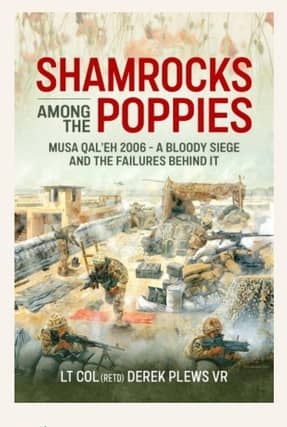

A new book by former Derry journalist and military historian, Derek Plews, tells the story of a bloody Afghan siege. Shamrocks Among the Poppies is a new account of the intense fighting that took place in the town of Musa Qal'eh, two decades ago, involving soldiers of the Royal Irish Regiment.
Now based in southern England, Plews (64) worked for the city's Sentinel newspaper in the late 1970s and early 1980s before switching to the public relations industry and taking up a series of positions in the UK Civil Service.
His latest book tells the story of the 37-day siege through the testimony of the soldiers who fought there. As well as bringing to life the reality of modern warfare in a dense, urban environment, it also lifts the lid on the flawed decision-making at the heart of government that resulted in the army being sent to Afghanistan while it was still heavily involved in Iraq.
And it spells out the dire consequences of those decisions in terms of the limited quantities of soldiers and equipment that could be deployed.
Plews was in Afghanistan in 2006, just as the events described in the book were beginning to unfold.
He explained: “An initial force of 3,500 – of whom only about 600 were fighting troops - was despatched to Helmand Province, tasked with providing a security bubble around the provincial capital, Lashkar Gah. The idea was to create a safe area within which the Afghan Government and the UK’s Department of International Development could begin to build modern institutions.
“But the Taliban had other ideas. Instead of challenging the rule of law in and around the capital, they chose to stretch the too-small British force by threatening to seize towns far to the north, including Sangin, Now Zad, Kajaki and Musa Qal’eh.”
At the latter, a small garrison – only 87 strong, including 67 Royal Irish Regiment soldiers, was ordered to hold the District Centre, come what may.
Well-armed, fanatical Taliban insurgents were determined to breach the walls, murder the garrisons and hoist the black flag of Taliban leader, Mullah Omar, signifying defeat for the Government of Afghanistan. This led to some of the most ferocious combat experienced by the British army since the Korean War (1950-52). There were many times when only the superior skills and drills of the Irish warriors, and the fast jet pilots who supported them, dropping bombs within yards of the compound walls, prevented the base from being over-run. By the time the siege was lifted, in a deal brokered by the local elders, three soldiers were dead and many others were wounded.
As the author pointed out: “Given the scale, ferocity and frequency of the Taliban attacks – up to 10 full-on assaults each day - it is a miracle the casualty count was not much higher.”
But not all wounds are physical. Many of those who fought at Musa Qal’eh have found themselves struggling with mental health issues attributed to their time in the compound.
“I had originally conceived the book in three parts. Part one would set out why the UK decided to re-invest in Afghanistan in 2006, while still under pressure in Iraq. The second part was to be an explanation of why we sent such a small force to take on such a potentially massive task. And the third section was the siege itself.
“In my mind, the book would end as the survivors clambered on board a Chinook helicopter, in a desert landing zone, for the short flight back to civilisation.
“But as I spoke to the veterans, it became very clear, very quickly, that the book couldn’t end there. For many of the soldiers, the combat had not stopped when they climbed into the back of that helicopter. They were still fighting…in their minds.
“So, the fourth part of the book exposes the scale of the psychological damage caused by exposure to high-intensity, life-or-death warfare over a prolonged period, and the lack of support that was available to service personnel struggling with their demons at that time.
“The government that had been so quick to send those soldiers into harm’s way was a lot slower to ensure they could get access to the vital, life-saving therapy that many of them needed. Some found the daily mental battles to be too difficult to overcome and we have seen a number of suicides and attempted suicides among the Musa Qal’eh cohort.
“The situation is getting better, but it is still far from perfect. There is still more to be done to ensure veterans can access the mental health care they need.”
Shamrocks Among the Poppies is published by Helion Books and is available at https://www.helion.co.uk/military-history-books/shamrocks-among-the-poppies-musa-qaleh-2006-a-bloody-siege-and-the-failures-behind-it.php