
Authorities and Government failing to protect people by reluctance to name and take on paramilitary groups
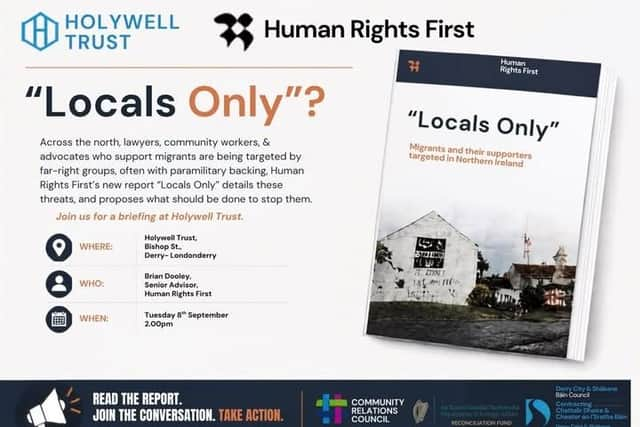
A new report examining the far-right targeting of lawyers, community workers and advocates supporting migrants in the North, often with paramilitary backing, is being launched in Derry.
Written by Brian Dooley and Suchita Uppal from Human Rights First, ‘Locals Only: Migrants and their supporters targeted in Northern Ireland’ is being launched in Holywell Trust, on Tuesday, September 8, 2026, at 2.00pm.
Human Rights First is a US-based international human rights organisation which defends individuals at risk, including refugees, asylum seekers, and persecuted human rights advocates. It focuses on refugee and immigrant rights, US democracy protection, and international human rights accountability.
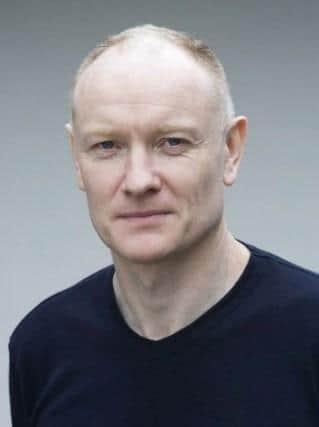
Speaking in advance of the launch, Mr Dooley highlighted the attacks on migrants which took place in pockets of the North this summer.

“Really when we talk about migrants, really we are talking about anybody of colour,” he said, “because the racists do not really differentiate if you are actually a migrant or not. To them, migrants equals Muslims, equals anybody who is not white.
“But, while the attention around those attacks comes and goes, sometimes there's a spike in the violence and a spike in the interest, it is a long running problem. It is not something that just goes away and comes back. It's always there,” he added.
“And there are people with power who ought to be addressing it, even in the ‘unfashionable’ times, even when it is not getting a lot of attention.
“What ought to be happening now is that police and the other authorities ought to be engaging with these groups, with these people, to find out how they can better protect them, because we can guarantee this is not the last time this sort of thing is going to happen.

“It will be back, and so now is a good time to start figuring out what to do next, how to prevent it, and how to protect people.
“Our focus at Human Rights First is always on activists, and we're pretty broad about how we define that, so in this sense it would be people who are helping migrants with services, whether that's legal advice or we have seen the targeting of landlords in the North of Ireland,” said Mr Dooley who warned the targeting of people who are seen to be on the side of migrants or helping them came in different forms.
Having recently returned from Poland where he was investigating the issue, Mr Dooley revealed the State there was “putting people on trial for helping migrants, accusing them of being people smugglers”.
“It is a bit different in Britain and a bit different in Northern Ireland again,” said Mr Dooley. “It is not really the State that is targeting, for example, lawyers for helping people but they are not doing enough to protect those people from far-right groups and of course in the case of the North of Ireland, paramilitary groups.
“So, we see the doxing. We see the threats. You see the doxing also of immigration lawyers, particularly in Britain, who help migrants,” he added.
“The North of Ireland is in a sense similar to but different from other places.
“The big difference, of course, is the paramilitary element and that is very sinister and very menacing. However, paramilitarism is not something that has just appeared in the last year or two.
“You would expect the authorities to have a better handle on how to deal with that, and I think they are failing on that for a variety of reasons.
“This issue of racism is really a perfect opportunity, in a sense, for some of the paramilitary groups to reassert control, to try to restore some of the ‘credibility’ which I think they had lost within their own communities, and all that really suggests this is going to be a long-term problem because there is a lot in it for paramilitaries to stoke this up, keep it going, because of the advantages it brings them,” said Mr Dooley.
Pointing to the examples in Europe and the US, Mr Dooley suggested some of the racist behaviour was “ideology driven” but some of it was “opportunistic”.
“I heard someone in Hungary say those sorts of people who were not really far right ideologues, just saw the opportunity, they were commercial fascists,” said Mr Dooley.
“So, I think for some of the paramilitary groups and some of the politicians too, it is just an issue that is there to exploit, which is just as dangerous as somebody who actually believes it,” he added.
“What I really want to talk about in Derry is to try and suggest ideas for what could happen to prevent or at least reduce further outbreaks of racist violence.
“I am conscious too that I don't want to come and tell people what they already know about what's happening.
“The onus cannot be on the migrants to protect themselves, or on the community, on the community groups. This is the responsibility of the authorities and of government to protect people, and they are failing on that, particularly in Northern Ireland, because of their reluctance to name and take on the paramilitary groups.
“You can see how susceptible some people are to this language of threats to our community, threats to our way of life, protecting our streets from outsiders.This is all horribly familiar. Again, I do not want to come and tell people in the North of Ireland about what they already know, but this is 1970s speak,” said Mr Dooley. “Paramilitaries see this as a way of controlling streets, deciding who gets to live in an area, who gets to open a business”.
Mr Dooley said he remained hopeful in spite of the challenges.
“There are more people with sense than without, but ultimately you should not need community groups and neighbours and other people who are sympathetic to be sorting this out.
“The authorities should not have allowed those threats and attacks to happen in the first place. Yeah. They ought to be providing the sort of protection people should be able to expect to take their kids to school, to go to work, to live their normal life.”