
Labour MP links concentration of university places in east to 31% productivity gap between Derry and Belfast
Mike Kane has linked the ongoing concentration of university places east of the Bann with a yawning productivity gap between Derry and Belfast that he has put at 31 per cent.
The Labour MP told the Northern Ireland Affairs Committee that third level provision has been ‘massively weighted’ towards Belfast with campuses in the city accounting for upwards of 80 per cent of the total number of graduates in the North.
"On skills, looking at our reports around those agglomeration issues, there seems to be a 31 per cent productivity gap between Belfast and Derry/Londonderry, yet Londonderry/Derry is served by both a train line and an airport.
"It seems to me that in NI you have to start from where you are at, and 82 per cent of graduates come out of Belfast. So if you want the agglomeration, in terms of industry, skills and infrastructure, the skills bit is massively weighted to one part of ‘the Province’, effectively,” said Mr. Kane during a briefing on economic growth.
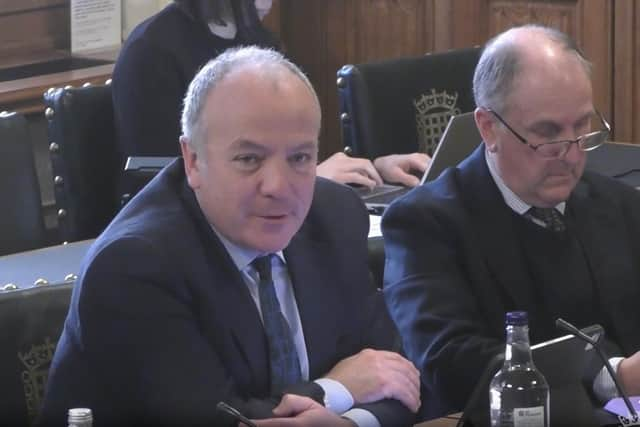

He said education was critical when it came to achieving sub-regional economic equality.
“There is also the issue of Derry being the only island on the island of Ireland without its own independent university. How can we begin to develop those skills? What can the UK Government do to help enable that?” he asked.
Alison McCullagh, Chief executive of Fermanagh and Omagh District Council, providing evidence to the committee, said she believed university provision was only one part of the solution and said that apprenticeships and industry training needed to be developed.
“I think there is a cultural issue continuing around university education as the only route available. We have seen, particularly in recent years, the value of industry-level apprenticeships, and industry themselves determining that another route is for school leavers—16 and 17-year-olds—to go straight into employment and to be trained on the job and progressed, typically through universities, but sometimes through FE colleges.
"That is something that we perhaps need to address more at second level in Northern Ireland, to show that there are other pathways available,” she stated.
The Council chief pointed out that Maximum Student Number (MaSN) cap restricting the total number of full-time undergraduate students from the island attending institutions in the North remains in place.
“The MASN cap is still in place. Our funding model is perhaps making things more challenging as well, in terms of additional places becoming available for students generally, but certainly for Northern Ireland students.
"We do have a brain drain. The work that we have done, not just within Fermanagh and Omagh but more widely across the border regions, tends to show that when students leave to go to university, it is very unusual for them to come home, and much more unusual if they go to university, or third-level education, in England, Scotland or Wales,” she said.
During the evidence session Ms. McCullagh pointed to the The Independent Review of Invest Northern Ireland (NI) in 2021.
“The Lyons [Gordon, former Economy Minister] review of Invest NI showed that the focus was Belfast first, and by some distance after Belfast it would have been Derry/Londonderry, and then everywhere else. That is the legacy that we are dealing with, and that is the reality of sub-regional economic imbalance in Northern Ireland,” she said.