
10% cap on HMOs needed to stop 'ghettoization' around Derry's university campus warn residents
Concerned Residents Around Magee (CRAM) representatives have said that a ten percent cap on Houses of Multiple Occupation (HMO) on streets near Magee University is needed to avoid “ghettoization”.
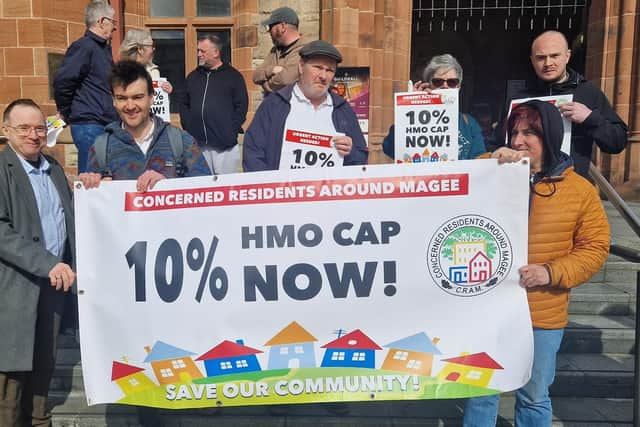
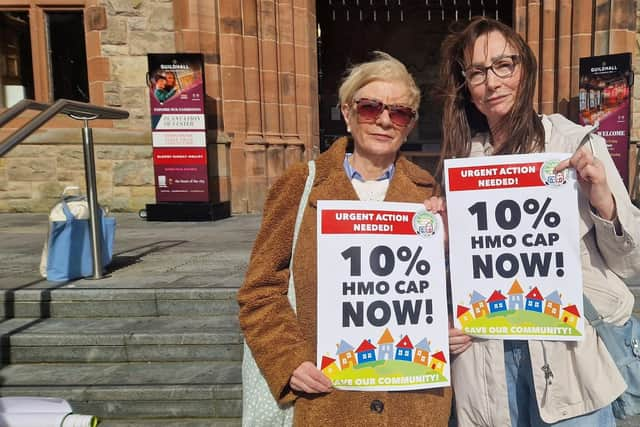
On Tuesday afternoon members of CRAM, an active community group comprising residents who live in the vicinity of HMO Management Areas around Magee campus, held a protest outside the Guildhall, calling for the introduction of a ten percent HMO cap in those areas instead of the current 30 percent cap.
At this month’s meeting of Derry City and Strabane District Council’s Governance and Strategic Planning Committee, which took place immediately after the protest, CRAM member, Kathleen Feeney, warned that some of the areas already had HMO levels exceeding 30 percent, and voiced fears of “further ghettoization of the streets and the creation of a Derry Holylands”.
Ms Feeney reiterated CRAM’s call for an immediate ten percent cap on streets around Magee, and claimed that the over-saturation of HMOs has led to increased crime and anti-social behaviour as well as “squalor” and “dereliction” due to the poor upkeep of accommodation.

“Probably the most serious of all [is] car parking,” she added. “The increase in HMOs is putting pressure on already-limited spaces.”
“This results in parking on footpaths and double yellow lines, and the obstruction of pavements compromises the safety of pedestrians including the disabled, the elderly, and children.”
Fellow CRAM representative, Stella O’Donnell, clarified that the group was in support of expansion at Magee.
However, she urged council to cap HMOs at ten percent and also apply “immediate, significant weight” to Local Policies Plan (LPP) Policy HOU 14, which makes up part of Council’s draft Local Development Plan (LDP) stipulates that council refuses any proposed HMO’s exceeding four bedrooms and/or 150 metres squared floor space.
“We have been told this policy could take years to fully adopt,” she added. “And [this] leaves us vulnerable to over-development of our Victorian terraced houses.”
Sinn Féin councillor Grace Uí Niallais noted that she put forward a successful motion earlier this year, meaning that any HMO applications which would increased the level above ten percent in a particular street would be brought to members of the Planning Committee for decision.
“This gives Committee members that chance to carefully consider any decisions based on residents’ concerns in the university area,” she said. “And decisions are made based on the detriment it would have on that area.”
“In terms of your request for the immediate ten percent implementation, the LDP process belongs to all the people of the council area.

“Everybody has the right to be part of that consultation period and to air their opinion, so for that reason it has to go through consultation.
“In the interim, be assured that we are listening to you, listening to communities, and supporting you in every HMO application.”
People Before Profit councillor Shaun Harkin said members should support the ten percent cap as a “starting point for people to feel they’re being heard” and a way to protect residential areas.
“Stella spoke about support for university expansion; we want expansion, but we also want residential areas respected, protected, and benefiting from development of the city,” he said.
“I think that can be done if we pay attention to what residents are demanding.”
Independent councillor Gary Donnelly said university expansion was needed but council “need to be respectful to the host community”, while SDLP councillor Rory Farrell asked officers how long it would take to implement the ten percent cap.
City solicitor Philip Kingston clarified that the proposed change would require a Committee paper to update members.
Director of Environment and Regeneration, Karen Phillips, said a paper could be returned to May’s Planning Committee, but she anticipated that it would be up to two years before the LPP was in place.
She added: “In the meanwhile, officers and members can give due regard to the draft plan strategy, and in January members agreed that applications that may reach ten percent on any street would come to Committee.”
Ms O’Donnell argued that any HMO applications the Planning Committee rejects have been overturned by the Planning Appeals Commission (PAC), as council “doesn’t have any legal documents to say [applicants] can’t have approval”.
“To date every application that has gone to PAC has been overturned,” she said. “So a ten percent discussion doesn’t mean anything.
“So this needs to move quickly.”
Sinn Féin councillor Christopher Jackson, who chaired Tuesday’s meeting, said the draft LDP strategy could offer council a “defensible position that could maybe stand up to appeal”.
“That hasn’t been tested,” he conceded. “And I’m hopeful that any applications that exceed the ten percent will be upheld at PAC.”
In a letter submitted previously, one resident Dave Duggan said: “Councillors can set an immediate 10% cap on HMOs in UU Magee’s neighbourhood. Otherwise the deluge of HMOs in these streets will continue to flood, with all the attendant problems of another Holyland. The city needs a complete cessation of granting HMO permissions in the UU Magee neighbourhood streets already at 10%, secured in such a way that cannot be overturned retrospectively or by Belfast-based Planning Appeals. This requires diligent monitoring.”
Another resident, Mary Gallagher, recently said: "We want to stop the over saturation of our communities with HMOs.
"We want to show the council the impact that the huge rise in the number of HMOs is having on our streets and communities. We are asking the councillors to vote for a cap of 10 per cent to prevent our neighbourhoods being further saturated."