
Strabane teenager Jamie donates stem cells to stranger - and sets a lifesaving milestone
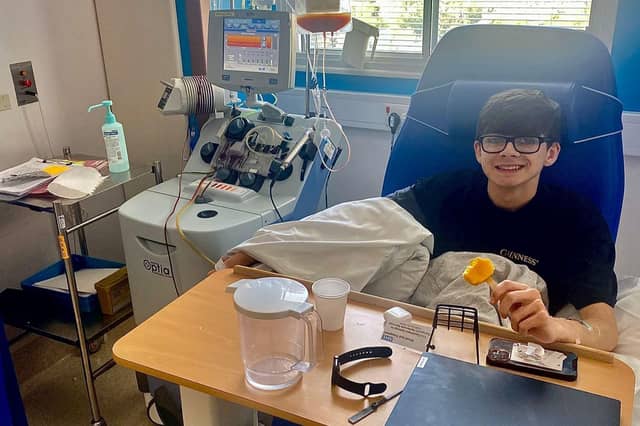

An 18-year-old Strabane teenager, who signed up as a stem cell donor just a few months ago at a donor registration event at his school, has flown to London to donate to a stranger.
Jamie McGuigan is a Year 14 student at Strabane Academy.
He has just turned 18, and is preparing for his A-Level exams, hoping to study Marine Biology at university.
In many ways he is a completely normal teenager, however, recently he did something truly amazing.
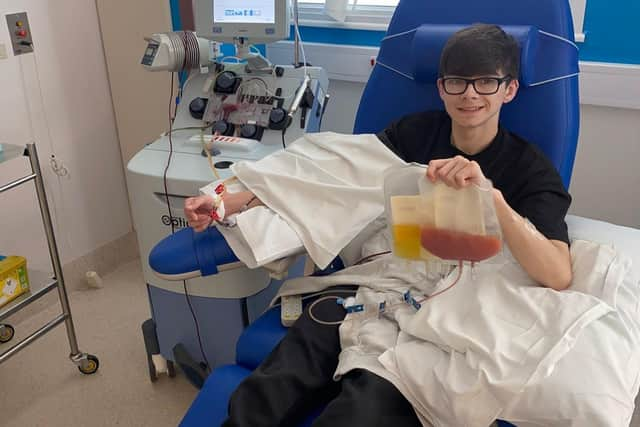
He offered a total stranger a second chance at life – selflessly donating stem cells after signing up to the donor register with blood cancer charity DKMS UK, after being matched as a compatible donor for a patient needing a transplant. He has also become the 3,000th person to donate stem cells through DKMS UK, and the first from their new schools programme.
For many patients with blood cancer or blood disorders, a stem cell transplant represents their only opportunity for a second chance at life, but most have no matching donor in their family, and only 7% of the UK eligible population are signed up to the donor register.
Anyone in general good health, aged 16-55 can register with DKMS UK, but young people under 25 make the best stem cell donors. Studies show that transplants from younger donor result in better outcomes for patients, but young people are also underrepresented on the donor register, so in 2025 DKMS UK launched a new schools programme, Generation Lifesaver. The charity runs sessions in schools and colleges, informing students about blood cancer, and encouraging them to register as potential donors.
One of the first schools to participate was Strabane Academy. They held a donor registration event in December, where 47 people signed up as potential lifesavers by completing some painless mouth swabs and answering a few health questions.
“I first heard about becoming a stem cell donor when DKMS came into school,” says Jamie.
“I supplied the cheek swabs that same day, and I found out some teachers had already been on the register for years. I didn’t really think too much about it and definitely didn’t think I’d ever be contacted.”
Most people who join the stem cell register will never be matched to a patient – the odds are around 1 in 800 – but if you are found to be a match, you could potentially save a life. Unusually, DKMS UK got in touch with Jamie just a few weeks after he signed up. There was a patient in hospital undergoing treatment, and Jamie was the person who could give them a second chance.
“It was just after my 18th birthday,” he says.
“Having been on the register for such a short time I think everyone was surprised to find out I had been identified as a match – I was very surprised myself. I was nervous at first, but the opportunity to help someone else outweighed the nerves.”
Jamie agreed to help, and he underwent some more medical checks to confirm he was fit to donate. He was sent home with some self-injections to encourage stem cell growth in the days leading up to the donation.
“DKMS UK kept in touch through the whole process. You could hear in every phone call how excited they were about finding me, which definitely gave me a boost of encouragement.”
Then recently Jamie flew to Sheffield with his mum to complete the donation. This was a major milestone, Jamie was not only the first donor from the schools programme anywhere in the UK – he was also the 3,000th person in the UK to donate stem cells through DKMS.
In England, Jamie donated his stem cells through his blood, in a simple, non-surgical procedure which is similar to donating blood platelets.
“It was amazing to see the machine working,” says Jamie. “It was a five hour process so I got out my laptop, put on Netflix, sat back and relaxed. The staff at the hospital were lovely, making sure I was comfortable and well fed the entire time.”
There are strict regulations protecting the anonymity of donors and recipients immediately following a donation, but Jamie should soon be able to find out some initial information, like the patient’s location and gender. If they both agree, they can be put in contact anonymously at first, and in two years’ time, they may even be able to meet.
“I was in hospital donating when I found out I was the first person in the DKMS UK schools programme to donate. I was really excited to tell my teacher, Mrs Sayers who had organised for DKMS to come into the school. I knew she would have be delighted, she has been a big support, especially as the donation was happening during my A-Level exams. It’s been a nice way for me to end my school journey.”
DKMS UK spokesperson Bronagh Hughes says, “Jamie has done something truly incredible at such a young age, and has given a total stranger a second chance. Young people are desperately needed on the stem cell donor register, so we are so grateful to the staff and students of Strabane Academy for doing their bit to improve the odds for blood cancer patients around the world. If you want to sign up as a potential donor you can find out more, and order a free swab kit from the DKMS website.”
Now, in recognition of this major milestone, Jamie has joined forces with DKMS to encourage other people to join the stem cell donor register too.
“I feel very grateful to be able to give someone another chance at life and I would definitely do it again,” he says. “I would strongly advise anyone to do it, at least get on the register. At 18 years old I didn’t realise that I could have such an impact on someone’s life and it all started with simply saying yes.”
To find out more, and order your swab kit, visit: dkms.org.uk