
July 1996: When tensions spilled over and tragedy struck during Derry’s summer of discontent
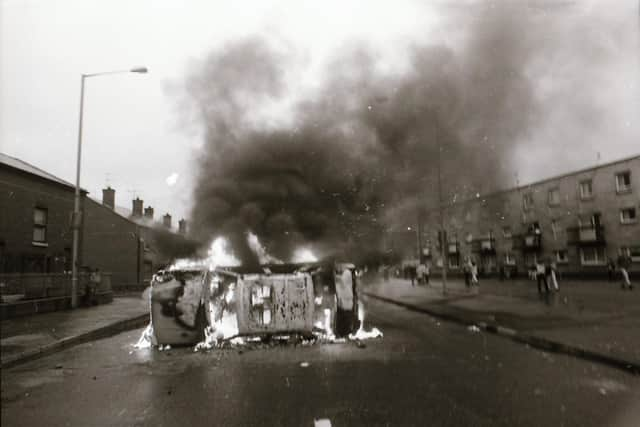
It was 30 years ago but for those who lived through it, few in Derry will ever forget the summer of 1996 when tensions over marching reached boiling point and then spilled over into riots on the streets. Over the course of that Twelfth weekend, one man tragically lost his life and hundreds more were injured.
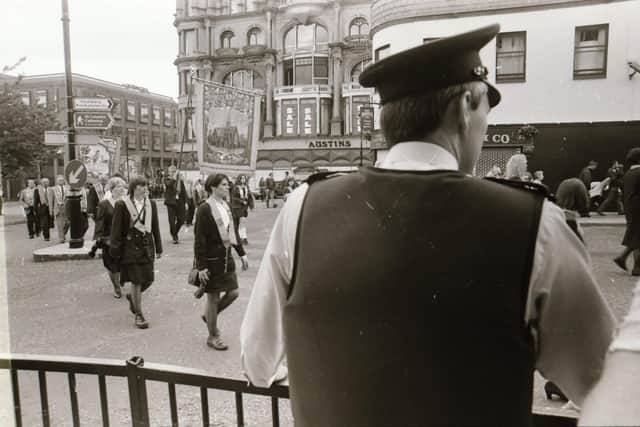
On Tuesday, July 9 that year the Derry Journal reported on its front page that Orangemen in Derry had refused to reveal details of a ‘controversial march plan’ lodged with the RUC the previous night. The plan was submitted amid speculation the Orange Order planned to march through Derry city centre rather than Coleraine on July 12, while numerous other Twelfth marches had also been hastily arranged across various areas of the Waterside. The paper reported that ‘Bogsiders’ had vowed to oppose any march through nationalist areas.
A deputation from the City of Londonderry Grand Lodge- including the then Mayor Richard Dallas - had handed over a letter to police expressing their ‘disgust’ at the re-routing of the Orange Order march in Portadown.
In their letter to the RUC the Orange Order accused the force of ‘bowing to Republican/ hostile foreign pressure’.

They said: "Law abiding citizens can only take so much. Appeasement of Republican demands leads not to peace but to further demands and ultimately to the denial of civil and religious liberties that are so precious to us all.”
Donnacha Mac Naillais of the Bogside Residents Group said at the time that like the Garvaghy Road residents, the people of Derry would not ‘bow to the intimidation of sectarian parades’.
Three days later on Friday, July 12 the Journal reported how the SDLP were planning to put forward a motion of no confidence in the Mayor and vowed to strip him of all his powers for his participation in a protest at an illegal road blockade.
At the time there had been reports of loyalist blockades and intimidation in various parts of the city.
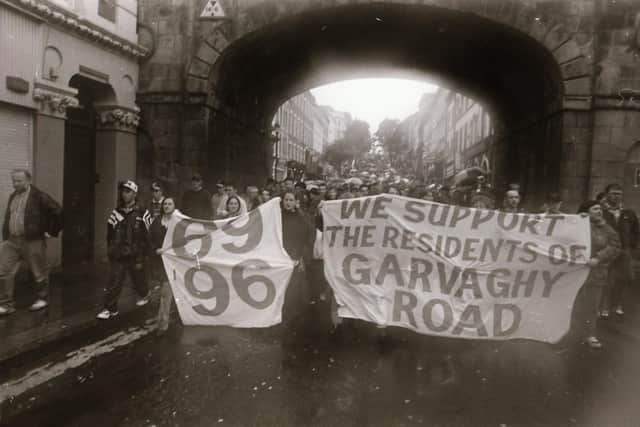
At the same meeting Councillors from the SDLP expressed their solidarity with the beleaguered residents of Garvaghy Road.
When the vote passed later in the month, Ulster Unionist Party Mayor Dallas refused to step down and defended his actions, stating that he had made no secret of his support Orange Order at Drumcree and claiming the effort to unseat him was ‘all because I took up my right as an individual to protest against unjustifiable restrictions on civil rights for any section of this community’. He was stripped of most of his powers.
Meanwhile there had been a massive response among the nationalist community to an impromptu call for a march on July 11 with thousands walking from Free Derry Corner through the city towards Strand Road RUC station to protest the decision to force the parade in Portadown through Garvaghy Road, and in solidarity with residents there and in Lower Ormeau.
The same edition of this paper reported how Loyalist protesters ‘went on the rampage’ in various parts of Derry in response to the Drumcree stand off, with roads blocked, businesses attacked and some families forced to flee their homes.
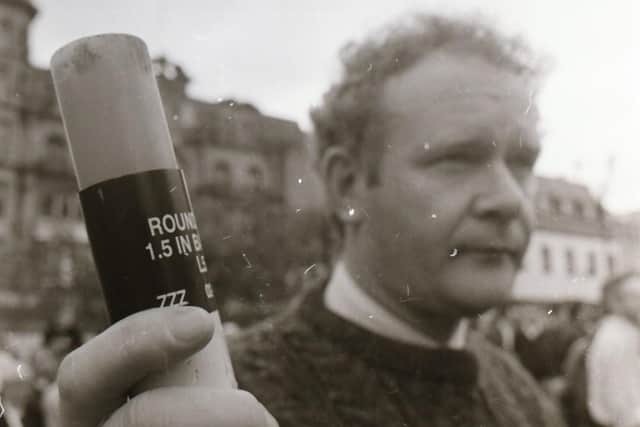
That same weekend rioting had erupted in Derry’s city centre and would not abate for several days. The next edition of the paper reported that it had raged for three nights with reports that thousands of petrol bombs and rubber bullets had been exchanged by nationalist youths and the RUC and army. The RUC commander at the time said that in 30 years the confrontation was the most ferocious he had ever seen.
More large scale protests were also held locally, with thousands taking part in peaceful rallies after the RUC u-turn at Drumcree, with nationalist unity being remarked upon as the SDLP’s Mark Durkan and Sinn Féin’s Martin McGuinness shared a stage.
Addressing the crowds, Mr Durkan said the last thing those gathered wanted was to be marching on July 12. But, he said, the ‘anger, hurt, betrayal’ at the ‘Drumcree climb down’ had to be clearly shown.
Mr McGuinness meanwhile told those gathered: “We are off our knees and we are going to stay off our knees. But let me tell the British government something now. If you hit one nationalist, be it in Garvaghy, Bellaghy, Lower Ormeau or wherever, you hit us all.”
Under the all capitalised front page headline ‘CITY STUNNED BY VIOLENCE’ the Journal of Tuesday July 16 stated: “Tensions remained high last night in the wake of the weekend’s unprecedented events as relations between the nationalist community and the RUC reached an all time low.”
Tragically one local man, Dermot McShane, was killed that weekend when he was struck by a British army vehicle. Over 10,000 people attended a black flag march a day later on Saturday.
"The mood of the march was sombre and many carried black flags as a mark of respect for Mr McShane," the Journal reported. “Local pubs and clubs had closed at 6pm and the town centre was empty but for marchers.
“Many observers complained of a provocative display by the British army who continually revved their engines as the march passed.”
Flowers and the flags were laid at the spot where he was fatally wounded on Little James Street, before a minute’s silence was held in Waterloo Place. Thousands later attended Requiem Mass for Mr McShane.
Over 200 more people were reported to have sustained injuries over the course of that weekend.
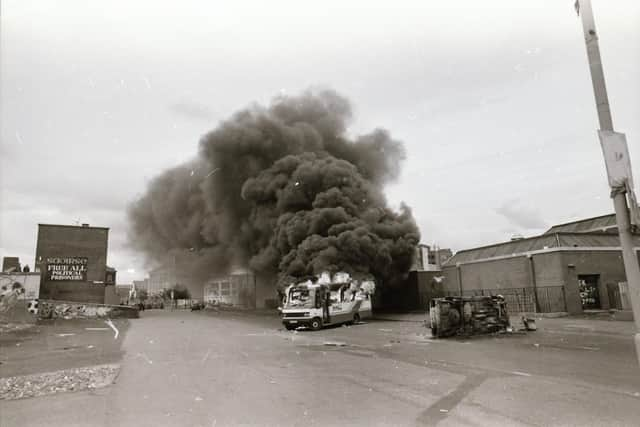
The paper reported how plastic bullets had ‘rained down like confetti’ as RUC riot police ‘felled innocent revellers trying to flee the violence’, as eyewitnesses claimed there was little to no effort to distinguish between rioters and others who were caught up in the violence.
During one of the nights, the Strand Bar had to lock people in for their own safety and British troops were dispatched to Derry for the first time in 20 months.
Martin McGuinness said he was convinced some RUC officers had tried to kill local people during the rioting, a claim dismissed by an RUC commander.
Businesses across the city were also counting the cost, with Jackie Mullan’s pub and the Post Office among those worst affected alongside others in the vicinity of Little James Street, Strand Road, Sackville Street and William Street.
Further peaceful marches filtered in from all over the city to Guildhall Square on the Sunday with a massive crowd of up to 20,000 people coming together to hear from local political representatives and representatives from Lower Ormeau Road and Garvaghy Road.
It would take time and a Herculean effort but many of the same prominent people named and quoted in the pages of the Journal that weekend 30 years ago in what became known as the summer of discontent were the same people who would enter talks and reach agreements in a pioneering and groundbreaking move which many considered impossible and which has helped change and shape the course of Irish history.