
When Buncrana’s John Doherty clashed with ‘The Great Liberator’ Daniel O’Connell over factory working hours
Today marks the 250th anniversary of the birth of ‘The Great Liberator’ Daniel O’Connell.
The Kerry-born lawyer is best remembered for delivering Catholic Emancipation in 1829.
His foundation in 1832 of the Catholic Association followed by a campaign of monster rallies ultimately led to the Catholic Relief Act of 1829 which gave rich Catholics the right to vote and sit in Westminster.
A lesser known episode in the great patriot’s career was his conflict with Buncrana’s John Doherty.


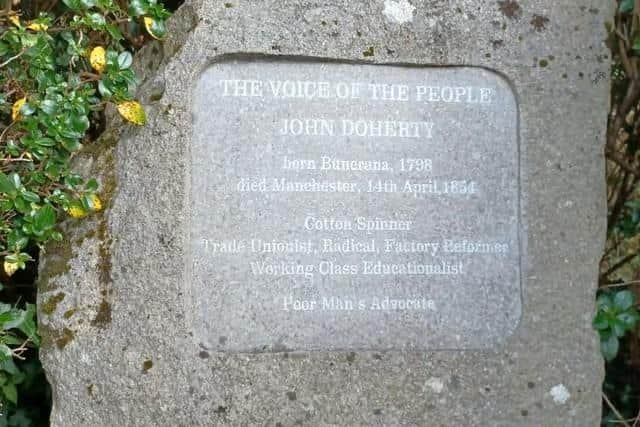
Frequenters of Cahir O’Doherty Avenue will be familiar with the stone recognising the native-born cotton spinner just beyond the memorials to Wolfe Tone and Eddie Fullerton.
Born in Buncrana in 1798 Doherty worked as a child labourer in the cotton trade in the town before emigrating to Manchester where he became a leading trade unionist and publisher of the radical newspaper ‘The Voice of the People.’
Today he is considered one of the founding members of the labour movement in England. The late British historian and socialist, E.P. Thompson, considered him one of labour’s three outstanding leaders of the early 1800s.
While Doherty was a steadfast supporter of O’Connell’s Catholic Emancipation, which incidentally provoked the great Derry newspaper schism of 1829 and led to the establishment of the anti-relief ‘Londonderry Sentinel’, the pair knocked heads over a campaign to limit the working hours of women and children to 10 hours a day.
In 1838 Doherty supported a bill by Anthony Ashley Cooper (Lord Ashley) that sought to enforce the Ten Hours Act 1833 and ensure no person under the age of 18 was working more than ten hours a day.
According to ‘The Voice of the People: John Doherty, 1798-1854: Trade Unionist, Radical and Factory Reformer’, Raymond George Kirby, Rosina Greene Kirby and Albert Edward Musson’s definitive biography, O’Connell took a contrary view.
"On June 22, Ashley himself moved the second reading of the bill, intending to move a ten-hours amendment in the committee stage, but he was opposed by Russell [John], Thomson [Charles Poulett], Peel [Robert] and O’Connell and eventually defeated by eight votes.
"Doherty printed a pamphlet in Manchester giving a report of this debate, in which Ashley eloquently exposed the repeated delays of the government despite Russell’s promises to promote the bill," they write.
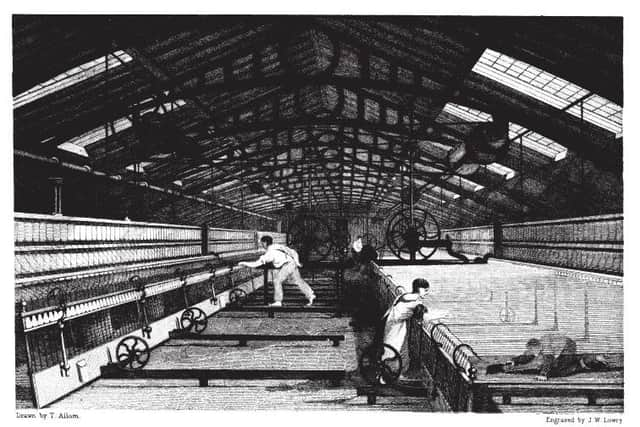
Ashley wanted to ensure factory owners in breach of the 1833 Act were punished.
"On July 20 Ashley again raised the question, denouncing the lenient penalties imposed by Lancashire magistrates and being supported by Brotherton [Joseph] and Fielden [John].
"O’Connell also denounced the impracticality of the relay system [different hours for children, young persons and adults], quoting Doherty’s recent evidence to the Select Committee on Combinations [of Workmen, 1837-38] as proof of the connivance of surgeons, parents and employers to evade the eight hours’ limitation.
"But O’Connell and Hume [Joseph] both opposed any interference with adult hours, which such a bill would entail, and maintained that the high price of food because of the corn laws was the real cause of overworking children and Ashley was again defeated in the resulting division by fifteen votes."

Kirby et al write that Doherty gave a detailed explanation of why the ten-hours bill was needed in his evidence to the Combinations Committee in June 1838,
"Factory reform, he emphasised, had been pursued consistently by the Manchester spinners’ union for the previous twenty years.
"He lamented that the proportion of females and young persons in factories was increasing, while the number of adult male spinners fell, and denied that the Manchester spinners supported the ten-hours bill because they thought their wages would be unaffected, although production and hence earnings on piece-rates certainly would not be reduced in proportion to the decline in hours."
O’Connell’s opposition to these reforms left an unsavoury legacy.
James Connolly in his ‘Labour in Irish History’ treatise of 1914, was scathing.
"O’Connell opposed the motion, and attempted to justify the infringement of the law by the employers by stating that they (Parliament) had legislated against the nature of things, and against the right of industry.’
"‘Let them not’, he said, be guilty of the childish folly of regulating the labour of adults, and go about parading before the world their ridiculous humanity, which would end by converting their manufacturers into beggars.’
"The phrase about regulating the labour of adults was borrowed from the defence set up by the capitalists that preventing the employment of children also interfered with the labour of adults - freeborn Englishmen!
"O’Connell was not above using this clap-trap, as he on a previous occasion had not been above making the lying pretence that the enforcement of a minimum wage prevented the payment of high wages to any specially skilled artisan," he blasts.
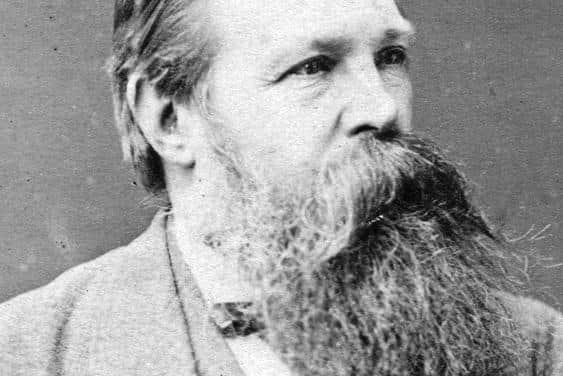
A contemporary of Doherty in the Manchester of the 1840s was Friedrich Engels whose partner Mary Burns/Byrne emigrated to the textiles capital from either Armagh or Tipperary.
Her experience of the Manchester slums informed Engels’ ‘The Condition of the Working Class in England’ in 1845, written three years before he co-authored ‘The Communist Manifesto’, and long before ‘Das Kapital: A Critique of Political Economy.’
It is inconceivable Engels would not have known Doherty and while he dismissed Ashley’s ten-hours campaign as an attempt by ‘reactionaries’ to co-opt the working-class he nonetheless acknowledged at the time ‘the Ten Hours’ Bill is indispensable for the workers. It is a physical necessity for them. Without the Ten Hours’ Bill this whole generation of English workers will be physically ruined’.
‘The Great Liberator’ though he took a different stance to Doherty on the question, speaking in the British House of Commons in 1838 could say of the Buncrana man that he was ‘as intelligent and as highly educated as any many could be expected to be, and a great agitator too, for a Ten Hours Bill’.
"He was one of the leading men for many years amongst those who agitated on the subject. He was also secretary to his union,” he stated.