
75 years of the VW Transporter : Derry Motoring with Jim Mc Cauley
Volkswagen Commercial Vehicles is celebrating 75 years of the VW Bus, the commercial vehicle with the longest production run in Europe. The first T1 Transporter rolled off the production line on 8th March 1950. Since then, more than 12.5 million VW Buses have followed – produced in Hanover from 1956.
The T1 was the second Volkswagen model when it followed the Beetle in 1950. With production up and running at the end of World War II, the Beetle was already in its fifth year of production. The company identified the need for a large van as Europe was rebuilding, and christened it the ‘Transporter’ or T1.
The first version of the 4.10-metre-long vehicle was a panel van without windows in the load compartment. Its load compartment had a considerable capacity of 4.5 cubic metres. It was powered initially by the Beetle’s 25PS flat four engine which took it to a top speed of 50mph. The engine was later upgraded to 44PS and an improved maximum speed of 65mph.
Further body variants followed, quickly led by a Kombi version (with windows at the rear), then by a minibus and a dropside. The special model that is today considered the most legendary of all classic VW Bus vehicles made its debut in June 1951 - the ‘Small Bus Special Version’ – christened ‘Samba bus’ by fans. It had room for nine people and came with up to 23 windows, two-tone paintwork and a luxurious specification including a panoramic folding roof. In 1956, Volkswagen relocated production to the new Hanover plant.


The second generation T2 appeared in 1967 leaving the T1 to maintain its historic origins with current day collectors. As a camper van it became the vehicle of choice for globetrotters. The new front end was the most distinctive feature of the slightly larger T2. Instead of the V-shaped vertical modulation between the round headlights, a design with horizontal lines now emphasised the width of the bus. But it was not just these details that made the T2 look more modern: visibly larger side windows and the one piece, strongly curved windscreen stood out the most. In addition, the T2 now had a sliding door as standard.
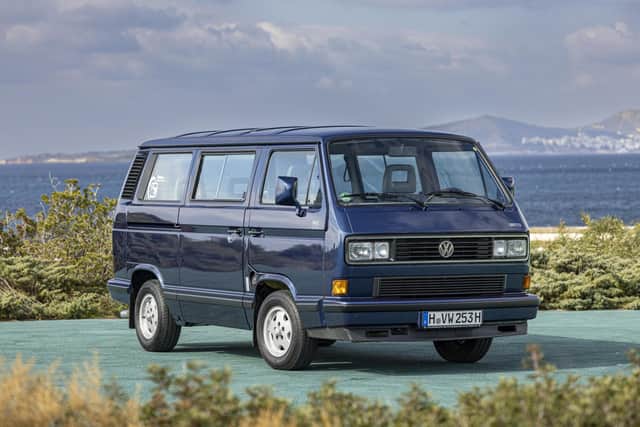
The T3, launched in 1979 was the most angular version ever, but significantly improved in performance. Engine options were increased with a choice of air cooled, water cooled and diesel engines, ranging in output from a modest 50PS to 112PS. The range was also extended with the availability of a ‘syncro’ all-wheel drive model.
The arrival of the T4 marked a turnaround in engine and drive positions with the models now front engined and front wheel drive. Power options ranged from 61PS to 204PS with all-wheel drive availability retained.
The T5 arrived in 2003, staying in production until 2015. The ‘syncro’ badge of the all-wheel drive models was now replaced by ‘4MOTION’. Engine improvements increased refinement with outputs ranging from 86PS to 235PS.
The T6 replaced this, recognised by its redesigned front section. It introduced hybrid drive along with a new California camper. Committing to electric-only power saw the ID.Buzz introduced in 2022. This modern version returns drive to the rear wheels. The latest Buzz GTX with 340PS output is the most powerful VW Bus ever built.