
Pothole Struggle - Derry Motoring with Jim Mc Cauley
The motorist is a godsend for the UK exchequer, continuously funding the government’s purse. The prize of the motor vehicle became apparent post First World War when the annual Road Fund tax was introduced to contribute to the building and upkeep of the roads. Initially managed by the Minister for Transport, this specific fund was abolished in 1937 when the Finance Act transferred the motoring road tax payments to general taxation. Every year since that, only a small proportion of what we pay in road tax (Vehicle Excise Duty or VED) is spent on the roads network.
We see the lack of investment locally with potholes becoming the most complained about motoring topic, coming in ahead of the other most complained about issue – projector headlights.
With claims frequently made for tyre, rim and suspension damage, the insurance comparison site, ‘CompareNI.com’ commissioned a survey to examine the extent of the problem on Northern Ireland’s roads. It found that 91% of drivers here have issues with potholes in their local area, with 96% of respondents saying they weren’t being fixed quickly enough.
Potholes are a persistent source of frustration for drivers, leading to costly repair bills for thousands of us every year. They are also a major safety concern, increasing the risk of serious accidents and injuries.
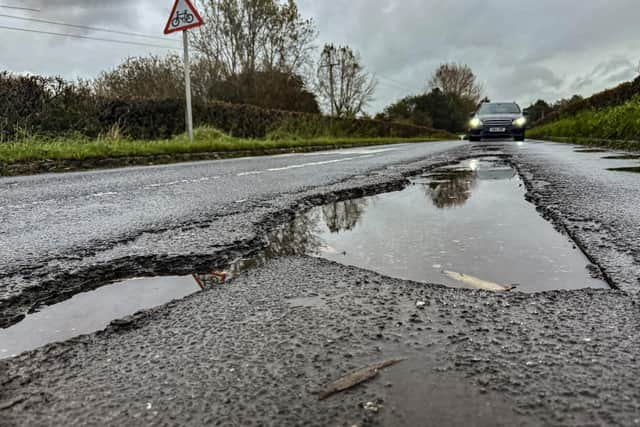

Under-investment in road maintenance has led to a surge in potholes over recent years and created a massive repair backlog, particularly on rural roads. Due to the budgetary shortfall, the Department for Infrastructure typically only fixes the highest priority road defects, with potholes generally needing to be at least 50mm deep before they qualify for a repair.
These repairs are often quick fixes that may only last a matter of months, an issue which is exacerbated by increasingly severe weather, with autumn 2025 being the third wettest here since records began. The Department has spent some £383m over the last three years trying to fix Northern Ireland’s roads, but it is estimated it would take £1.2bn to bring the region’s road network up to standard.
The car insurance experts at ‘CompareNI.com’ have sifted through the latest government data to identify the worst-hit areas in 2025 and find out which local councils made the most progress in carrying out repairs.
While there was a slight drop in the number of potholes reported over the last 12 months, they continue to present a significant challenge accounting for 80% of all road claims received by Stormont last year.
The statistics show that of the 127,109 surface defects recorded on Northern Ireland roads in 2025, a staggering 77% (97,897) were related to potholes.
Although around two thirds (67%) of all reported potholes were fixed last year, the repair rate varied wildly between council areas – with Fermanagh and Omagh tackling 87% of defects compared to 44% in Belfast. Derry and Strabane was one of only four council areas which showed an increase.
Within the eleven local council areas, Derry and Strabane finished 9th in the survey with only 54% of potholes repaired in 2025. Relevant figures sourced for the survey show that the 8,787 potholes reported in 2024 had risen to 9,008 in 2025. Of these, 4,903 were repaired where the average success across all council areas was 67%.