
Eastwood urges Benn to drop plan to give himself power to appoint judges to legacy inquisitorial mechanism
Colum Eastwood has urged Hilary Benn to drop proposals to give himself the power to appoint judges to an Inquisitorial Mechanism in a mooted new Legacy Commission.
The Foyle MLA was speaking as the Secretary of State introduced a new Troubles bill at Westminster to give effect to the Joint Framework on the past announced last month.
Under the proposals the Independent Commission for Reconciliation and Information Recovery (ICRIR) will become the Legacy Commission.
A judge-led Inquisitorial Mechanism will be established within the Commission with the Secretary of State having the power to appoint members of the judiciary.
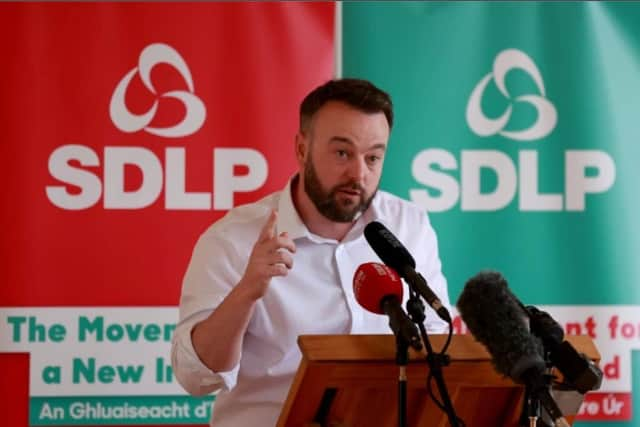

Speaking at Westminster Mr. Eastwood asked: “Will he drop his proposal to give himself the power to appoint judges in that inquisitorial mechanism because the very important principle of the independence of the judiciary needs to be held up?”
Mr. Benn replied: "No doubt my honourable friend will make the point about appointment processes when we come to discuss the bill.”
In introducing the new legislation, Mr. Benn told MPs the small number of Troubles inquests stopped by the Legacy Act will be restored.
Inquests that had not yet commenced will be referred to the Solicitor General who will independently consider whether they should be dealt with by the Commission or the coroners’ courts.
Mr. Eastwood said: “The Secretary of State will forgive some of us for being cautious before we are ready to believe that the Government will, and the State, and any paramilitary organisation will, give over the information that is required.”
He continued: “When it comes to inquests will he look again at the sifting process and will he put family views, and will he give family views primacy, when it comes to deciding which cases will have an inquest?”
The Secretary of State replied: “On the subject of inquests there will be three statutory tests that the Solicitor General will have to apply...family views will be one of the considerations but if inquests cannot proceed because of sensitive information, well, wouldn't it be more sensible to put it into the commission which can deal with sensitive information because it has provision for closed hearings?”
Mr. Benn suggested protected disclosures to a proposed new cross-border Independent Commission on Information Recovery (ICIR) – originally proposed under the 2014 Stormont House Agreement – could be another avenue to provide answers to families.
The ICIR was aimed at building on the work of the Independent Commission for the Location of Victims’ Remains (ICLVR), established in 1999 to secure the recovery of the remains of ‘The Disappeared’.
“This was something that the previous Conservative government negotiated with the Irish Government and formed part of the Stormont House Agreement.
"What is the purpose of it? The purpose of it is to enable those who have information to pass it to the body which can then pass it to the families and the information will be a protected disclosure which is not the same as immunity,” said Mr. Benn.
He said this model had worked well in ‘recovering quite a number of the remains of those who were abducted, tortured, murdered and buried by the IRA through the ICLVR’.