
William McGreanery and Annette McGavigan remembered as families’ half century fight for justice continues
Billy McGreanery will never forget his uncle William, a second father, who used to treat him with Toblerone and packets of Rolo.
More than half a century has passed and the bond hasn’t lessened.
“My memories of my uncle will never die,” pledges Billy, who today is remembering his namesake on his anniversary. “I get emotional talking about this still. It's 55 years ago but it's still very fresh in my mind.”
William, a 41-year-old shop assistant who lived in Francis Street, used to chat with neighbours at the corner of Laburnum Terrace and Westland Street in the evenings.
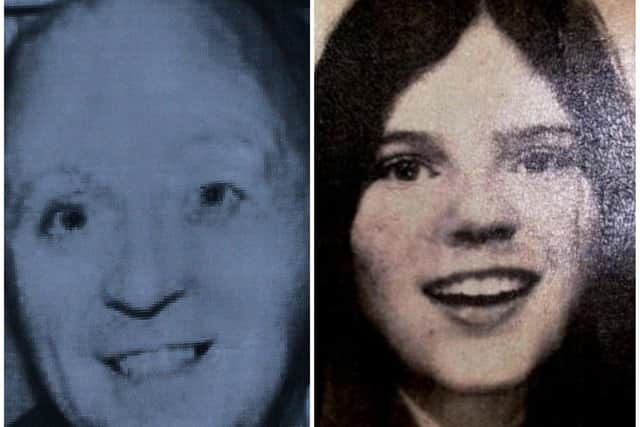

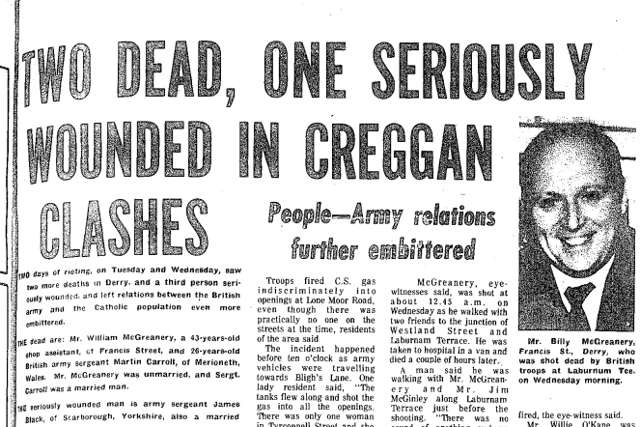
On September 15, 1971, he was walking with friends close to the top of Westland Street when a Grenadier Guard shot him dead from a sanger overlooking the junction of Eastway and the Lone Moor Road.
He was an unarmed and innocent man despite lies peddled by the British Army that he was carrying a rifle.
"The ripple effect that went through our family because of the death was enormous. It is still there today. I know some people will say it's a long time ago, let it go, but I can't let it go. It is easy for somebody who hasn't experienced it first hand to say,” says Billy.
Nine days earlier Martin McGavigan’s 14-year-old sister Annette was among a group of school children caught up in a riot that broke after a court hearing involving local MPs John Hume and Ivan Cooper over a sit down protest in the Bogside.
“Annette was a loving girl. She cared about everybody. She had no enemies and she was like a second mother to us. She was a remarkable girl. Her ambition was to study and to become a nurse or a teacher. Kind-hearted. For that to be taken away….” Martin pauses.
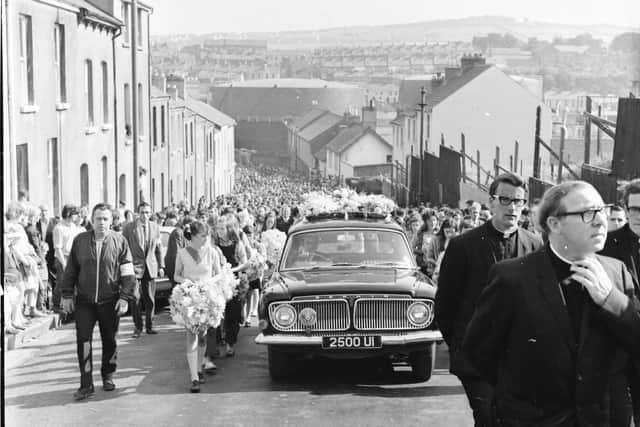
Annette was still wearing her St. Cecilia’s uniform when she was shot in the head by a Royal Green Jacket. She died instantly on September 6, 1971.
Martin remembers his big sister being carried into a house in Blucher Street.
"I was just down the street when it happened. I saw her getting carried into Meenan's house, her long hair. I was 11 years of age. I'm 66 now. It is still as fresh in my mind now,” he attests.
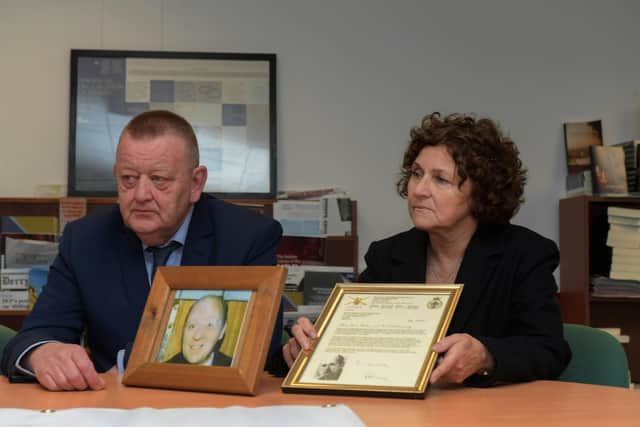
From a distance of 55 years Martin fondly recalls Annette as a ‘remarkable wee girl’ and how her death devastated the McGavigan family.
In the aftermath of the killing he would return to their home in Drumcliffe Avenue and find his mother Annie inconsolable with grief.
“People don't realise the after effects. When I used to come home from school my mother was up the stairs hugging Annette's clothes, the clothes she was murdered in in the hot press, her wee skirt and her plimsolls.
"Instead of coming home for your dinner you are coming home to find your mother up the stairs crying. There was no such thing as counselling. You had to deal with it,” he explains.
For Billy too, the impact of his uncle William’s death was long and far reaching.
"It is trauma. You can't let this stuff go. It's always in your mind. It is not too far under the surface. For you to try to recall facts, you have to put yourself back to the time it happened and doing that, you retraumatise yourself.
"It is verging on cruel what the British Government has put the families through. They put the families over the coals and made nothing easy for anyone.”
Two years ago the McGreanery and McGavigan families were informed by the Public Prosecution Service (PPS) that the soldiers accused of killing their loved ones were not to be prosecuted.
In the case of Annette McGavigan this referred to a Royal Green Jacket with the cipher Soldier B and for William McGreanery, a Grenadier Guard known as Soldier A.
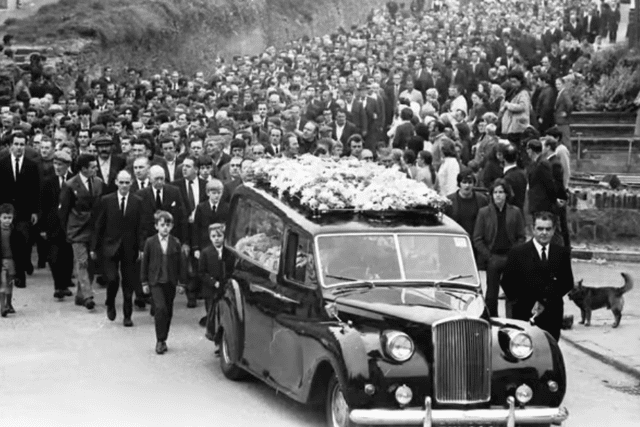
The information was relayed just before the cut-off date for investigations relating to the conflict of May 1, that was imposed through the Legacy Act.
“It was the worst day of my life. I've been fighting and fighting for justice and I thought that before the deadline they might have allowed our cases to go through in a goodwill gesture.
"If this had happened anywhere else in the world… it is because we are Irish. If it happened in America there would be uproar. I don't believe there is enough being done by the politicians and the church. It is left to the families,” Martin tells us.
Billy and the McGreanerys requested an internal review of the PPS decision but this was upheld last December.
Both families are now pressing for fresh inquests after the British Labour Government moved to replace and repeal the controversial Legacy Act that had banned them.
“The only way now we can get him into court to give evidence is through a new inquest. That now is being dragged out. Originally the timescale was for that to be introduced at the start of the year.
"It was pushed back until March or April and now it is October. Then you are put on a waiting list which could be another two years before it is heard or anything else,” says Billy.
After more than half a century Martin is sceptical about the prospects of securing meaningful justice for his big sister but is determined to continue the campaign.
"They are just waiting for us to die and the soldier to die and that's the sad thing about it,” Martin suggests. “That's the reality but my son and my daughter will fight and my grandchildren will fight, because all we want is justice.”
Billy too has little faith in the British justice system.
“I've come to the conclusion, as any sane person would, that we are never going to get the justice that we deserve but if our case can even be used as a stepping stone for other people to obtain justice that in itself would be an achievement, if not for our family, then for other families.
"Our cases were right at the start of the troubles in 1971 but there are other similar cases 25 years down the line. We've achieved a lot and I'm quite proud of where we have gotten to.
"They have apologised and apologised and apologised but I describe it like this, it's like having a meal, and getting the starter and dessert but skipping the main course, which is justice,” he points out.
Almost six decades after the killings the pain is as raw as it was that bleak September.
"It still haunts me,” says Martin. “I live with that every day of the week. I saw her getting carried into the house and I ran over to the house. It never leaves you. You can't move on. People say you can. You can't move on. I talk about Annette every day of the week, the same as the rest of my family. It's very, very hard."