
Ele Jan Saaf to sound alarm on international water crisis at Derry symposium
“Rivers are dying all across the world. The environment is dying. We don't know it yet, but we're already past the tipping point, and there's no going back,” says Ele Jan Saaf, an international consultant in water resources management.
Saaf will explore these issues at Loughs Agency’s ‘Smart Waters Beyond Borders: Collaboration, Water Quality and Citizens’ symposium on September 23-24 at Derry’s Guildhall.
His international outlook was shaped from an early age: he moved to Karachi at four and had lived in five countries by 18. After university, his career took him from Egypt to Pakistan, the Czech Republic, Jordan, Bangladesh and now Uganda.
It is fitting, then, that much of his career has focused on an area that ignores those borders entirely: water.
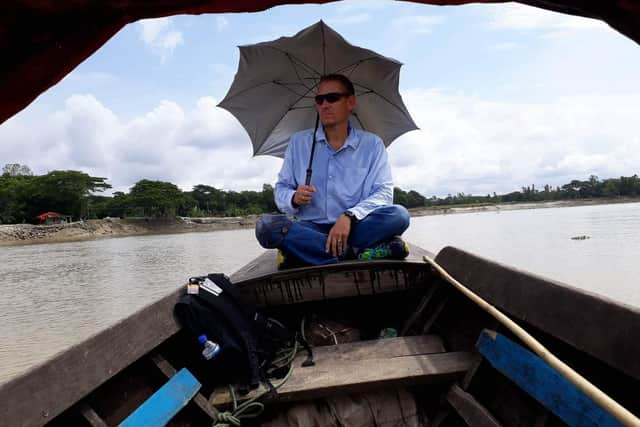

Saaf isn't simply calling for governments to do more to protect water. He believes rivers should have a seat, and a voice, at the table.
For Saaf, the idea that rivers should have rights began with a book he read to humour his daughter, but it has since become something he believes could fundamentally change the way governments negotiate over water.
In New Zealand, the Whanganui River was recognised as a legal person in 2017. Two years later, Bangladesh's High Court recognised all the country's rivers as living entities.
“The rights of rivers is a movement, whereby rivers are seen as an independent owner of certain rights. The river, if it could speak, has the right to claim the right to clean water, consistent flow, the right to have fish.
"This is being brought into negotiations where one person at the table represents the rights of the river or water, as if it were a living being. We can't just sit at the table and talk about the resource as if it belongs to us because it doesn't belong to us. We're borrowing it and we're abusing it most of the time.
“The last time I did this, I was laughed out of the room. People saying: ‘You're a romantic, it's never going to work’. But that's nonsense. We can't keep on talking about rivers and water resources as if they are external to us.”
For Saaf, this summer’s droughts across Europe, with major rivers experiencing record-low water levels, are another indication that we are approaching a tipping point.
“If you look at the climate change models, they're pretty clear. This is all foreseen. They don't need to be surprised, but they are, because nobody wants to face reality.
“The response of governments is let's try to put out this little fire and once it rains a bit and the rivers are back to reasonable levels, we go on with the business of the day, but the impacts are already more or less irreversible, that you're wondering how long can this go on.”
The warning signs have been building for years. His work in Eastern Europe has shown him how decisions made when water is plentiful can have lasting consequences when conditions change.
“They’ve always had these swamps between Hungary and Romania. There used to be so much water that their whole focus was on drainage and getting water off the land. These swamps were drained, rivers were rationalised and straightened out, and the water flowed through at high speed and flooded areas.
“They are now suffering from complete drought due to climate change. So you have these huge water infrastructures to prevent flooding, standing in the middle of dry fields because there's no more flooding.
“The irony is that big infrastructure can help prevent flooding, but if climate change can cause drought, then you must suddenly adapt and ask how do we share water, because we're all running out of water rather than having too much of it.”
Saaf points to Cape Town, South Africa, as an example of what could become increasingly common. In 2018, the city came close to ‘Day Zero’, when authorities warned taps could have to be turned off as dam levels fell.
“Imagine opening your tap and nothing coming out? That was the reality Cape Town came close to facing. All countries understand the fact that if you run out of water, you run out of everything.”
In his technical role representing the International Union for Conservation of Nature (IUCN), Saaf worked alongside UNESCO on transboundary water issues between Kenya and Ethiopia, where cooperation proved key.
The dispute centred on Ethiopia's construction of dams in the Omo, which supplies 90% of Lake Turkana's water, located downstream in Kenya. Saaf's team monitored the impact on Turkana and its communities.
“Through negotiations, they agreed on slowing down the process of filling the reservoirs, environmental flow releases, which means the seasons are imitated so biodiversity can still flourish to a certain extent. Ethiopia offered Kenya very cheap electricity in return for slowing down and changing the flow.
“That is where the shared benefits come into place. Ethiopia, in theory, being the upstream riparian had the ability to just say: ‘Tough. It's just the water flowing through our lands. We need it. We're not going to talk to you’. They didn't do that and, in the end, I would say it's a good example of how things can be.”
Saaf believes society fails to properly value water. He recalls driving through the Jordan Valley and stopping to buy melons.
“He said: ‘That's €3.’ I said: ‘You're growing melons in a very dry climate, where water is very scarce, all the effort you put in and you're asking me €3 for three melons? That doesn't make any sense.’
“He thought he was getting a good deal but it illustrates the fact that water is not valued.”
Saaf's message is simple: water cannot continue to be treated as an unlimited resource.
“It's on our generation to make younger generations value rivers and water before it's too late. Business as usual is not an option.”
The event is open to the public. Tickets are available via www.tickettailor.com/events/loughsagency/2252128