
Planets to align in Derry with Mars, Jupiter, Uranus, Venus, Neptune, Mercury and Saturn visible together for last time until 2040
The planets are set to align tonight when Mars, Jupiter, Uranus, Venus, Neptune, Mercury, and Saturn form a parade which will be visible from Derry and Donegal.
Between sunset and 6.30pm Mars, Jupiter, Mercury, Venus and Saturn will all be visible to the naked eye, while Uranus and Neptune will be discernible with the use of a telescope or binoculars.
Mars and Jupiter will be the easiest to see on either side of Orion, while Venus will shine brightly lower in the horizon to the west. Saturn, less bright, will not be so easy to see, also in the west.
Stargazers are advised this is the last time all seven of these planets will be present simultaneously in the night sky until 2040.
Tonight is an opportunity to follow the the example of Annie Scott Dill Maunder (née Russell) from Strabane, a pioneering astronomer who has a crater on the ‘dark side of the moon’ named after her.
Ms. Maunder wrote a guide to the cosmos in 1908 called ‘The Heavens and Their Story’. In it she describes in detail the mysterious movements of the planets.
"The midnight sky is in it greatest glory in winter,” writes Ms. Maunder. “If we look out at eleven o'clock in the evening the first of January, we see, due south before us, the on beautiful constellation of Orion, the brightest in the sky.
"Lower down to the south-east, the great Dog, with flashing Sirius as its chief jewel, is shining; above Orion and Sirius, the rich stream of the Milky Way flows down from north-west to south-east; on the further border is the bright constellation of the Twins, Castor and Pollux; whilst Procyon, the lesser Dog, attends at their feet.
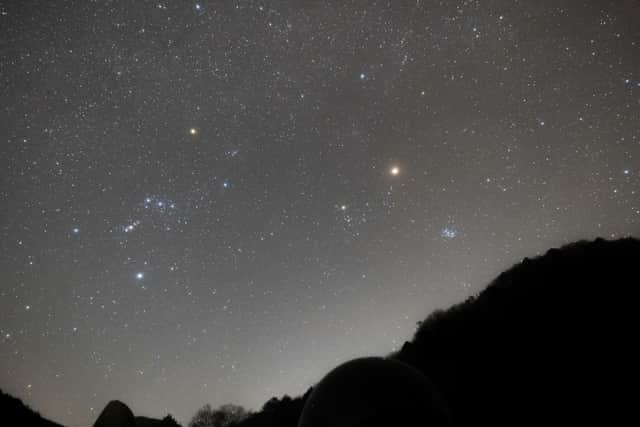

"Nearly overhead is Capella, one of the three brightest stars of the northern hemisphere, and the chief brilliant of the constellation, Auriga, Holder of the Reins; little further west along the Milky Way is the long stream of stars that mark out Perseus; and below the feet of both, bending his head to repel the attack of Orion, is the Bull, with the bright star of Aldebaran shining as his eye.
"Nowhere else in our northern latitudes do we see such a glorious collection of stars.”
She describes too the appearance of three of the seven planets that will form part of the planetary parade visible this evening.
“The red star, the leaden star, and the serene star, are evidently quite unlike the rank and file of the heavenly host. We know them today, as the ancients knew them of old, as planets, that is to say, wanderers; and it was a very slow and tedious process by which men reached an understanding of their movements.
“The names by which we know them today are those of three of the gods of ancient Rome. The red star is Mars; the serene, Jupiter; and the leaden star Saturn. Their movements are like the movements of the moon, with one remarkable difference.
"The moon moves always eastward amongst the stars – moves rapidly eastward, more than twenty times its own diameter in a single day.
"Jupiter, Saturn, and Mars move eastward too, but each of them has a time when their eastward motion becomes very slow, then ceases, and is converted into a westward motion.”