
Stéphane Verlet-Bottéro's new Void art exhibition ‘The Wishing Forest’ may see new natural woodland sprout in Derry
A native forest will eventually sprout in the North West under a pioneering art and ecology project just launched at the Void Art Centre.
That’s the long-term vision of Stéphane Verlet-Bottéro, whose latest collaboration with Void, ‘The Wishing Forest’, runs until June 7, 2025.
The current time-limited show is the start of a process the artist and ecologist hopes will germinate and flourish in the years ahead.
“This show is just to start the conversation that will unfold over the next few months or years – maybe one year, five years, ten years.


"It is following up our collaboration with Void on rethinking what an arts centre can do and how we can go beyond this modernist or elitist tradition of art or the artist as something or someone remote from the outside world who just shows something in a white cube.
"This show is engaging with this history but trying, with Void, multiple partners and the communities of Derry, to acquire a forest or a piece of land that we would like to convert into a native forest and a space of biodiversity and leisure and access as if it was an art work,” explains Stéphane.
A number of sites have already been visited. Stéphane insists, however, that it is not about development of a ‘Void forest’ but bringing together communities and organisations with the right expertise to make such a rejuvenated woodland a reality.
In preparation for the current show – a play on the title of a poem by the late Seamus Heaney, ‘The Wishing Tree’ – Stéphane visited grass-roots activists.
“George McLaughlin took us to Prehen and shared with us the history of the woods. His idea is very important to us and aligned with what we are doing because he is trying to secure the woodland as a common - not private but public and owned by everyone.
“We also visited Roy and Kathryn Nelson in Co. Tyrone. They are regrowing forest and native woodland on former farmland. They are doing phenomenal work and were a big source of inspiration for us in the vision of where we are trying to get to.”
One of the aims of the project is to expand the idea of what a ‘gallery’ is.
“Maybe there are some people who don't necessarily feel at home in an art centre but would be more comfortable going into a forest, engaging with a dance workshop or activity, all these things. That's the vision.
"I'm an artist. I pay rent because I sometimes sell artworks. It's a very old tradition that dates back to the Renaissance. But we are slowly, slowly beginning to realise that nature also produces culture. Animal and plants are part of culture and art culture is part of nature.
"That is the key concept. If a forest is an artwork and is being cared for as an artwork, as heritage in a public collection, how does it redefine relationships? Who is the artist? How do we care for an eco-system?”
During his research for the exhibition Stéphane has had a chance to consider the dearth of native woods in Ireland today.
"There is a history behind the lack of forest cover in Ireland with the colonialist mode of exploiting the land,” he says.
But he has been impressed by the survival of ancient nature-based traditions and mythologies.
“What struck me was how the connection to mythology, the imagery of forests, fairies, the poetry of forests, is very alive. It has survived.
"Coming from the country of Descarte [the French philosopher René], which is Cartesian, very rationalist, about everything, I am very attracted to the survival of myth and folk wisdom.”
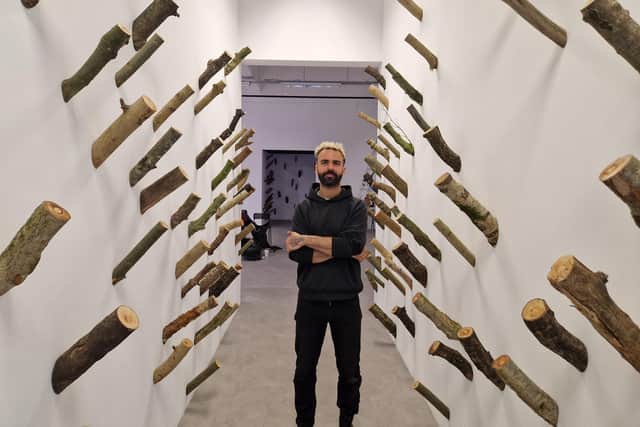
Visitors to the ongoing show enter via an avenue of branches, fashioned from the dead limbs of trees felled by Storm Éowyn.
Light circles of cork against the darker wood of the native species suggest other plant-based processes are underway within each offcut.
"There is spirit - metaphorically but also literally - in this wood. We are maturing home-made poitín, and now it is getting the flavour from the wood, the oak, the chestnut, birch, beech, the native species.”
In another room a 1972 film mediation by Seamus Heaney on ancient Christian and pre-Christian sites around Lough Erne shore called 'The Loughsiders’ plays.
“‘The Wishing Forest’ is taken from the title of one of his poems called ‘The Wishing Tree’. It felt very fitting. The image of ‘The Wishing Tree’ as a place of beliefs, respect and imagination, and the act of wishing for the forest to grow collectively.”
Opposite the film installation hang four tapestries created with Inishowen-based artist Ruth McCartney.
“It's made from things collected from the forest: brambles, oak leaves, bark. The figures are imaginary mythical creatures from the Renaissance, Celtic mythology and mystical traditions."
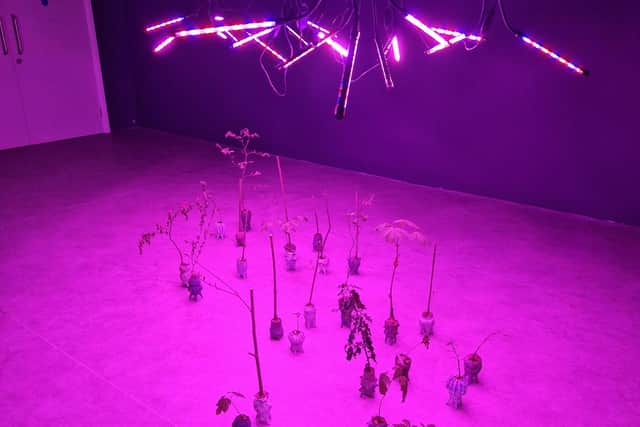
In a final room saplings gifted to the Void by contributors to the project grow under LED lights.
"They are an anticipation of ‘The Wishing Forest’. We keep them in these little ceramic pots. It is a commitment for us to take care of them until we are able to plant them in the land.”
Stéphane hopes the project will increase awareness of the importance of nature for both the climate and society.
"We have evidence now from psychology and the social sciences that forest bathing or going into the forest helps wellbeing, community connectedness and mental health. We also have evidence that moving in nature helps children with mobility, development and the sense of responsibility of caring for nature,” he observes.
An underpinning theme of the project is about ‘life-nurturing commitments that benefit more-than-human communities’.
"‘More-than-human is to say we are never just human in our body. What we thought for centuries was outside - nature - is actually in the centre of our bodies, bacteria, microbes, all this living. We were always ‘more-than-human’. We were never separate.”
‘The Wishing Forest’ runs at Void Art Centre until June 7.