
40% of social housing tenants can’t access car but suffer worst impacts of traffic congestion: Transport Strategy 2035
Forty per cent of social housing tenants to do not have access to a car but those living in urban areas of Derry experience some of the worst impacts from traffic congestion, such as poor air quality.
That’s according to the Department for Infrastructure’s (DFI) new Transport Strategy 2035, which sets out the goal of decarbonising transport by reducing private car journeys, switching to zero and low emission fuels and encouraging greater public transport use.
The strategy was published this week by DfI.
It states that data from the 2021 Census show that ‘around 40 per cent of social housing tenants in Northern Ireland do not have access to a car, significantly higher than the Northern Ireland average’.

"In urban areas such as parts of Belfast and Derry/Londonderry, communities with lower levels of car ownership can experience some of the worst impacts from traffic congestion, such as poor air quality.
"This means those who contribute least to the problem can feel the impacts the most,” the strategy says.
The authors acknowledge the particular reliance of rural communities on private cars.
“In rural areas limited transport alternatives and longer travel distances can restrict access to essential services and opportunities for those without a car.
"Although there have been significant improvements in the provision of accessible and inclusive travel options, the lived experience for many people shows that access to transport remains a major issue that limits the number of travel options,” the report states.
According to the document private cars remain the most popular mode of transport.
Data on journeys per person by travel mode show that on average 68 per cent of journeys were made by car; 24 per cent were completed on foot; three per cent were made on public transport; three per cent were made by other means; one per cent were made by bicycle; and less than one per cent were made on motorcycles.
The strategy document shows that in 2022 of all greenhouse gas (GHG) emissions from surface transport cars were responsible for 71.6 per cent; heavy duty trucks and buses (18.8 per cent); light duty trucks (8.2 per cent); rail (0.7 per cent); other modes (0.4 per cent); and motorcycles (0.3 per cent).
Progress on decarbonising transport in Derry is noted.
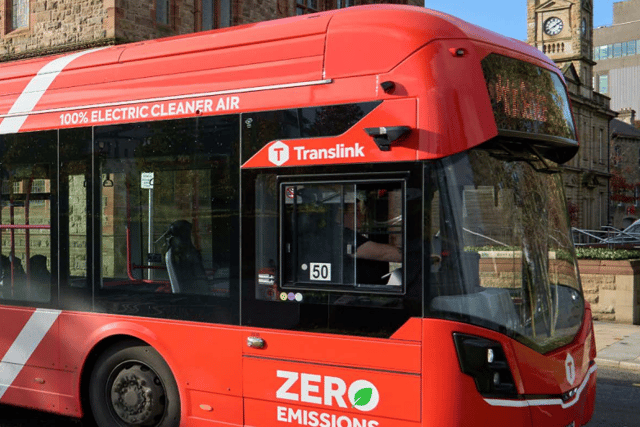
“Considerable funding has already been provided or committed for the purchase of zero and low emission buses. The focus to date has been in the metropolitan areas of Belfast and Derry/ Londonderry where battery electric and hydrogen fuelled vehicles have been deployed, improving air quality in those areas,” it states.
Derry’s Foyle Metro fleet went fully electric three years ago and switching to zero and low emission fuels is one of the strategy’s primary objectives. However, the authors warn that this will require public investment in fleet renewal as combustion engine buses remain cheaper than electric ones at present.
"There will continue to be a need for ongoing fleet renewal programmes. In recent years bus fleet renewals has focussed on replacing diesel vehicles with electric vehicles, with much of the Metro fleet in Belfast and Derry/Londonderry having been replaced.
"An electric bus is currently more expensive than a Euro 6 compliant diesel bus. Affordability and the most effective means to reduce the carbon emissions from transport will need to be considered before embarking on full replacement of all Translink buses and coaches with zero and low emission alternatives,” the report advises.
Rail improvements also form part of the strategy’s focus with the 2024 All-Island Strategic Rail Review (AISRR) cited.
This ambitious document made a range of recommendations across the island, including that the Derry to Portadown rail connection be reopened as a ‘long-term intervention’ by 2050.
Last year’s Rail Project Prioritisation Strategy (RPPS) outlined how best sequence and optimise the recommendations of the AISRR.
The RPPS said planning approval should be secured by 2035 so that enhancements could be realised between 2040 and 2045.
Separate to the Derry-Portadown proposals Taoiseach Micheál Martin announced almost €200 million from the Shared Island Fund for upgrades to the Derry-Belfast-Dublin railway line during the summer.
These developments are acknowledged in Transport Strategy 2035.
“As rail is less suited to serving lower demand corridors and dispersed communities, future feasibility work will prioritise connections identified in the RPPS, published in December 2025, and how it links between larger settlements with the greatest potential to achieve modal shift.
"However, there will also be opportunities for smaller settlements to connect to an expanded rail network through enhanced bus services.
“In June 2026 the Irish Government announced Shared Island funding for capital expenditure on rail projects on the Northern Ireland rail network. This funding provides a valuable opportunity to accelerate the delivery of key rail projects identified in the AISRR.
"It supports earlier investment in critical infrastructure, particularly along the Belfast–Dublin and Belfast– Derry corridors, strengthening regional and cross-border connectivity,” the strategy states.
The new paper cites research from the Consumer Council on the Decarbonisation of Transport (2023) which noted that 61 per cent of people said it would difficult to reduce their use of private cars with this rate rising to 78 per cent in rural areas.
Sixty-five per cent reported that they would support traffic calming measures; 56 per cent said they would support increasing cycle lanes; and 25 per cent said they were dependent on public transport to get around.
Transport minister Liz Kimmins said the strategy outlines the Department's ambition to deliver a cleaner, smarter and more inclusive transport system by 2035.
"As we respond to climate change, technological advances and changing lifestyles, a modern, efficient and sustainable transport system will be essential to future prosperity,” she said.
This week DfI also unveiled its draft Eastern Transport Plan (ETP) 2035 for the Belfast area.
A long-awaited draft North West Transport Plan (NWTP) for the Derry area focusing in greater depth on shorter, local transport movements is expected to be published in early 2027.