

‘Good Trouble: The Selma, Alabama and Derry, NI Connection 1963-1972’, penned by award-winning author Forest Issac Jones, will be published on April 1.
The new history may well be the definitive account of the connection between the civil rights and liberation movement mounted by Black Americans in the 1960s and its sister campaign in the North.
Through oral history based on interviews – including with figures such as Eamonn McCann and Bernadette Devlin – ‘Good Trouble’ shows the visceral connection between the Black Civil Rights Movement in the US and the Catholic Civil Rights Movement – specifically the influence of the Montgomery to Selma march on the 1969 Belfast to Derry march.
Mr. Issac Jones examines the movements’ origins, its links, marches, protests, riots and dangerous confrontations, and the roles of individuals that helped bring change.
The Virginia-based historian speaks of how this interconnected history, for him, is very much a personal story.
His mother Betty Jones (née Coates) was on the March on Washington in August 1963. She was among the 250,000 who heard Martin Luther King’s ‘I Have A Dream’ speech and listened while Mahalia Jackson sang ‘I've been 'buked an' I've been scorned’ and Joan Baez performed the civil rights anthem ‘We Shall Overcome’.
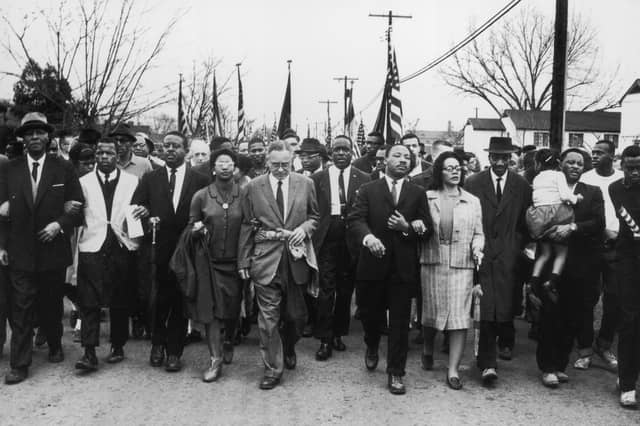
Mr. Issac Jones draws parallels between the Selma to Montgomery of March 1965 when Black Civil Rights demonstrators and their supporters were battered and tear gassed off the Edmund Pettus Bridge, whilst campaigning for the vote and an end to segregation.
He points to how history repeated itself on January 4, 1969, when a unionist mob tried to beat People’s Democracy’s own recreation of the ‘Selma to Montgomery’ march off the roads at Burntollet.
He writes: "I chose to focus on the attack on Burntollet Bridge which was eerily similar to the attack on the Edmund Pettus Bridge in the Selma to Montgomery, Alabama march in 1965.
"The ambush of the Catholic Civil Rights group that day in 1969 became a defining moment of the Troubles in Northern Ireland.”
The book acknowledges how the anti-interment march in Derry that ended in the Bloody Sunday massacre was inspired by the Black Civil Rights campaign.
"Most books about the Catholic Civil Rights movement begin with Bloody Sunday, when thirteen unarmed Catholics who were marching against internment without cause, were murdered by British paratroopers in January 1972.
"My friend and fellow author, Julieann Campbell, is the niece of Jackie Duddy, one of the youngest killed on Bloody Sunday. He was 17 years old.
“I am touched by the stories of Blacks and Catholics who were killed unjustly due to a lack of understanding and empathy among different groups in the US and NI,” he states.
‘Good Troubles’ relates how a ‘new generation of politically and socially aware Catholics in NI looked at the civil rights movement in America as a model for ending what they saw as blatant anti-Catholic discrimination in their country’.
"Young Civil Rights leaders like John Hume, Eamonn McCann and Bernadette Devlin refused to accept this way of life. They saw what was occurring in the United States and how peaceful mass protests had shone the spotlight on Blacks who were living under Jim Crow’s segregation laws,” Mr. Issac Jones observes.
The US historian visited Derry during the summer of 2022 and again in the spring of last year while carrying out research.
"The warmth of the people in Derry, I’d never seen anything like it. The Peace Bridge, the iconic picture that I had on my Twitter page with John Lewis and John Hume was stunning to see in person,” he recounts.
Mr. Issac Jones’ friend Julieann Campbell provides an introduction to ‘Good Trouble’, pointing out: “It’s no exaggeration to say that our own early Civil Rights activists gleaned ideas and inspiration from their US counterparts.
"They borrowed their hard-hitting slogans and adopted protest anthems like ‘We Shall Overcome’. More importantly, they observed how civil disobedience and peaceful demonstration could bring attention to their cause – and so they took to the streets in pursuit of change.”
Ms. Campbell makes the apposite observation that the twin struggles for justice continue in the US and Ireland.
"While much has been achieved on both sides of the Atlantic, there is more work to do. Ireland’s colonial legacy continues to cause suffering throughout the north, and justice evades the majority of those affected by the Troubles.
"We still march and protest, but about different things nowadays like austerity, racism and global awareness.
"In the US, Black Lives Matter reignited the embers of defiance within the black populace – incensed at police brutality and too many needless deaths.
"To an onlooker, it seems that history repeats itself across the USA, the achievements of the past no longer enough. It seems that, once again, the need for action is too great to ignore if we are to live peacefully and in parity with our neighbours,” writes Julieann.
In his conclusion Mr. Issac Jones speaks of how both Civil Rights movements were spearheaded by the young.
"Whenever I talk to young people I remind them of what their parents and grandparents went through to give them the advantages that they have today, me included.
"Eamonn McCann said about the legacy of the Civil Rights movement, ‘The only thing that ever got us anywhere in this town was not paramilitary manoeuvre. In my view, it certainly wasn’t armed struggle. What it was, was the sound of marching feet’.
"Young people need to know that they can change the world. And don’t let anyone tell you that you can’t. They have the power to make our world an even better place for future generations,” he notes.
‘Good Trouble’ will be released on April 1.
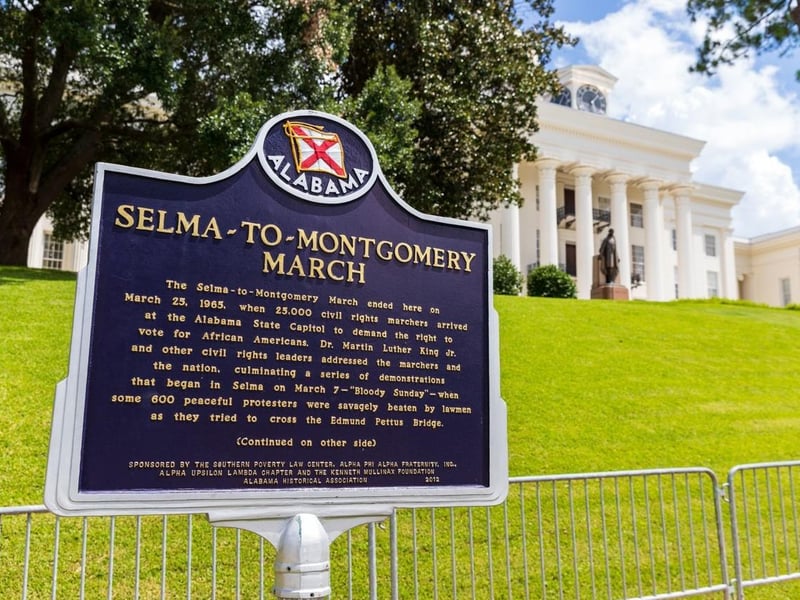
13. A plaque commemorating the Selma to Montgomery march in Alabama.
A plaque commemorating the Selma to Montgomery march in Alabama. Photo: Getty Images