
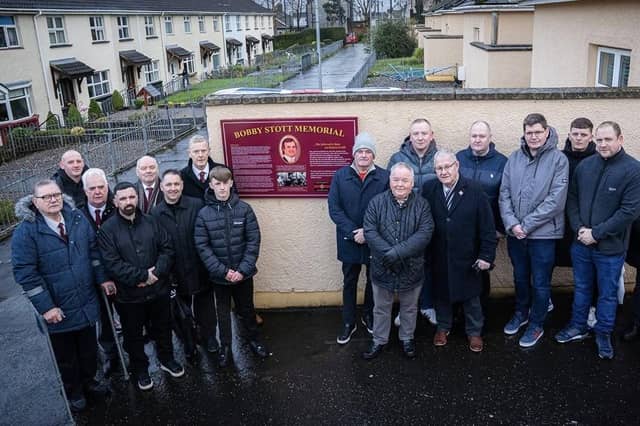

The 22-year-old was almost on his doorstep when he was gunned down on Tuesday, November 25, 1975.
He was on his way home from his work as a shirt cutter in a factory 300 yards away on Bishop Street.
Mr. Stott was a founder member of the William King Memorial Flute Band who in the company of his family and friends unveiled a memorial in his memory on Sunday.
Trevor Mitchell, Mr. Stott’s close friend, said: “When we were starting the band, Bobby was one of the very first to join. He was a hard worker in those early years, determined to help get us on the road. Sadly, we only had his company and friendship in the band for three short years before he was so cruelly cut down.”
Mr. Mitchell recalled the day of Bobby’s murder.
"We grew up together, went to the same schools, and eventually worked side by side in the same factory on Bishop Street. It was there, on Tuesday, November 25, 1975, that I last saw him alive.
“After work, Bobby walked up the street to the Fountain while I went to a driving lesson. I did not know what had happened until I arrived home later. I remember very little of the rest of that night. Everyone was stunned and shocked that such a thing could happen right outside his own front door.
“Bobby was a quiet, decent, and good person, and I am honoured to have been his friend. God bless, old friend – until we meet again.”
The officers and members of William King Memorial Flute Band noted that ‘to this day, his family have received no justice’.
“As a band, we honour Bobby’s name every time we wear our uniform with pride and dignity. His memory remains woven into our history, our values, and our purpose,” the band said.
The new memorial was unveiled at a moving service led by Mark Roxborough on Sunday.
Mr. Stott, who was single at the time of his murder, was the son of Mr. Myles Stott, who had been Superintendent of the Guildhall. His mother Grace had died while he was still at school.
He was educated at Carlisle Road Primary School and later, Templemore Secondary School.
The young Fountain-native had served as a Private with the Ulster Defence Regiment (UDR).
At a meeting of the Council on the evening he was killed the Mayor, Alderman Ivor Canavan, said: “It seems to me that all of us must leave no stone unturned until men guilty of such acts are brought to justice.
He spoke of how Myles Stott, as a council worker, was a man ‘loved and respected by them all’.
“I find it difficult to find words to condemn an act of this sort. The work in this Council seems for naught when such an act can be perpetrated in the streets of this city,” he said.
The previous Mayor, Alderman J Allen, said: “This young man in his early twenties, was brutally murdered. The people of the area are very concerned about the matter.”
Patrick Devine, SDLP, said: “The tragedy of our country is that too many people are trying to solve their problem by the gun.
“If we could release ourselves from this course maybe we could go forward.”
Deputy Mayor, Alderman James Hegarty, said: “I would plead, for God’s sake, don’t let’s have another winter of this shooting.
“Here was a young man in the prime of his life cut down from his family.
“Again, I would plead for God’s sake stop this killing.”
Statements condemning the murder were issued by the Bishops, Rt. Rev. Dr. Robert Eames, and Most Rev. Dr. Edward Daly.
Bishop Daly said: “Murder cannot be justified by spurious excuses and intimidation or harassment.”
“Let me say clearly that no excuse justifies murder, which is the most serious offence against God or man,” said the Bishop, who added: “The people who seem bent on creating sectarian conflict in Derry must be isolated and rejected by the whole community.”
The two SDLP Convention members, John Hume and Michael Canavan, said: “We condemn this callous cold-blooded murder of Robert Stott, son of a well-known and respected local family.”
Their statement added: “It can only deepen the divisions and postpone peace.”
About 1,000 people had walked in the cortege from the deceased man’s home in the Fountain to First Derry Presbyterian Church.
They included people of all denominations, amongst them were the Mayor and members of the City Council.
The Northern Ireland Secretary of State, Meryln Rees, was represented.
Marching at the head of the cortege, from Carlisle Square to Glendermott New Cemetery, was a detachment of the UDR who also supplied the pall bearers and a bearing party for the Union Jack-draped coffin.
The late Mr. Stott had been associated with the Ulster young Unionist Movement, which was represented.
The Official Unionist organisation was represented by many officers and members, including William Ross, MP.
The service in First Derry Presbyterian Church was conducted by the Minister of the church, Rev. James Young, who in tribute to the UDR said: “The saddest part of the 52 members of the Regiment, who had been killed is the number who died not in uniform, not on active service, but at their work, in their homes and in their cars in craven attacks on unarmed men and their undefended families.”
“This murder might remind us how good is the cause people serve - the wish for peace. industry and democracy.
“On the other hand there is destruction, murder, intimidation and the law of the jungle,” Mr Young continued.
Approximately 100 wreaths were laid on Mr. Stott’s grave with one reading, ‘From the mothers of Creggan and Bogside’.
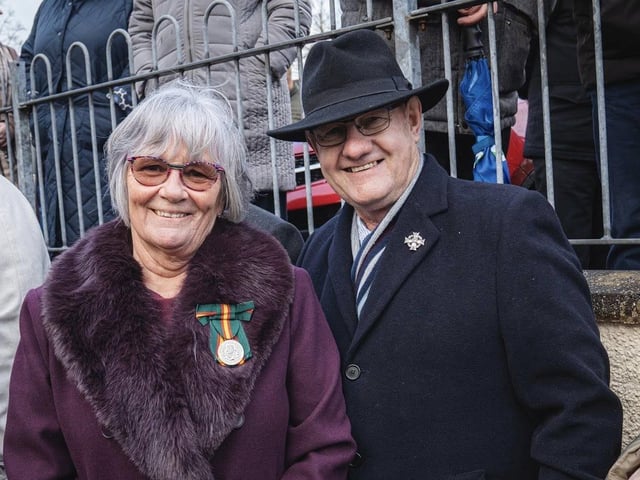
5. Remembering Bobby Stott on his 50th anniversary.
Remembering Bobby Stott on his 50th anniversary. Photo: Gillian Lindsay Photography
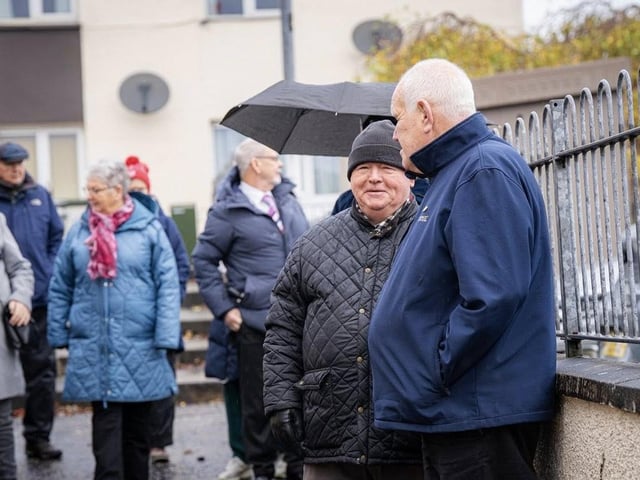
6. Remembering Bobby Stott on his 50th anniversary.
Remembering Bobby Stott on his 50th anniversary. Photo: Gillian Lindsay Photography
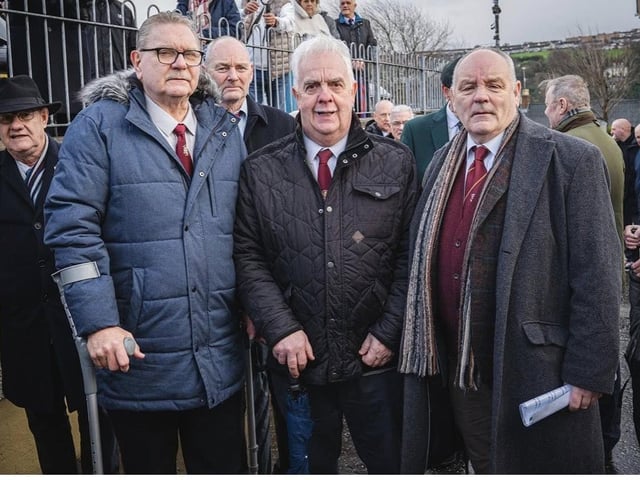
7. Remembering Bobby Stott on his 50th anniversary.
Remembering Bobby Stott on his 50th anniversary. Photo: Gillian Lindsay Photography
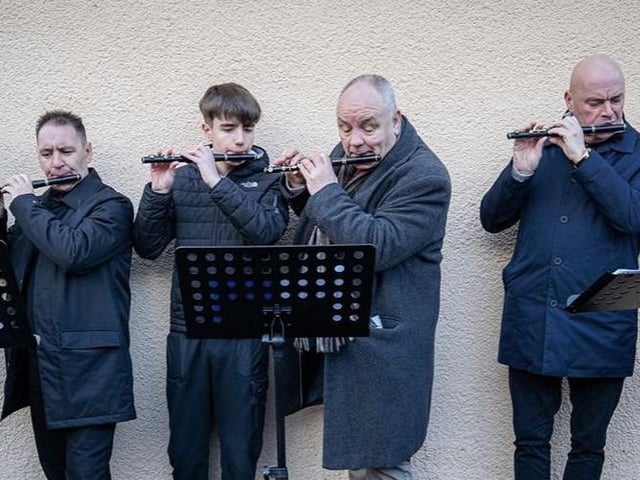
8. Members of the William King Memorial Flute Band playing at the service on Sunday.
Members of the William King Memorial Flute Band playing at the service on Sunday. Photo: Gillian Lindsay Photography