
Derry astrophysicist Dr. Matt Nicholl receives prestigious gong for pioneering black hole and supernova discoveries
Derry astrophysicist Dr. Matt Nicholl has been awarded a prestigious award for his pioneering research into supernovae and super-massive black holes.
The 2025 MERAC Prize for the Early Career Researcher in Observational Astrophysics was awarded to the Eglinton scientist for his work on explosive transients, compact object mergers and tidal disruption events (TDEs).
Dr. Nicholl is a leading scientist in the field of major cosmic events such as supernovae and supermassive black holes, their properties, their causes and effects.
Announcing the award Queen’s University said Dr. Nicholl has consistently applied novel approaches to data to understand transient physics throughout his career.
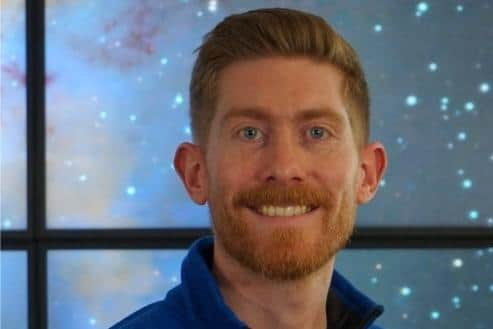

He has been responsible for several scientific breakthroughs in his chosen discipline, playing a key role, for example, in discoveries including ‘the first electromagnetic counterpart to a gravitational wave source, and in developing analysis techniques now used to model many types of transients’. ‘Transients’ is a term for short-lived cosmic explosions of unusual brightness such as supernovae.
On August 17, 2017, he helped identify that gravitational waves from GW170817 had been caused by two merging neutron stars in what was the biggest scientific breakthrough of the year.
Queen’s said: “He played an influential role in the beginning of multi-messenger astronomy, initially by obtaining spectra and leading one of the discovery papers on the binary neutron star merger and gravitational wave event GW170817, and later adapting his modelling techniques to combine the gravitational wave and electromagnetic measurements to tightly constrain kilonova properties.
"His group used this multi-messenger framework in the detection and interpretation of the two best-observed kilonovae since GW170817.”
In 2023 he observed a new type of supernova as bright as hundred of billions of suns named AT2022aedm. He and his colleagues dubbed this new type of cosmic event ‘Luminous Fast Coolers’ or LFCs, partly because they were luminous and cooled quickly, but also because he and his fellow researchers were fans of Liverpool Football Club!
"He has continued his work on extreme supernovae, using Hubble Space Telescope images and late-time spectra to reveal evidence for rapidly rotating engines inside these explosions, and discovering the supernova that holds the record for the highest integrated luminosity.
"Turning to TDEs, he characterized how their spectra evolve and found definitive evidence for outflowing gas, and discovered a new class of luminous fast transients, which may be the disruptions of stars by low-mass black holes.
"He proved the causal connection between TDEs and X-ray quasi-periodic eruptions, pioneering techniques to measure TDE disk sizes and constrain the eruption mechanisms,” said Queen’s, announcing the accolade.
Dr. Nicholl is a past pupil of Oakgrove Integrated Primary School and Foyle College.
He completed his PhD at Queen’s University Belfast in 2015 and was awarded the Royal Astronomical Society (RAS) Penston Prize for best PhD thesis.
He moved to Harvard University as a postdoctoral fellow, before moving as RAS Research fellow to the University of Edinburgh, and then as Assistant Professor to the University of Birmingham, where he obtained an ERC Starting grant in 2020. He returned to Queen’s University Belfast in 2023 as Reader. In 2022 he was awarded the Fowler Prize of the RAS.