
Patrick O’Callaghan is far too modest to claim credit for this.
But the retired academic was one of a group of researchers who provided the impetus for the roll-out of the world wide web in the Caribbean country back in the 1990s.
Professor O’Callaghan was teaching computing outside Caracas as the era of modern telecommunications was dawning in the 1980s.
In 1979 he had landed a role at the country’s main technological university, the Universidad Simón Bolívar, located on an old coffee plantation in a mountain valley on the fringe of the Venezuelan capital.
"In the late 1970s Venezuela was very stable and economically well off. It was probably one of the better-off countries in Latin America. It was just after the big oil boom in the mid-1970s and Venezuela got a lot of money out of that.
"The economy started to slide a bit in 1983 when there was a devaluation of the bolívar. Several colleagues decided to leave. They were pessimistic about how things were going to go,” explains the former Professor of Computer Science.
Originally from the Glen Road in West Belfast, Dr. O’Callaghan has family ties to Derry, where he now lives.
"My father was from the Waterside near Top of the Hill. But they left when he was in his early teens and moved to Belfast. His father was in the Royal Irish Constabulary so after partition he was out of a job,” he tells us.
In the early 1970s Patrick left Ireland to study computing in Cambridge. It was there he met his late wife Carol Cañizares who was studying anthropology. They wed and after spells in Cambridge and Edinburgh decided to move to South America.
“I said at the time that we’d been here for four years so why not go to Venezuela for four years just to be fair. That four years turned into 30 years as things do,” he adds.
Patrick forged a highly successful career teaching computer architecture and operating systems at the Department of Computer Science at Simón Bolívar.
From this vantage he could see the world of communications was on the cusp of major change.
“In the mid to late 1980s we started to get indications that we should be connected to a wider world. They had installed a very, very rudimentary email system using a modem, a really slow modem, and the university was outside Caracas so it didn't even have a good phone connection.”
One of the first things he did was establish an electronic mailing list in the university for academic staff.
"People came to rely on that a lot and that became the standard form of communication very rapidly. I often wondered if I had done the right thing because it was absolutely full of all kinds of things, especially in a highly, politically charged atmosphere!” he admits.
In early 1992 Hugo Chávez’s Revolutionary Bolivarian Movement-200 tried to overthrow the government of Carlos Andrés Pérez.
“When Chávez and his men had their initial attempt at a coup that was something that was discussed among Venezuelans who were living abroad, ex-students of ours who were doing their doctorates, mostly in America.
"We were able to listen in on that conversation. I was able to take that to the university rector and say, ‘look all of this conversation is going on and we are not part of it and it is important that we get connected'.”
Things gathered momentum at Simón Bolívar. Similar conversations were underway among like-minded academics at other universities in the country.
“The national research council called a meeting of interested researchers to talk about applying for money from an international organisation called the Inter-American Development Bank (IDB) who tended to fund that kind of thing.
"The council had a kind of basic system connecting to databases in the United States using fixed lines. In order to use it you had to physically go to their office in Caracas and sit down in front of a terminal. It was an information service, kind of like a remote library. They were thinking of trying to get money to expand this.
"At this meeting in Caracas I stood up and said, 'actually we don't want that, what we want is to be connected to the internet.'
"They weren't really aware of what the internet was. In fact, most people weren't because the internet was still in its early stages. So I said this is what we want and that got a lot of support from the other people in the room.”
Following this intervention Patrick got a call from the research council asking if he would put together a proposal with a group of other technical experts.
“We eventually got an assignation of around $2m to start investing in an academic internet in Venezuela. That was the initial stage,” he says.
By the mid 1990s Patrick had identified the lack of a decent commercial internet service as a major impediment to connectivity.
"There were no internet service providers (ISPs). After trying to get the university to establish one itself I decided to get together with some students and some other people that we knew.
"We founded an ISP called True.net in Caracas. It was one of the first ISPs in Venezuela. We started offering it as a service. It even served the university for a while.”
True.net was founded in 1995. Within two years it was snapped up by the national telecommunication company CANTV.
“Much like British Telecom at the time it was a monopoly. They decided they needed to get into this so they made an offer to buy us out lock, stock and barrel. Then they started offering it domestically to people, to universities and so on so that is really how it all started.”
The sale of the tech start-up to an operation of CANTV’s scale led to the wider roll-out of web services within the country. The rest is information technology history.
After 1997 Patrick had no further direct involvement with True.net. He became head of telematic services at Simon Bolivar working on improving internet connectivity and bandwith within the college network.
Patrick stayed on in Venezuela briefly following the loss of his wife Carol in 2012 but when Chávez died thirteen years ago he sensed things were not going to hold together and decided to return to Ireland.
His sons Patrick and Michael, both of whom work in animation, are based in Dublin and Derry respectively, while his daughter Annie resides in Barcelona.
Now living in Derry, Prof. O’Callaghan watched the capture of the President Nicolás Maduro by US special forces in January with some interest.
"Has it actually changed?” he asks. “We don't really know. In a sense I don't attribute any of this to [US President Donald] Trump. It is actually [US Secretary of State] Marco Rubio who is behind it. Trump takes the wind as he always does.
"I'm sure a lot of Trump’s motivation was that he wanted the photo opportunity. [Former President Barack] Obama got [Osama] Bin Laden so he wanted to get somebody. I don't think it goes any deeper than that.
"But Chavismo is so entrenched at every level of government, the civil service and the state in Venezuela after so many years that you can't just take out the top level and replace it with a democratic opposition and everything will go swimmingly. You can't just do that. Is there any plan to actually progress? We don't know.”
Having helped kickstart a telecoms revolution in Venezuela 30 years ago what does he make of the current great leap forward with Artificial Intelligence?
"Undoubtedly it is going to have a big effect. I tend to be sceptical about all the alarmist notions about an AI apocalypse and the idea that everybody is going to be out of a job.
"It is going to change things. It has changed things already,” he suggests.
Looking back at life in the Venezuela he found upon emigrating there in the 1970s and the world we live in today, he says it was like living on a different planet.
"When I went there it was very different to what it became. There was no internet and no email. It was just postal letters and very expensive phone calls. It was very isolated for a long time. Going there was very much like going to Mars. It was so completely different with a completely different atmosphere, different social norms, different ways of behaviour, everything was different.”
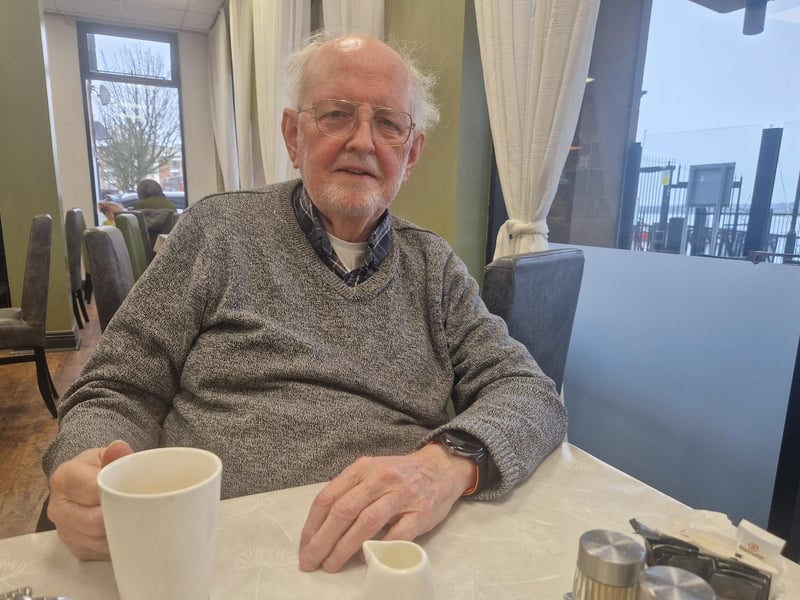
1. Derry-based retired academic Patrick O’Callaghan who helped establish widespread internet access in Venezuela in the 1990s
Derry-based retired academic Patrick O’Callaghan who helped establish widespread internet access in Venezuela in the 1990s Photo: Kevin Mullan
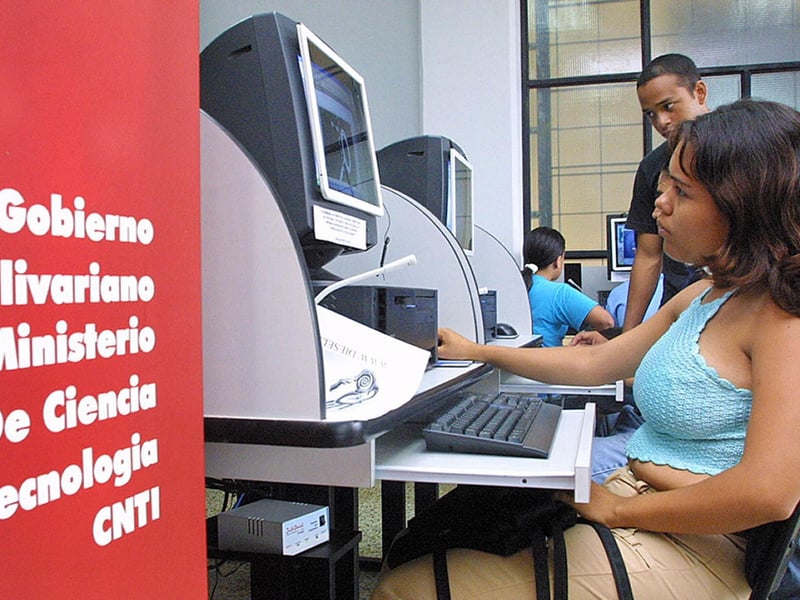
2. An internet centre in Caracas in 2004. AFP PHOTO/Andrew ALVAREZ (Photo credit should read ANDREW ALVAREZ/AFP via Getty Images)
An internet centre in Caracas in 2004. AFP PHOTO/Andrew ALVAREZ (Photo credit should read ANDREW ALVAREZ/AFP via Getty Images) Photo: ANDREW ALVAREZ
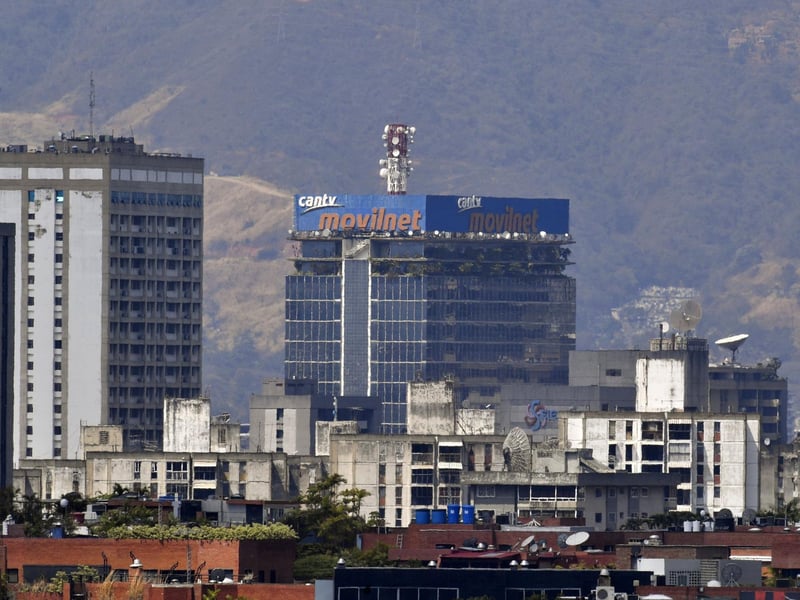
3. View of the state-owned telephone and internet company CANTV headquarters in Caracas, on March 10, 2019. CANTV acquired True.net, the internet service provider established by Patrick 1995, in 1997. (Photo credit should read YURI CORTEZ/AFP via Getty Images)
View of the state-owned telephone and internet company CANTV headquarters in Caracas, on March 10, 2019. CANTV acquired True.net, the internet service provider established by Patrick 1995, in 1997. (Photo credit should read YURI CORTEZ/AFP via Getty Images) Photo: YURI CORTEZ
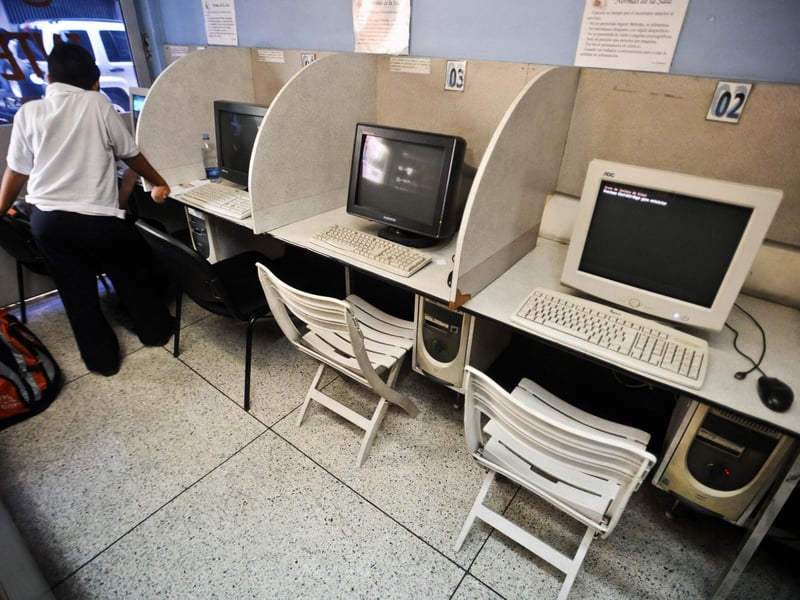
4. A cybercafe in Caracas, March 17, 2010. AFP PHOTO/Miguel Gutierrez (Photo credit should read MIGUEL GUTIERREZ/AFP via Getty Images)
A cybercafe in Caracas, March 17, 2010. AFP PHOTO/Miguel Gutierrez (Photo credit should read MIGUEL GUTIERREZ/AFP via Getty Images) Photo: AFP