
Derry Teddy Boy inspired John Travolta’s Saturday Night Fever disco dancing icon Tony Manero
So ‘Tony Manero’ was from Derry. Well, kind of.
John Travolta’s snake-hipped Brooklyn disco dancer who defined an era was actually a Teddy Boy who frequented the cafés of the Strand Road and William Street in the late 1950s. True story.
‘Saturday Night Fever’ – the iconic 1977 movie – was inspired by an influential article entitled, ‘Tribal Rites of the New Saturday Night’.
Written by Nik Cohn, who grew up in Derry, it had been commissioned by New York magazine in 1976 who suggested he write a piece on the burgeoning disco scene.


The acclaimed music critic headed to Bay Bridge in Brooklyn and visited the 2001 Odyssey club in order to gather intelligence.
The subsequent article gave the world ‘Vincent’ a young working-class Italian-American ‘who was the very best dancer in Bay Ridge’ and 'owned 14 floral shirts, five suits, eight pairs of shoes, three overcoats, and had appeared on American Bandstand'.
A legend was born. Disco, until then an underground scene among the black and Puerto Rican gay community in New York, went stratospheric.
‘Vincent’ became ‘Tony Manero’, the Bee Gees did the soundtrack, Saturday Night Fever took $237.1 million at the Box Office, and the rest is history.

Except ‘Vincent’ didn’t exist.
Years later Cohn admitted he had invented the character and that he had based him on a young gang member he had encountered when he was growing up in Derry.
In a December 1997 article for New York magazine Cohn wrote that he had actually gone to the 2001 Odyssey in 1976 but a fight broke out and someone threw up over his leg.
Before clearing for Manhattan he had glimpsed a figure in flared crimson trousers and a black body shirt standing in the shadows. But that was all.

“I knew nothing about this world, and it showed. Quite literally, I didn’t speak the language. So I faked it. I conjured up the story of the figure in the doorway, and named him Vincent,” he wrote.
Intriguingly he revealed that the character that later became ‘Tony Manero’ was actually an amalgam of a Bogside Teddy Boy and a Mod he knew in London in the 1960s.
"Taking all I knew about the snake-charmer in Derry and, more especially, about Chris the Mod in London, I translated them as best I could to Brooklyn. Then I went back to Bay Ridge in daylight and noted the major landmarks,” he acknowledged.
Cohn was born in London in 1946 but grew up in Derry where his father, Professor Norman Cohn, taught history and French at Magee.
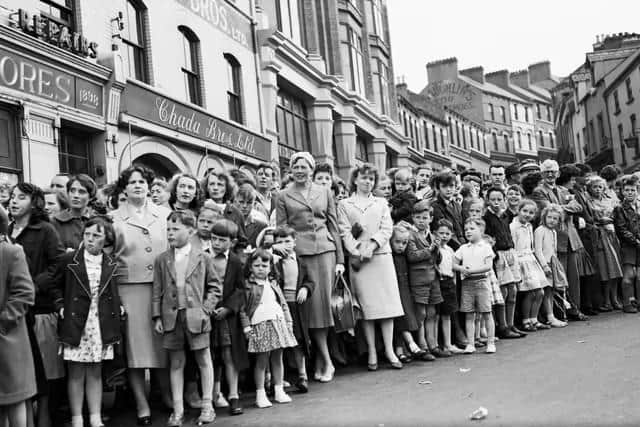
In an early work of autobiographical memoir he gives us a few clues as to who the aforementioned ‘snake-charmer’ and inspiration for Vincent-Manero might have been.
The essay ‘Delinquent in Derry’ tells us how in 1957, aged 11, he was walking the dark streets of Derry when he arrived suddenly at the ‘downtown end of The Strand, hard by the docks, on the borders of the Bogside’.
"Directly across the street was a perfect neon inferno, brightly lit and self-contained like a stage-set: Rock ’n’ Roll blasting from the open doors of coffee bars; beehive blondes with sky-blue or scarlet skirts and bright orange lipstick; sailors hunting in packs; leather boys, motorbikes, the reek of diesel,” he recalls.
Watching from an unlit doorway he noticed a ‘snake’.
"From deep inside the chasm of the Roseland Café a jukebox let loose with Tutti Frutti, Little Richard, and on the pavement outside an impromptu jitterbug broke out.
"Teenagers in fancy dress, whom I later learned were Teddy Boys, began to jive with each other, males with males, in a craze of flashing fluorescent socks and shocking-pink drapes, drainpipes and blue suede shoes; and as they whirled they kept passing the snake, which I took at first to be a whip or a length of elastic tubing, back and forth like a baton.

“When the music died out, so did the dancing. But the snake remained, dangled beneath a street lamp, framed and backlit by the Roseland’s plate-glass window.
"I could now see it clearly. It appeared to be about two feet long, with a tapering greenish coil for a body and a great, black hooded skull.
"Something between a cobra and a python, I guessed, and it twirled and corkscrewed, stretched and contracted in rhythm, twined around a blue mohair sleeve with a purple velvet cuff,” he relates.
Was it one of these colourful, whirling dancers in ‘flashing fluorescent socks and shocking-pink drapes, drainpipes and blue suede shoes’ dancing with a ‘snake’ at the ‘Roseland Café’ on the Strand Road that resurfaced in Cohn’s mind when he visited 2001 Odyssey and saw the crimson flared, black-shirted shadow twenty years later?
‘Tribal Rites’ turbo-charged the disco movement and helped change the course of music history.
In 2011, Mark Rozzo, writing in the New York Times, mused: “Without Cohn’s original story, it’s possible that disco would be a dimly remembered fad from the days of the Ford administration: no Bee Gees megahits, no Travolta superstardom, no nostalgic polyester parties for decades ever after. Barry Gibb reportedly once said to Cohn, ‘It’s all your bloody fault, isn’t it?’ He may have been right.”
Fittingly, when the legendary Brooklyn disco producer and former Studio 54 resident DJ Nicky Siano played The Glass Works as part of Celtronic in 2014 he said the energy from the Derry dance crowd was as close to the 1970s New York scene as anything he had encountered anywhere.
That gig was about 100 metres from the ‘downtown end of the Strand’, ‘the Roseland Café’ and ‘the Derry snake-charmer’.