
Derry’s contribution to American Independence
This July 4 marks the 250th anniversary of the signing of the American Declaration of Independence. It has long been acknowledged that Irish people made a significant contribution to the process. It was signed in Philadelphia by 56 signatories. Eight were of Irish stock, three of whom were born in Ireland. Two were from Derry and the official printer of the document came from Strabane.
Philadelphia and the state of Pennsylvania played a big part in the evolving history of Derry. From the first Ulster Scots settlers in the 17th and 18th centuries to the many post-famine Catholic Irish, strong bonds of affiliation have developed. That great son of Derry and Donegal, Brian Friel, noted the linkages through emigration in his renowned play, ‘Philadelphia Here I Come’, a familiar cry of many departing Derry people. As widely acknowledged, Derry was for centuries, a major port for emigration to the United States and to Philadelphia in particular. Both are seafaring cities of long standing which deepen the links further.
A notable figure from Derry, Charles Thomson joined other Irishmen from Antrim, Cavan, Dublin, Galway and Tipperary/Offaly as signatories of the Declaration. Thomson was born near Maghera in 1729 and emigrated to America aboard a boat from the port of Derry with his widowed father and brothers in 1739. The family sailed to Philadelphia and settled in New Castle in Delaware. In 1776, Thomson was appointed to the position of Secretary of Congress, an influential position in the unfolding efforts to achieve independence. He held that post for 15 years. Close to John Adams and Thomas Jefferson, the second and third Presidents of the United States, Thomson was deputed to travel from Philadelphia to the home of George Washington in Virginia to inform him that Congress had elected him as first President. Thomson was also responsible for creating the Great Seal of the United States still used to this day. Thomson was also a staunch abolitionist who sagely predicted that the new state would face civil war if the matter was not attended to. Thomson was a signatory of the Declaration by dint of his being Secretary of the Continental Congress, as distinct from the other signatories who were members of the Congress.
A further signatory from Derry was Matthew Thornton. He was born on a farm a mile outside Derry in 1714 but emigrated at the age of two with his family and after landing in Maine, settled in Worcester, Massachusetts. Becoming a physician, he established a practice in the town of Londonderry, New Hampshire. Taking a strong interest in local politics, he became the President of the New Hampshire Provincial Congress in 1775 and in the following year, was elected a member of the state’s House of Representatives. In the years following the Declaration, he became a senior judge and a member of the New Hampshire Senate. He died at 89 and his name is remembered throughout the state, including a town in his honour, Thornton, New Hampshire.
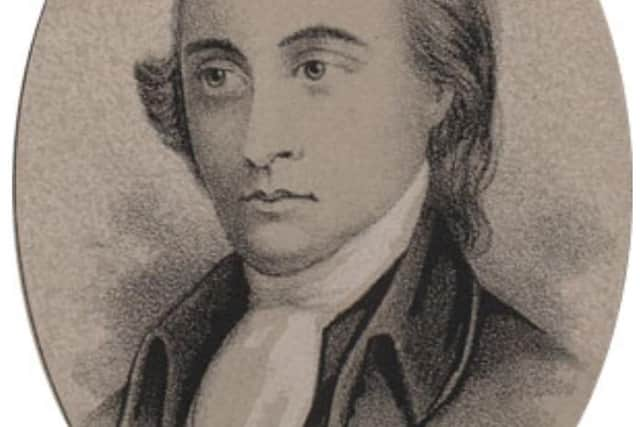

Although not a signatory, John Dunlap of Strabane, was appointed the official printer of the Declaration. Dunlap was born in 1747 and at the age of ten was sent to Philadelphia to work with his uncle, William Dunlap, a printer and bookseller. Later establishing his own printing business, he also published a paper the ‘Pennsylvania Packet’. In 1776, Dunlap won the contract to print the Declaration of Independence – a great honour for a man of 30 years of age. Fighting in the War of Independence, he saw action with George Washington at the battles of Trenton and Princeton. Given his strong patriot credentials, in 1787 he was commissioned to print the US Constitution Responsible for disseminating the principles and ideals of American independence to a widely spread American public, he remains a revered figure in the United States. Although part of Tyrone, Dunlap’s birthplace of Strabane is widely seen as part of the Derry hinterland. Dunlap could thus. justly be included among the ‘Derry Diaspora’.
Hercules Mulligan of Coleraine was not a part of the Congressional efforts to secure American independence, yet he played a significant role during the Revolutionary War, mainly as a spy. Born in Coleraine in 1740, he emigrated from Derry with his family when he was six. They settled in New York City.
Mulligan opened his own tailoring and haberdashery business and was to become a close associate and friend of Alexander Hamilton, the patriot from New York. Mulligan was said to have saved George Washington’s life twice while working as a spy during the War. He also took an active part in several battles during the War. He became a strong advocate of abolishing slavery along with Alexander Hamilton and John Jay, the latter a future Chief Justice. Mulligan’s legacy includes appearing as a character in the successful Broadway play ‘Hamilton’. He died at 84 and was buried close to Alexander Hamilton in a New York cemetery.
The majority were signatories of the Declaration, one was an official of Congress, one was the printer of the Declaration, and one was a zealous activist and promoter of American independence. They did not form a cohesive group, but what links them all is their Derry heritage. That spirit of freedom and independence which they embodied remains a strong feature of Derry people to this day. That Derry mettle has been tested on many occasions over the centuries and found to be resilient both at home and abroad. Importantly, that spirit helped build a nation that has thrived and prospered for 250 years and which we now celebrate.