
Derry’s Dermot Hegarty highlights the plight of Sudanese refugees amid worst humanitarian catastrophe on earth
Dermot Hegarty has heard stories of a hell on earth at the border.
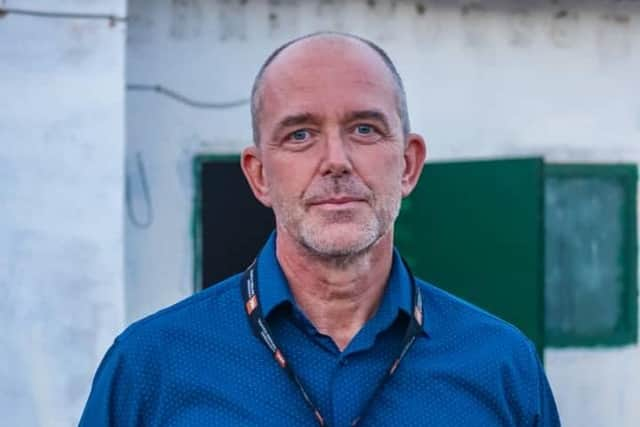
For the past two years the 56-year-old, who is originally from Greenwalk in Creggan, has been based in N'Djamena in Chad where he is country director with the Norwegian Refugee Council.
The witness testimonies from those who have so far survived the worst humanitarian crisis on the planet are beyond comprehension.
“They have endured so much hardship,” he tells us. “Eighty to ninety per cent are women and kids. The women have been raped, the men are either murdered or stay behind to fight, or to try to cultivate whatever small piece of land they have left.
"But most of them have been murdered. About 80 per cent of the men have been wiped out through ethnic cleansing.”
Over a million refugees have fled the war in neighbouring Sudan to seek refuge in encampments in Eastern Chad, where NRC, and other humanitarian aid agencies provides rudimentary shelter and sanitation.
“We have most of the Sudanese refugees. They cross the border into the east of the country. There are around 1.5m refugees there now.
"It is hard to convey the number when you think of how big Derry is.
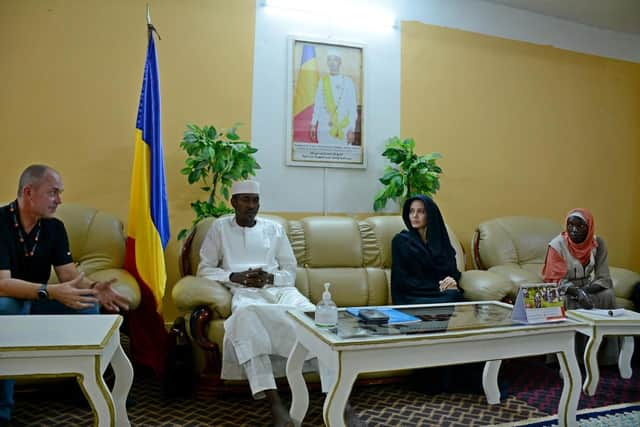
"When I go home and talk to my cousins and friends in Derry you can tell people what it is like but it is hard to really visualise how grim it is.
“We recently had the three year anniversary of the start of the war. It is incredibly depressing. I don't know how to explain to people how bad it is.”
Dermot has been working in the international humanitarian aid sector for a decade and a half, mostly in Francophone countries thanks to his education at St. Columb’s College and Queen’s in Belfast.
He did a post grad in Business and French at the then University of Ulster in Coleraine after graduating from Queen’s and ended up pursuing a career in IT in London.
“London life was good in the 1990s but after that I thought I needed to do something better with my life. I headed off to Australia and started working for this wee Australian charity based in Vietnam that looked after street kids that had been abandoned. That was in 2006.
"I spent almost four years in Vietnam. Then I went to work with Catholic Relief Services (CRS) in the Central African Republic in 2012. I got my first job as a country director in 2019 in Cameroon,” he says.
Over the past 14 years Dermot has worked for CRC, Concern, the Danish Refugee Council and now the NRC, in Mali, Congo, Djibouti, Cameroon and CAR.
His current posting is extremely challenging given the unfolding catastrophe in Sudan.
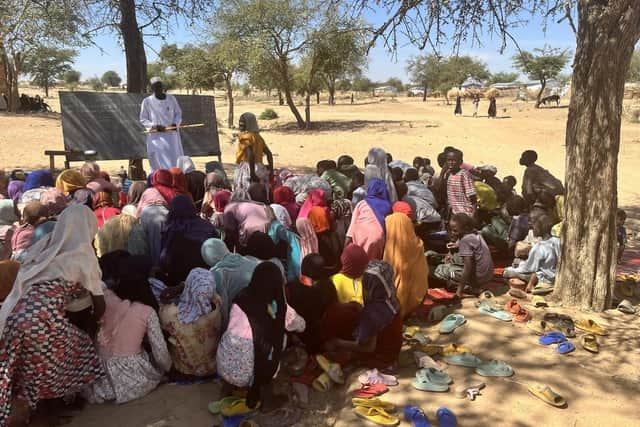
“Here in the capital I am about an hour and half flight away from the border. We have to take these humanitarian flights to get there. When you arrive at the border it is like you are in the middle of the desert. There is nothing there.
"You have all these people. Typically you have the UN Refugee Agency (UNHCR) who build shelters and camps.
"But that money is gone. When the Trump administration took away United States Agency for International Development (USAID) funding, they took all the money away."
The Derry man says it has been dispiriting to witness expenditure on armaments being ramped up while people are starving in the Sahel.
"They are quite happy to spend a billion dollars a day messing around with Iran but the $45 billion they removed from international aid has had a massive impact.
"Anyone who works in my sector noticed it was a huge deal but for the rest of the world it is just business as usual unfortunately. Now we are living with the consequences.”
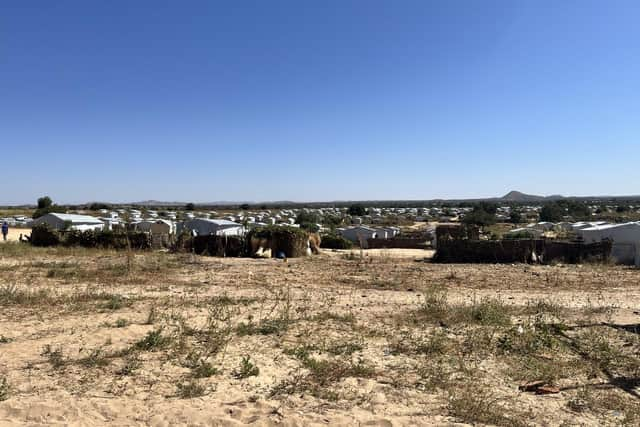
As country director for NRC Dermot’s job is to ensure donor funding is spent appropriately and that the audits are all done properly.
The money they receive is then used to build shelters and latrines for those in dire need at Adré on the Chad/Sudan border.
"Right now that is what we are doing. When I say a shelter I'm talking about a plastic tent with wooden poles and when I say latrines I mean digging holes in the ground to try and stop the spread of disease.
"We do education as well and help people with advice on getting documentation because they will have fled Sudan and tried to take their stuff but they get hammered on the way."
Chad and Sudan were already in the midst of a humanitarian crisis when the latest round of civil war broke out between the Sudanese army and the paramilitary Rapid Support Forces (RSF) three years ago.
"It’s the same as it was 20 years ago with the Janjaweed [an armed militia based in the Sahel who were involved in the Darfur genocide],” says Dermot. “Now they are rebranded as the Rapid Support Forces. It's horrible.”
“There have been 1.5m refugees in the space of three years. During the last conflict in Sudan there was a total of 400,000 refugees in that 20 year period. We have more than three times the number in a very short space of time.
"When you hear about the ethnic cleansing and you hear the first hand witness statements from people at the border...I genuinely can't talk to people anymore because it is too upsetting,” he says.
Dermot knows that with so many conflict zones elsewhere attention has been diverted from North East Africa.
“The focus was on the Ukraine at the beginning, then it was on Gaza and Palestine, now we are in Iran and Lebanon. Sudan has been a constant pulse since the get go,” he says.
As the dry season draws to a close conditions in the camps are especially difficult and are only going to get worse over the next several weeks.
"We are at 43 degrees Celsius and it is going to head up sharply until the rains come in June, thank God,” says Dermot.
But that will in turn bring its own problems.
"Everything is built on an emergency basis. By the time the rainy season ends they will be lucky if they have walls on the wee tents,” he says.
Dermot points to how UN Emergency Relief Coordinator Tom Fletcher recently estimated the US-led war in Iran was costing $2 billion a week and that it would take just $23 billion to reach 87 million people at risk under his relief plan.
But he fears the level of funding previously provided to the aid sector will not be restored even after the current administration in the United States comes to an end.
"Not just the US, but all the other governments that fund international assistance, have had to earmark money for defence spending because the US is no longer a reliable partner.
"This has had a huge knock-on effect. Where are they going to take that money from? Their education budgets? Their transport budgets? No, it will be their overseas development budgets. Because nobody is going to complain about it except our small voices in the humanitarian community. That's the sad thing.”
Dermot grew up in the Waterside area of Derry and moved to Creggan when he was 11. He finishes his term as country director with the NRC in Chad later this year.
To find out more about the work he is doing or to donate visit: https://www.nrc.no/countries/africa/chad