
Derry’s population to fall by 1.1% as net migration out of city outstrips natural growth
The population of Derry and Strabane is set to decline by 1.1 per cent from 150,800 in 2022 to 149,200 in 2032 with net migration out of the city outstripping natural growth.
The population is forecast to rise naturally by 1,800 but the district will likely lose 3,500 people through migration leading to an overall decline.
The proportion aged 65 or over, meanwhile, will increase significantly. One in five will be pensioners by 2032.
Derry and Strabane is one of three areas alongside Causeway Coast and Glens and Mid and East Antrim projected to experience a decline, according to a new bulletin from NISRA.
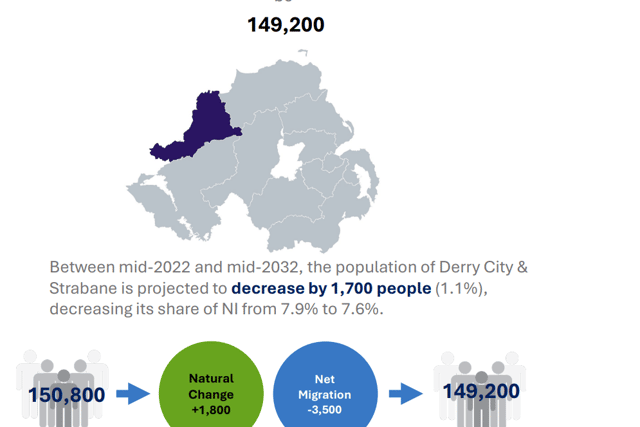

"The populations of Causeway Coast and Glens, Derry City and Strabane, and Mid and East Antrim are projected to decline by 3.2 per cent (4,500 people), 1.1 per cent (1,700 people) and 0.6 per cent (800 people) respectively," a newly-published paper estimates.
The population of Derry & Strabane was 150,800 in mid-2022 but is set to fall to 149,200 by mid-2032.
Derry & Strabane’s overall share of the population of the North will fall from 7.9 per cent in mid-2022 (150,800 of 1,910,500) to 7.6 per cent in mid-2023 (149,200 of 1,950,400).
NISRA forecasts there will be 15,700 births and 13,900 deaths in Derry and Strabane over the decade yielding a natural increase of 1,800.

But the analysis suggests 3,500 people will leave Derry and Strabane leading to an overall population decline of 1,700.
Derry/Strabane, the authors report, is one of just three areas projected to experience negative net migration over the decade alongside Causeway, Coast and Glens (-2,800) and Fermanagh and Omagh (-600).
If the projections are realised by mid-2032 Lisburn and Castlereagh (158,800) and Antrim and Newtownabbey (151,200) will surpass Derry/Strabane in population size.
The Belfast exurb of Lisburn and Castlereagh has the fastest growing population with the number of people their growing by 8,900 from 149,900 in mid-2022 to 158,800 in mid-2032.
Despite the projected natural change for Lisburn and Castlereagh (+ 1,400) being less than that forecast for Derry and Strabane (+1.800) net migration of 7,500 into the former area will see its population grow by 6 per cent.
The report confirms Derry and Strabane continues to get older.
Between mid-2022 and mid-2023 the percentage of children aged between 0 and 15 will fall by 14.9 per cent (-4,800 children) and the percentage of those aged between 16 and 64 will fall by 4.2 per cent (-3,900 adults).
By contrast the percentage of the population aged 65 and over will rise by 28.4 per cent (+7000 pensioners).
As a result more than one in five people will be aged 65 or over with the proportion of this age cohort rising from 16.4 per cent in mid-2022 to 21.3 per cent in mid-2032.
This will see the old age dependency ratio (OADR) in Derry and Strabane increasing from 242 in 2022 to 295 in 2032.
This is defined as the ‘proportion of people of State Pension age relative to the working age population, expressed as the proportion of dependants per 1,000 working age population’.
There will be 295 people reliant on the State Pension for every 1,000 people of working age in Derry and Strabane by 2032.
The median age locally will increase from 39.6 years in mid-2022 to 43.2 years in mid-2032.