
Eoghan ‘Gino’ Mac Cormaic sheds light on Derry’s contribution of republican prison literature from the Fenians to Good Friday
Eoghan ‘Gino’ Mac Cormaic’s new history of the underground prison press provides an overview of republican jail communications from the days of the Fenians up to the Good Friday Agreement.
‘Captive Columns: An Underground Prison Press 1865-2000’ is the Derry man’s sixth publication and looks at the jail literature produced in over sixty titles over the period surveyed.
The Galway-based republican served 15 years in jail and was on the blanket protest at a time when 10 of his comrades died on hunger strike.
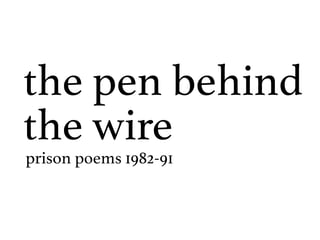
He began writing poems on toilet and cigarette paper, with some of the works smuggled out of jail and published in ‘Republican News’ before they appeared in his 2023 collection ‘the pen behind the wire’.
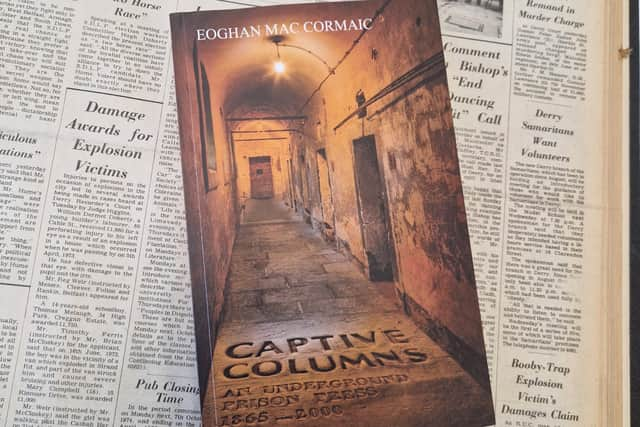

His compelling new study surveys the entire history of republican jail literature from 1865 to 2000.
It cannot but reference, of course, the Tyrone Fenian and later Easter Rising leader, Tom Clarke’s seminal, ‘Glimpses of an Irish Prison Felon’s Life’, which published posthumously in 1922, provides key insights into his experience as a republican prisoner and his efforts to maintain lines of communication in English jails in the late 19th century.
Mr. Mac Cormaic relates how Clarke first published and circulated ‘The Irish Felon’ in Chatham prison.
"Not a trace remains of ‘The Irish Felon’ today, except in the pages of Tom Clarke’s memoir ‘Glimpses of an Irish Prison Felon’s Life’…‘The Irish Felon’ was a digest without news but...served a greater purpose than any newspaper. [It] raised morale, and validated the publishers, and the readers as people apart,” writes Mr. Mac Cormaic.
Fast forward to the period after the Easter Rising and the Irish revolution and the book examines a series of jail publications produced in the Derry and Belfast jails between 1924 and 1970.
A chapter entitled ‘Legion of the Rearguard’ sheds light on a series of newspapers circulated in the prisons.
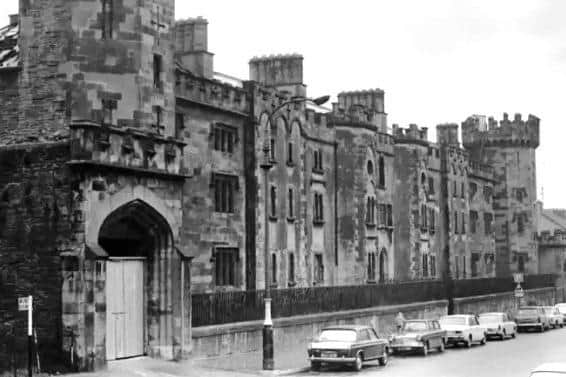
‘Faoi Ghlas’ (Locked Up) was started in 1939 and reported during a period when nearly 200 prisoners were transferred from Derry jail to the Al Rawdah prison ship in Strangford Lough.

"Around 170 prisoners had been bussed from Derry Jail in September 1941 to the boat, moored off Killyleagh, where they were joined by 30 or 40 more from Crumlin Road. Living conditions, food and medical care were all grim and one prisoner, Jack Gaffney (who had been OC in Derry jail before the move) died of medical neglect when he fell from a bunk.
"Another ten prisoners would die in the months and years later. Seán Dolan, from Derry, died in October 1942, just eight months after his spell on the Al Rawdah,” writes Mr. Mac Cormaic.
After ‘Faoi Ghlas’ came ‘An Drithleog’ (The Spark), the newsletter of a sub-committee of the same name established by the Cumann Gaelach in Derry jail.

The new paper faced a quandary when it lost its editor in unusual circumstances in 1943.
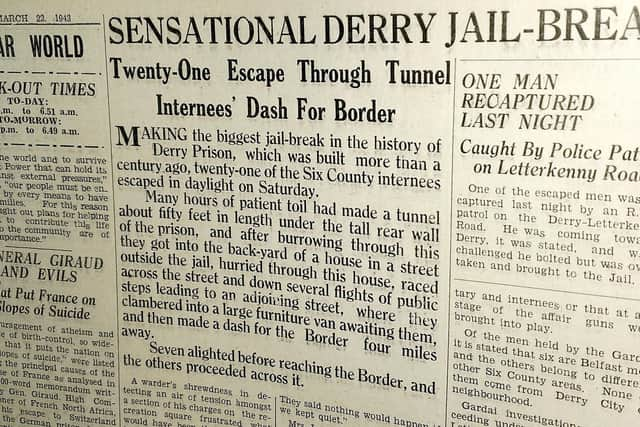
“On March 20, 1943, the editor Breandán Ó Baoighill, was one of twenty-one prisoners who dramatically escaped from Derry jail. The prisoners had tunnelled from a ground floor cell, going down eighteen feet below the eighteenth century jail walls, digging through an old graveyard and passing under a coffin to emerge in a coal shed in Harding Street,” the book relates.
Pádraig Ó Gallchobair agreed to take over but ‘An Drithleog’ was soon replaced by the short-lived ‘An Freamh’ (The Root).
‘[Ó Gallchobair] asked the committee of Cumann Gaelach to take on the responsibility for the paper. The committee agreed, but changed the name of the paper yet again, to ‘An Chuis’ (The Cause). To attract articles a writing competition was announced with a prize of twenty cigarettes,” explains Mr. MacCormaic.
The last number of the Derry prison paper appeared in August 1944 after which ‘internees were once more manacled together and driven in buses back to Belfast, guarded by greater numbers of B-Specials than there were of prisoners on each bus’.
A later chapter ‘Last Editions 1970-2000’ covers some of the republican papers that appeared in the 1970s including ‘An Giall’ (The Hostage) and ‘The Free Derry News’.
The former was produced in 1975 in the cages at Magilligan.
"‘An Giall’ had the conventional mix of light-hearted camp banter, some Irish language content, and some serious articles too, but it was a properly printed paper with the content smuggled out and the finished paper smuggled back into the jail on a monthly basis.
"The paper was usually edited by whichever POW had been elected as the public relations officer of the prisoners. Derry’s Séamus Keenan had succeeded Seosamh Ó Donnaile as editor and in time he would followed after his release by Laurence Arbuckle,” the book explains.
‘The Free Derry News’, though printed and circulated on the outside, followed the situation within Magilligan closely.
"In 1975 a republican newssheet in Derry, ‘The Free Derry News’ began allocation a page or two each week to prisoner news, mainly from Magilligan, including extracts from ‘An Giall’.
"In August the Derry newssheet printed, in full, the the lead article from ‘An Giall’ which looked at whether the IRA ceasefire/truce currently in place would hold, after leading republican Daithí Ó Conaill was arrested by the Gardaí,” Mr. Mac Cormaic writes.
The paper, Mr. MacCormaic informs us, carried regular coverage of the Derry republican Billy Page’s campaign for political status.
In the mid-1970s Mr. Page, was one of a small group of prisoners sentenced to ‘Detention at the Secretary of State’s Pleasure’, the book relates.
‘An Giall’ circulated outside Magilligan in Derry and Donegal but was another paper with a short existence.
"In 1977 the prison paper was absorbed into the weekly ‘Republican News’ – a page being reserved for prison updates – and ‘An Giall’ ceased to exist as a separate entity. It would have ceased anyway because in January 1978 Magillian’s political prisoners were all transferred to Long Kesh,” Mr. Mac Cormaic advises.
‘Captive Columns’, published by Greenisland Press, is available online and from selected bookshops.