
Father of young woman who spent two nights on A&E chair in acute pain says it is ‘soul-destroying’
The father of a young woman who spent two nights in acute pain on a chair in Altnagelvin A&E has called on health chiefs and politicians to urgently address the bed-blocking crisis locally.
Sean Moore, from Eglinton, described his daughter’s experience earlier this week as ‘soul-destroying’ and ‘wrong’.
The young woman, who is in her early 30s, arrived at the local Emergency Department (ED) at around 4pm on Monday, due to the severe pain she was experiencing when a pre-existing condition flared up.
Mr. Moore contacted the ‘Journal’ over 40 hours later when his daughter was still on a chair in the department.


"She is still sitting on a chair in A&E,” he said on Wednesday morning. “It is just frustrating. Sitting on a chair for that long. It is soul-destroying. It's wrong.”
It is the second time Mr. Moore’s daughter has experienced such a long wait in the space of a year having once been in the A&E for around 30 hours. She had been on a waiting list for an operation, said Mr. Moore.
Later on Wednesday she was admitted to the hospital and operated on.
But Mr. Moore told the ‘Journal’ he believes more needs to be done to free-up beds in the general hospital in order to prevent very sick patients, those in acute pain, and the elderly and vulnerable having to wait days in A&E.
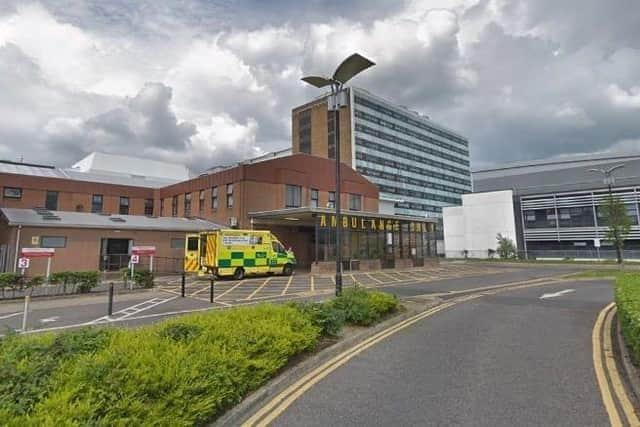
He said it is his view that a lack of provision within social care for patients requiring domiciliary care packages or nursing home places is creating a bed crisis within the acute hospital system.
"We want to highlight the issue with social care. I know the situation. I know there are people in hospital who want out and they can't get out because they are older people and they have nowhere to go.
"It is a political problem and I understand that but it doesn't help my daughter and other people, 40 odd hours sitting in chair.
“I blame the chiefs in the hospital and the politicians for not sorting this out before. The issue of bed-blocking has been going on how many years now? How much money have they spent over those years? Millions and millions,” said the frustrated father.
A spokesperson for the Western Trust said: “We are acutely aware of the long waits being experienced by our patients in both of our Emergency Departments and we sincerely apologise for this. This is not the service we wish to provide our patients.”
The health authority has been experiencing particular pressure this week, it said.
“Our EDs continue to see high numbers of attendees and an increase in acuity of patients. Eighty per cent of those attending ED will be discharged from ED, but 1 in 5 will require admission to hospital for further investigations or treatment.
"On any given day, there may be up to 60/70 patients or more awaiting admission across our two acute hospital sites at SWAH and Altnagelvin, however at present, this number has significantly increased, which impacts on the ability of staff to assess the high number of patients attending ED each day,” the spokesperson said.
The Trust acknowledged the issue of bed pressures at Altnagelvin.
“With the number of patients requiring admission to a bed this also leads to ongoing challenges around bed pressures, with every available escalated bed being used on both sites at present,” it stated.
Mr. Moore called for the Department of Health to work with the Trust and other statutory authorities to examine the possibility of establishing step-down facilities for patients well-enough to leave the general hospital but not yet in a position to return home or to a nursing home place.
"How many years have we heard there are unprecedented pressures?” he asked. “Why can't they open a nursing home or a halfway house? A lot of patients don't need 24 hour care. They need someone there to give them their medicine and so on.
“To me it is not rocket science. Buy a building and have it there as a halfway house between the hospital and the home.
"People are in the ED and they can't get a bed because someone is perfectly well enough to leave the hospital but they can't leave the hospital because the home is not fit or they don't have anyone to look after them.
"The problem is the beds. If beds were free my daughter would at least have got two nights sleep.”
The Western Trust stated: “We want to reassure the public that we are doing the best that we can to care for our patients at this very challenging time and wish to thank our staff for the excellent care they provide to our patients under difficult circumstances.”
The local authority regularly appeals for the public’s assistance to facilitate the early discharge of patients in order to free up beds.
Last month it warned too many people remained at Altnagelvin and the South West Acute Hospital who no longer needed to be there.
The most recent ED waiting times that were published last week show the average wait to be admitted to the hospital or discharged home from arrival at the Altnagelvin A&E in December was 15 hours 37 minutes, a 1 hour 36 minute reduction on the same month in 2024 (17 hours 13 minutes).
Over a thousand of the patients attending (1,032) waited for 12 hours or more.
In total 1,402 patients spent under four hours in the Derry A&E and 2,322 were there for between four and 12 hours.
The Department of Health had not responded as the ‘Journal’ went to Press.