
Givan says closures and amalgamations on table as school enrolments decline and deficits rise
A major policy document proposing a five-year-plan for school closures and amalgamations among other interventions to address a 'system at breaking point' has been put out for consultation until April.
Education Minister Paul Givan said: “The system is under severe and sustained strain. Years of chronic underfunding and limited structural reform in service delivery have combined to create a financial crisis in education.”
Mr. Givan said the Department of Education’s 2025-2026 budget is £3.36 billion, ‘more than £250 million short of what is needed’.
Based on projected budget allocations, he said, the gap between funding available and spending forecasts ‘widens dramatically to over £0.8 billion by 2026-27 and over £1.15 billion by 2028-29’.
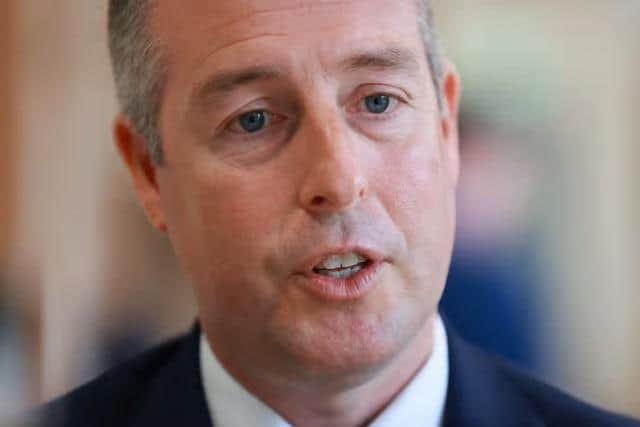

He made the remarks as he published a five-year budget strategy for public consultation.
The Education Minister said the document draws on the Independent Review of Education and identifies ‘a number key areas where reforms could reduce costs over the next five years’.
The reforms include restructuring the schools estate, including reducing the number of schools; reforming home-to-school transport; modernising school meals delivery; reshaping the SEN support model in mainstream schools; and introducing a new model of financial management for schools.
On the table are school closures and amalgamations.
The consultation documents notes that in 2024-25 nearly 300 schools had enrolments that fell below the recommended minimum numbers.
These included 215 primary schools (28 per cent); 41 post-primary schools in years 8-12 (21.6 per cent) – less than 500 pupils (pro-rata); and 35 sixth forms (22.2 per cent) - less than 100 pupils.
School enrolment numbers, the document states, are expected to fall even further over the next decade or so.
“By the 2033-34 academic year, overall enrolment is expected to fall by 12.7 per cent. This decline will not affect all sectors equally: pre-school education - projected to fall by 18.8 per cent; primary and preparatory schools (Years 1–7) - projected to fall by 20.4 per cent; and post-primary schools - projected to fall by 9.5 per cent,” it states.
It suggests this would result in 306 primary schools (39.8 per cent); 56 post-primary schools (29.5 per cent); and 40 sixth forms (40 25.3 per cent) falling below the minimum enrolment by 2033-34.
The policy document proposes the establishment of an Area Planning Commission to oversee an audit of all schools and the subsequent development of a five-year plan for closures and amalgamations and a timetable for this to be implemented.
"This trend highlights the urgent need to plan for a smaller, more sustainable school estate. Without action, increasing numbers of schools will struggle to meet minimum enrolment thresholds, placing pressure on resources and limiting opportunities for pupils,” it argues.
The public are also being asked to consider a new model of financial management for schools with a growing number of schools in deficit.
"Schools have been under significant pressure for a number of years and school deficits have grown sharply over the past decade. In 2011–12, 21 per cent of schools were in deficit, amounting to a total value of £13.9million.
"By 2024–25, 60 per cent of schools were in deficit, with a combined shortfall of £179million. Projections suggest that 70 per cent of schools will be in deficit by the end of 2025–26,” the document adds.
Drastic actions is required, according to the authors of the paper.
"The scale and magnitude of the problem is stark and a complete overhaul of financial oversight arrangements for schools is now urgently required. Northern Ireland’s school deficits are the highest across the British Isles, both in the proportion of schools affected and in the size of deficits as a share of total education funding,” they state.
Among solutions suggested are a traffic-light system to allow for the Education Authority to intervene.
A centralised staffing model such as that used in the 26 counties is another proposal.
Other measures proposed include the introduction of charges for Home to School Transport for some pupils with exemptions for vulnerable groups; increasing income from school meals and consolidating the number of smaller kitchens in schools; and a move away from one-to-one Special Educational Needs (SEN) classroom supports with schools being provided with a SEN budget to introduce alternatives such as ‘small group-based provision alongside specialist therapeutic input from a range of professionals’.
Launching the consultation Mr. Givan said: “I will continue to make the strongest possible case for sustained and increased investment in our education system, but the numbers tell a stark story.
"In the absence of significantly increased funding, financial sustainability will require significant structural reform of the education system. Our starting point is clear: the classroom must come first.
"My Department’s reform proposals have, therefore, been guided by the clear principle of protecting teaching and learning while we put education on a sustainable financial footing. Delivering this protection requires difficult choices.
“To be clear, we cannot close a billion‑pound gap, or even meaningfully reduce it through making marginal efficiencies. Nor can we contemplate large‑scale redundancies. Northern Ireland’s education system is now at a critical turning point. The proposed reform programme offers a credible and necessary roadmap to stabilise budgets, protect learning and build a sustainable, high‑quality system for the long term.”
He argued the decisions required to deliver structural reform will not be easy and will require political consensus.
"This reform programme is not about temporary fixes. It is about reshaping the system so it is stronger, more resilient and better equipped to deliver excellent outcomes for every child, now and for generations to come,” he declared.
The Public Consultation and the Five‑Year Education Budget Strategy can be accessed on the on the DE website at: https://www.education-ni.gov.uk/consultations/consultation-five-year-education-budget-strategy. The consultation ends on April 3.