
Human eyes to gaze upon Maunder Crater as NASA flies around the moon
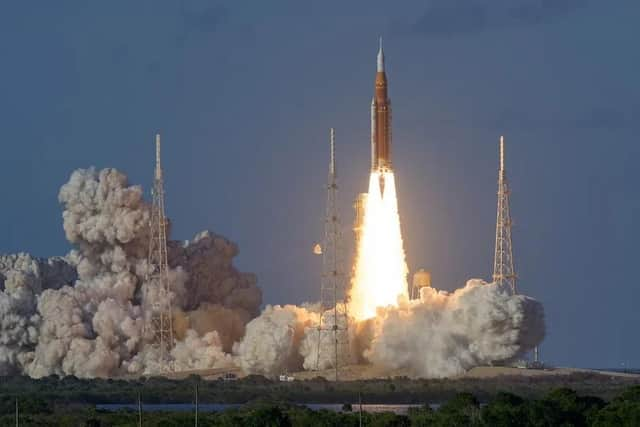
Human eyes are set to gaze upon the Maunder Crater for the first time in half a century after NASA’s Artemis II successfully blasted off from the Kennedy Space Centre in Florida.
High quality modern space photography of the massive depression on the far side of the moon is likely be captured when the four astronauts aboard NASA’s Orion spacecraft complete their multi-hour lunar flyby on Easter Monday, April 6.
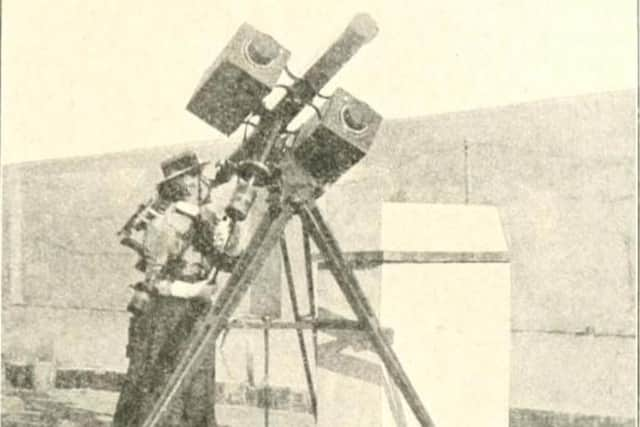
The Maunder Crater is named after the pioneering Strabane astronomer Annie Scott Dill Maunder (née Russell), who was born in the Co. Tyrone town in 1868.
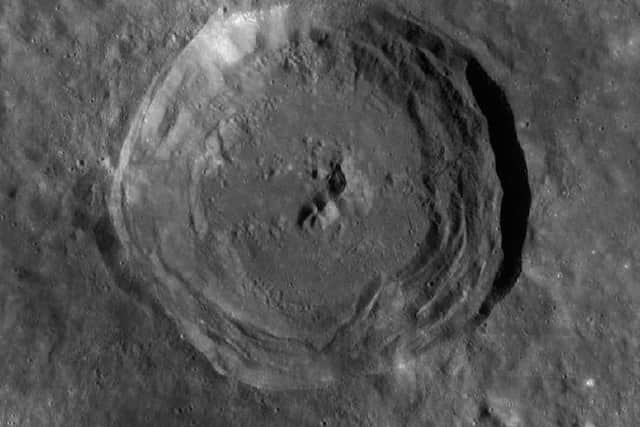
Four kilometres deep and 54 kilometres wide, the enormous cauldron is located on a region of the far side of the moon that is only ever partially visible.

Derry astrophysicist Dr. Matt Nicholl said scientists have been looking forward to the Artemis II mission eagerly.
Dr. Nicholl specialises in much larger phenomena of the heavens – supernovae and super-massive black holes, for example – that are much farther away but he will be watching the lunar mission keenly.
"We’re all very excited about Artemis,” the QUB based astrophysicist told the ‘Journal’. “Most astronomers now aren’t old enough to remember the first age of space exploration, so this is the first time we’ve been around to witness such an ambitious mission.”
He added: “It would be great if they get some nice pictures of the Maunder Crater. Annie Maunder is a very important figure in the history of astronomy, both for her discoveries in solar physics and for being one of the first women elected to the Royal Astronomical Society, in 1916.”
The Maunder Crater was created when an object struck the moon during the Eratosthenian age, 3.2 billion to 1.1bn years ago.
It forms part of the Montes Rook mountain range that encircles the Mare Orientale lunar sea.
NASA confirmed the Artemis II mission successfully launched at around 6.35 pm United States Eastern Time on Wednesday.
The successful launch is the beginning of an approximately 10-day mission for NASA astronauts Reid Wiseman, Victor Glover, Christina Koch, and CSA (Canadian Space Agency) astronaut Jeremy Hansen.

As the first crewed mission of NASA’s Artemis program, among its objectives, the flight will demonstrate life support systems for the first time with crew and lay the foundation for an enduring presence on the Moon ahead of future missions to Mars.
New photographs of the Maunder Crater are likely to be taken on Monday.
NASA confirmed that during a planned multi-hour lunar flyby, the astronauts will take photographs and provide observations of the Moon’s surface as the first people to lay eyes on some areas of the far side.
Although the lunar far side will only be partially illuminated, the conditions should create shadows that stretch across the surface, enhancing relief and revealing depth, ridges, slopes and crater rims that are often difficult to detect under full illumination.
Crew observations and other human health scientific investigations, will inform science during future Moon missions, said NASA.
Following a successful flyby, the astronauts will return to Earth and splash down in the Pacific.
On Wednesday NASA Associate Administrator Amit Kshatriya said: “Over the next 10 days, Reid, Victor, Christina, and Jeremy will put Orion through its paces so the crews who follow them can go to the Moon’s surface with confidence.”