
‘Just keep your head up’: Young Greencastle man shares Chronic Myeloid Leukaemia journey to raise awareness and offer hope
A young Greencastle man, who thought he had a stubborn flu, but was later diagnosed with Chronic Myeloid Leukaemia (CML), has shared his story to raise awareness, offer hope, and encourage others to take symptoms seriously.
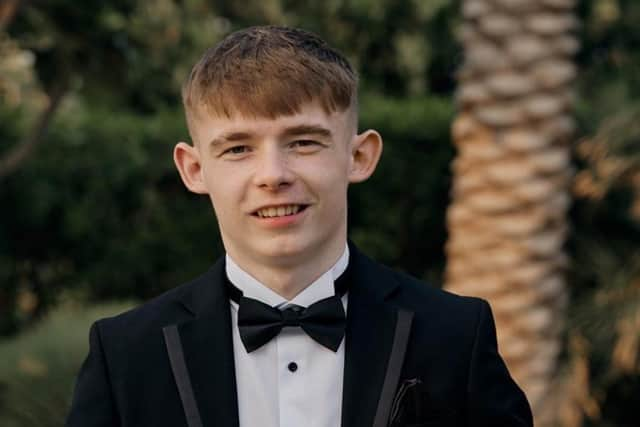
Joel Messenger has shared his experience, this Blood Cancer Awareness Month, with the Irish Cancer Society and on Instagram, where his posts have reached hundreds of thousands and sparked conversations around resilience, health, and support.
Speaking to the Irish Cancer Society, Joel outlined how, in Winter of 2024, he thought he has a stubborn flu.
“I wasn’t sick but I had a severe lack in energy. Being 19 and having no energy sent alarm bells off in my head, so I went to my GP who put it down to flu.”

Over the next two weeks, he returned for repeat sick notes while something else began to worry him. A visit to the dentist ruled out gum disease even though his gums were bleeding.
“I found it strange when I discovered I didn’t have gum disease and my gums were bleeding a lot for no apparent reason,” he says.
At his third GP visit, Joel had a blood test at 11am on November 7. That evening everything changed.
“The day went by and then at 8pm, I got a call from my GP telling me to go to Letterkenny University Hospital immediately,” he says. He arrived around 11pm.

“They initially thought I had an infection as my white blood cell count (WBC) [was] over 100,000. They didn’t look for cancer for the first day because only 0.0074% of teenagers and kids are diagnosed with a blood cancer.”
After more tests, and a bone marrow biopsy, Joel was diagnosed with Chronic Myeloid Leukaemia (CML), a type of blood cancer that starts in the bone marrow, where the body makes too many white blood cells that don’t work properly.
Hearing the word 'cancer' at the age of 19 was surreal for Joel.
“I remember the specialist telling me and initially I thought it was some kind of bad joke, because in my head I was only 19; I’m still ‘invincible’ and nothing can hurt me,” he recalls.
“I couldn't hear a word that was coming out of the consultant’s mouth. Once the shock wore off which took about 24 hours, a lot of emotion came with it and I think I went through every stage of grief within five minutes.”
CML is a chronic condition, and Joel’s treatment plan reflects that.
“Because my cancer is chronic my treatment will last my lifetime unless I qualify for treatment free remission (TFR) in around two years, but all I have to do is take five tablets a day. They were a struggle at the start but now they became a part of my routine and I don’t bat an eye on it,” he explains.
“I take imatanib 400mg once daily, which is a form of TKI [tyrosine kinase inhibitor, a targeted therapy drug]. Although I am in remission, I still need to take them to prevent the cancer coming back. I consider myself lucky.”
Looking back, he’s clear that support can make a real difference, particularly when the emotional impact bites.
“The biggest challenge is the isolation, not literally but I always felt different after my diagnosis, like nobody ever truly understood me despite their best efforts,” he says.
At the same time, he believes the experience changed him for the better.
“I think just the journey itself, it is the most life changing thing that has ever happened to me. My opinions, my mannerisms, my attitude and my general perspective all changed drastically. It matured me so much and to be honest I am thankful for it, the journey made me a better person to myself and everyone around me.”
Support from the people closest to him became essential.
“My best advice is to surround yourself with people you love, whether that’s one person or a hundred. I’m blessed to have a lot of close family and friends. I spent every day in contact with 10-20 of my closest, whether it is hospital visits or phone calls, it made all the difference,” he says.
“It was the best thing I could have done because, when I was at my most anxious, I knew that my friends were only a call away and they could distract me or just let me vent about the situation. They helped me handle the trauma of the diagnosis so well. If anything is to be taken from this, it’s do not go through this alone. Talk, whether it’s to your family, friends or a trained professional.”
Mindset mattered, too. “As clichéd as it sounds, just keep your head up. I’m a firm believer that your mental state reflects your health,” Joel says
After spending 14 days in hospital at the start, Joel searched online for someone his age to relate to.
“There are only 7.4 cases in every 100,000 people under 20, so it is really isolating and can put you in a really dark place if you don't have the mental tools to persevere, so I spent a lot of my 14 days in hospital trying to find somebody on social media that I could relate to but I couldn’t find anybody my age.”
That gap pushed him to become the voice he couldn’t find.
“Since being in remission I have begun doing all I can via social media to be the person I never had in hospital, I am using my Instagram as a platform for primarily young people going through cancer to feel seen, like they have someone to relate to and somebody to reassure them that it will be okay,” he says.
“I take a lot of time out of my day to reply to 50+ young adults a day, who come to me with questions and even just for a conversation, so from being this person and knowing how many people I help daily, I have learnt to be thankful for my cancer diagnosis, and I hope one day everyone reading this will be able to become thankful too.
You can follow Joel on Instagram on @jgmessenger and visit the Irish Cancer Society online at www.cancer.ie