
Liam Devlin, the Derry man born in ‘Peadar O’Donnell’s’, whose Dublin pub was IRA HQ during the War of Independence
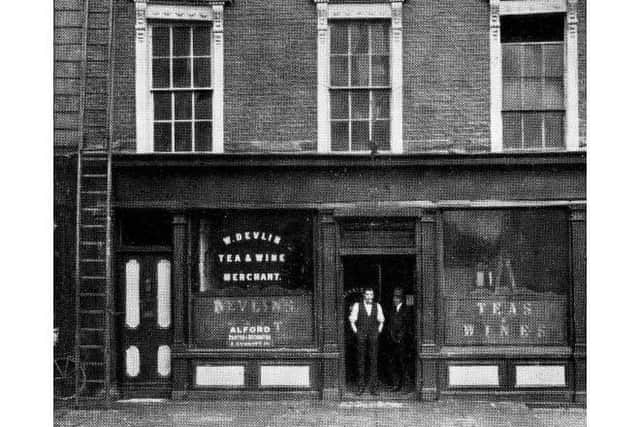
When Kevin Barry ‘gave his young life for the cause of liberty’ on November 1, 1920, Michael Collins awaited news in Devlin’s pub.
The ‘Big Fellow’ was in the bar at the corner of Parnell Street and Moore Lane too on November 21, 1920, the day his ‘Squad’ killed over a dozen members of British intelligence’s notorious ‘Cairo gang.’
Later that day Collins learned of the Bloody Sunday massacre when 14 civilians were shot dead by British forces in Croke Park, also in Devlin’s.
The eponymous proprietor of the bar, one Liam Devlin, was born in 1877, at 59 Waterloo Street in Derry city centre.

According to his grandson John Healy, in an account of his life published in the Dublin Historical Record, Vol. 72, No. 2 (Autumn/Winter 2019), five years ago, ‘Liam was born to Denis and Ellen Devlin (née McLaughlin) in 59 Waterloo St, Derry on 18 June 1877 and christened as William Devlin in St. Eugene’s parish that year’.
Liam’s father Denis had worked variously as a car driver, labourer, clothier and potato dealer in Derry and the family had lived at Waterloo Street from the 1870s through to the 1890s.
After working for a time as a post office clerk in Derry himself, Liam moved to Greenock west of Glasgow around 1900.
In Scotland he met Moville-native Margaret MacDermott and the couple were wed in St. Mary’s Church, Greenock on his 30th birthday on June 18, 1907, Healy tells us.
Liam became a vintner and was at one stage the proprietor of the Crown Hotel in Irvine in Ayrshire.
He was also heavily involved in the nascent Sinn Féin movement and with the Irish Republican Brotherhood (IRB) in Scotland.
"Devlin had been active in the local business, social and church affairs of Greenock and, while in Scotland, was also involved in Sinn Féin and the Irish Volunteers, being listed in the 5th Battalion, Greenock and Port Glasgow,” writes Healy, this time in an account in the Dictionary of Irish Biography.

This is not surprising. Michael Sheerin, O/C of No. 1 Section of the IRA on Derry's west bank during the Tan War, providing evidence to the Bureau of Military History in the 1950s, said that during this period ‘we regarded the Glasgow Battalion as our neighbours’ and that ‘most of the Derry unit had occasion to visit the Clyde especially during the late years of the war and up to 1920 when the Admiralty was changing the Destroyers from coal burning propulsion to diesel’.
Sheerin recounted that the Glasgow Battalion had sub-units at ‘Campbelltown, Greenock, Port Glasgow and other small towns of the Clyde’.
In mid-1919, Devlin relocated from Glasgow with his family of seven children to a public house that he bought at 68 Parnell Street, Dublin.
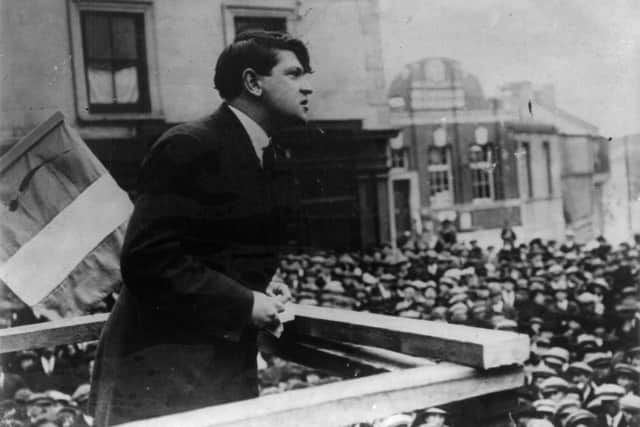
Within a few weeks he had offered the use of the upstairs rooms to Michael Collins, President of the IRB.

Healy takes up the story in his DHR article: "Very soon after moving in, Devlin met with Michael Collins. Devlin, who had been active in Sinn Féin in Scotland and was put in touch with Collins through the IRB now offered a means of protection to Collins through the use of his pub as an office and meeting place.
"As a colleague of his recorded: ‘Liam [William] offered the full use of his establishment to the IRA. This offer Mick readily accepted and at the end of a short period it became Mick’s unofficial headquarters’.
"Piaras Béaslaí [IRA member, writer, politician] also recalls in his memoirs that: ‘Mr. Liam Devlin placed a room upstairs in his premises, 68 Parnell Street, at the disposal of Collins and his associates, for meetings and appointments’.
"On a personal level the Devlins became very close to Collins as referred to warmly by Frank O’Connor [IRA member, writer, academic and literary critic] in ‘The Big Fellow’.
"Similarly Frank Thornton [IRA member] further noted: ‘We used Devlin’s extensively and every night Mick, Gearóid O'Sullivan, Liam Tobin, Dermot O’Hegarty, Piaras Béaslaí, Frank Thornton, Tom Cullen and Joe O’Reilly met there; the events of the day were discussed and plans were made for the following day.’”
Healy recalls how the Devlins used to bamboozle raiding parties during the War of Independence using an ingenious method.
“My mother liked to mention that she remembered, as a three year old, being rushed hurriedly in the middle of the night out of her own bed and into the bed that Collins had just left as he ran to evade a late night raid on Devlin’s Pub on Parnell Street, as a way of explaining the body heat of the mattress should the soldiers or police get that far,” he relates.
The pub and the Devlin family witnessed many of the key moments in the War of Independence including the hanging of Kevin Barry and Bloody Sunday.
According to Healy: “In February 1921, having been almost fatally tortured in Arbour Hill prison, it was to Devlin’s pub that Eamon ‘Ned’ Broy (Collins’s most important agent within Dublin Castle) went, straight after his release, to report to Collins.”
Such was its importance as a meeting venue for GHQ Intelligence and for the IRB from 1919 to 1921, it was memorialised by a Dublin City Council commemorative plaque earlier this year.
As many as eight to ten Volunteers and Officers were accommodated there every night during this period. Devlin was himself an IRA Intelligence Officer and was entrusted with the safe keeping of National Loan Funds.
One IRA Volunteer, Michael Leahy, Vice O/C Cork No. 1 Brigade, recalled receiving orders from Seán O'Hegarty, his Brigadier, to proceed to Dublin and report to Michael Collins. He was to pick up a passport in order to travel to Italy to purchase guns for the IRA.
On January 2, 1921, he met Gearóid O'Sullivan, the Adjutant General, at his office on the North Quays.
They proceeded on a ‘very lengthy journey’ but finished only at Devlin's, a trip that would normally have taken around five minutes on foot.
“I asked Gearóid why the considerable detour had been made and he said one couldn't be too careful in these times in Dublin on account of the likelihood of being followed by enemy touts,” Leahy told the Bureau of Military History in the 1950s.
“Nevertheless, I had the suspicion that it was all done to impress me, the boy from the country. Actually, when we entered Liam Devlin's pub, I was surprised to find nearly all the GHQ staff assembled and a merry party in progress, this, despite Gearóid’s intimation that Dublin was dangerous place for the likes of him.
“My choice of lemonade when whiskey was being pressed on me did not go down too well with Michael Collins who seemed to be master of the revels.
"The party was a prelude to the wedding next day of Tom Cullen, then, I think, Quartermaster General. Dick Mulcahy was in Devlins but was quiet in comparison with a number of the others, and was not drinking and left early,” Leahy recalled.
The pub later was the location of ‘The Mutiny’, which threatened the very survival of the Free State, led by Liam Tobin, in March 1924.
Healy confirms: “In 1924, it was in Devlin’s pub that officers and soldiers of the new Free State army, led by Liam Tobin, met on the night of March 18, 1924 to launch a coup d’état against the Free State executive in the biggest crisis of the emerging state, referred to as ‘The Mutiny’.
"Dan Breen confirmed this in his witness statement to the Bureau of Military History.”
After his career as a revolutionary Devlin went on to develop a confection beloved by generations of Dubliners in his Blue Badge Toffee (BB Toffee).
The product was made in his toffee factory at 81 to 85 Gloucester Street Lower in the north inner city’s famous ‘Monto’ neighbourhood – now Seán McDermott Street Lower..
Earlier this year, unveiling a plaque at what once was the site of Devlin’s pub, the former Lord Mayor of Dublin Daithí de Róiste said: “Liam Devlin made a significant contribution to the independence movement in Ireland at great personal risk to himself and his family.
"He continued his involvement in nation building through an enormous contribution to the industrial development and the creation of significant employment in the new Ireland.”
The decision to erect the plaque was made by the Dublin City Council Commemorations & Naming Committee. Councillor Vincent Jackson commented: “The Commemorative Plaques Scheme allows the City to formally commemorate people who have made a significant contribution to the life of Dublin. We welcome suggestions from the public for people and events to be commemorated and full details are on the Council website.”
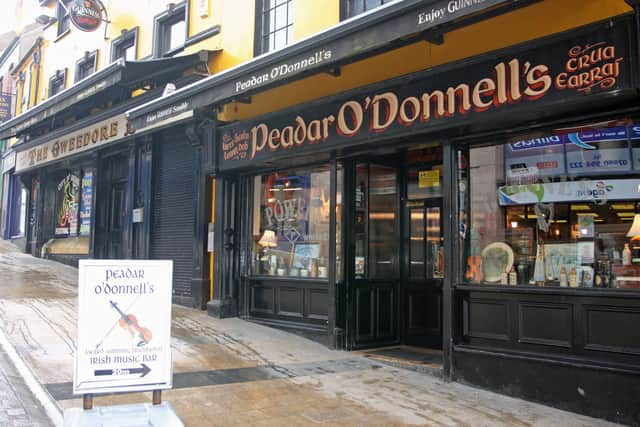
Rather fittingly the address where Devlin was born at 59 Waterloo Street is now home to one of the city’s most famous hostelries and one that by happy coincidence happens to be named after a fellow revolutionary of the 1910s and 1920s, none other than Peadar O’Donnell’s.
Liam Devlin died aged aged 87 in 1964 and is buried at Deansgrange in Dublin. September 30 will mark the sixtieth anniversary of his death.