
Metro North-West rail proposals launched for Derry, Donegal and Tyrone
Rail campaigners Into The West have launched an ambitious new proposal to radically improve rail across the North West with a series of public meetings planned from next week.
Branded as ‘Metro North-West’, the idea takes the existing rail network that runs between Derry, Coleraine and Portrush and expands it “in ways that are already progressing following the All-Island Rail Strategy” with routes re-opened to Letterkenny, Strabane, Omagh and Limavady.
The proposals then enhances this further by adding a number of new stations – many of which are already under consideration including Strathfoyle, Ballykelly and City of Derry Airport.
Into The West have said that this would create a new regional rail ‘brand’ operating within and alongside the wider rail network, stretching from Letterkenny in the west to Coleraine/ Portrush in the east and Omagh in the south, with all services converging in and travelling via Derry city.
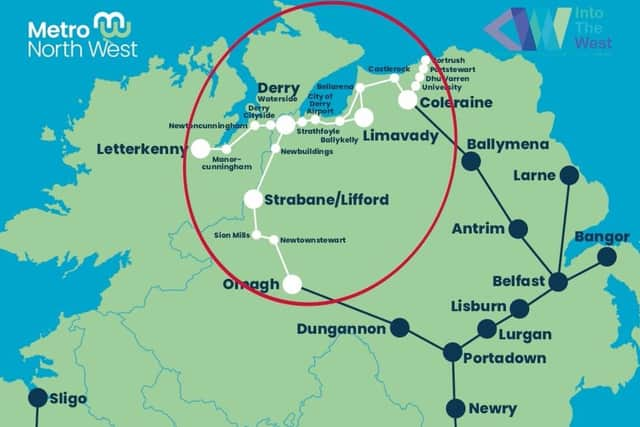

This newly proposed regional sub-network has been christened ‘Metro North-West’ by the lobby group.
Into The West envisage a greatly enhanced passenger experience for rail users, including services every 30 minutes, seven days a week, from 7am to at least 11pm.
They also propose a ‘Pay As you Go’ system with Tap in, Tap out payment, ticketing and timetables that are integrated with local bus networks, improved on-board cycle space on fully electrified routes/ trains (for quicker, cleaner & quieter journeys).
The idea takes its inspiration from similar ‘Metro’ networks which have recently been introduced in England and Wales.
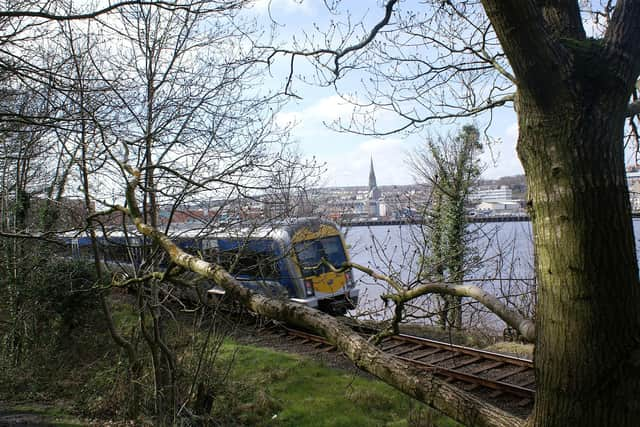
These networks take existing rail services, improve them in obvious ways, and then re-brand them into coherent new regional sub-networks – often without requiring major sums of money to get started. They continue to operate within and alongside their wider rail network, but also have their own distinct regionalised identity and branding.
The Welsh government introduced three such networks last year within the wider Transport for Wales network = North Wales Metro (connecting Wrexham, Bangor and Holyhead), South Wales Metro (linking Cardiff, Newport and the Welsh Valleys), and the West Wales Metro (connecting Swansea, Carmarthen and Milford Haven).
The largest population centre covered by the North Wales Metro is the Wrexham Borough Council area – which with 135,000 residents is smaller than the Derry-Strabane council district.
Meanwhile in England a ‘Mid-Cornwall Metro’ has also been established using the same principle - taking existing services, improving them in sensible ways, and branding and promoting them as a single regional network within the wider rail system. The largest town served by this new Mid-Cornwall Metro is Newquay, who’s population of 24,500 is almost identical to Letterkenny or Coleraine.
Into The West are promoting the Metro North-West concept as an essential solution to the challenges that Derry and other towns across the region are facing – such as poor connectivity, growing road congestion, economic underdevelopment and pressures caused by university expansion.
Chair of Into The West, Steve Bradley, said: “When people hear the word ‘Metro’, they probably think of expensive and complicated networks like the London Underground. But that’s not what the Metro North-West proposal is about. Instead it’s an exciting and relatively low-cost way to tackle a number of key challenges facing towns across this region. Firstly it seeks to address the extremely limited presence of rail here, and the very slow progress in changing that.
"The 2024 All-Island Rail Strategy agreed rail should return to Tyrone, Donegal and Limavady. And there is also now recognition that having only one station for the Derry area is insufficient – with a 21 mile gap when trains leave Waterside Station before they stop again. Translink and the Department for Infrastructure now recognise the wisdom of adding new stations in areas like Strathfoyle, Derry Airport and Ballykelly.
“The problem is that these projects in the north-west have been made their lowest priorities – with Derry-Portadown not scheduled to reopen until 2045 at the earliest. And Letterkenny won’t see rail again until even later than that. So the first key challenge is to not only tackle the poor rail provision across the north-west, but also the low priority that the authorities have placed on doing so. Secondly – towns in this region face significant challenges which Metro North-West would help address.
“For example - Derry has experienced a notable increase in road congestion in the last few years, which will only get worse as its economy and population increase, whilst Letterkenny has been suffering even worse traffic problems for many years. 40% of passengers using City of Derry Airport come from Donegal, yet none can currently travel there by public transport. And the three key towns across the north-west - Derry, Coleraine and Letterkenny - all have universities, two of which are expanding rapidly. So the limited ability of staff and students to access campuses by public transport is also a significant barrier and a generator of further road and parking chaos. Metro North-West would therefore give students and everyone else across the region an alternative way to travel for work, study, health, entertainment, tourism or sport. Finally – Metro North-West aims to completely change the conversation about transport across this island. At the moment the decision makers on both sides of the border think that infrastructure is primarily about getting people to and from Belfast and Dublin. That ignores the huge amount of travel that occurs daily WITHIN the North-West City Region, especially on a cross-border basis. We need to alter the mindset that everything must always be about Belfast or Dublin, and instead recognise that this region has significant localised and internal journeys which generate problems on our roads and for our economies because they can’t be fulfilled by pubic transport”.
Mr Bradley continued: “The Metro North-West concept aims to tackle these challenges by creating a new localised and meaningful ‘brand’ for rail across our region. The concept starts with the limited rail that already exists here, expands it in ways that have already been agreed in the All-Ireland Rail Strategy, and then enhances it further by adding additional stops – some of which are already under consideration, and some of which like Sion Mils and Portstewart are new proposals. The concept takes its inspiration from similar Metro networks in places like Wales and Cornwall, which cover regions with similar or smaller populations than our’s. If Cornwall can justify a branded Metro network when its largest town is only the size of Coleraine, then why couldn’t a similar system also work here? Because much of the Metro North-West concept is about branding, frequency and additional stations – with the rest of its proposals taking advantage of rail improvements that are already due to progress anyway - it doesn’t require huge sums of additional funding beyond what is already being planned. What it does do instead is create a reason to expedite those plans – and ensure that projects in the North-West receive a higher priority within the island’s transport plans. Because every individual improvement to rail here will no longer be able to be treated as an isolated project, but instead as another core piece of the much larger Metro North-West jigsaw”.
This Saturday marks the 61st anniversary of the closure of the old ‘Derry Road’ rail route from Derry to Portadown via Strabane, Omagh and Dungannon. It’s closure removed the North-West’s direct rail link with Dublin, Tyrone’s rail route to Belfast, and also marked the end of services in counties Donegal and Tyrone. Both the Metro North-West concept and the All-Island Rail Strategy propose restoring this route.
Into The West have created a short video to help explain and promote the Metro North-West concept, which can be viewed on their website at www.IntoTheWest.org/MetroNorthWest.
They are also holding a series of free to attend public meetings across the region to discuss Metro North-West, the All-Island Rail Strategy and the case for better rail in Derry, Tyrone and Donegal.
The dates and locations for these are as follows :
Derry – Monday February 16, 7pm (Holywell Trust, 10-14 Bishop Street, BT48 6PW).
Letterkenny - Wednesday February 18, 7pm (Station House Hotel, Lower Main Street, F92 ERV1)
Strabane - Monday February 23, 7pm (Strabane Library, 1 Railway Street, BT82 8EF).
Pmagh – Tuesday February 24, 7pm (Strule Arts Centre, Townhall Square, BT78 1BL).
Coleraine - Wednesday March 4, 7pm (Causeway Rural Urban Network, 1 Foundry Mews, BT52 1XH).
Limavady Thursday March 5, 7pm (Roe Valley Arts Centre, 24 Main Street, BT49 0FJ).