
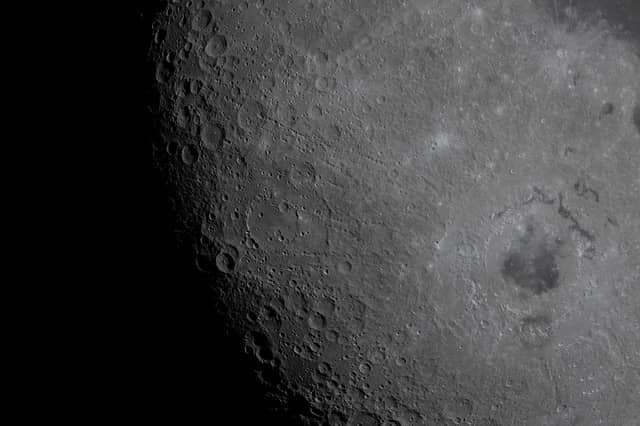

The stunning photographs were captured by NASA astronauts Reid Wiseman, Victor Glover, and Christina Koch, along with CSA (Canadian Space Agency) astronaut Jeremy Hansen during their flyby of the far side of the Moon in their Orion spacecraft on Monday.
NASA released the images as the crew prepared to commence their journey back to Earth on Tuesday.
Clearly visible is the Maunder Crater that is named after the Strabane astronomer Annie Scott Dill Maunder (née Russell), who was born in the Co. Tyrone town in 1868.
Four kilometres deep and 54 kilometres wide, the enormous cauldron is located on a region of the far side of the moon that is only ever partially visible. It is the largest crater within the Mare Orientale, or the Moon’s Eastern sea, one of the most identifiable features on the far side of the Moon.
Mare Orientale is easily distinguishable as a large circle with a black patch of ancient lava in the middle.
The Maunder Crater is on its northern fringe forming part of the Montes Rook mountain range that encircles the lunar sea.
The flyby on Monday is the first time human eyes have been laid on the crater in half a century.
When the fresh images were shared by NASA Orion's crew were 36,286 miles from the Moon and 236,022 miles from Strabane.
9. Artemis II
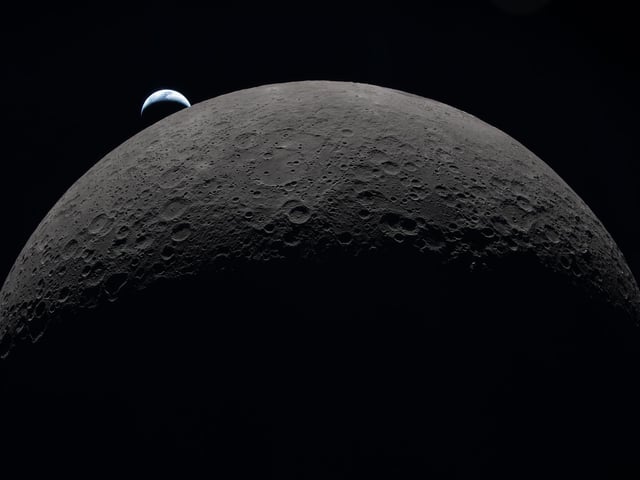
Earth sets at 6:41 p.m. EDT, April 6, 2026, over the Moon’s curved limb in this photo captured by the Artemis II crew during their journey around the far side of the Moon. Orientale basin is perched on the edge of the visible lunar surface. Photo: NASA
10. Artemis II
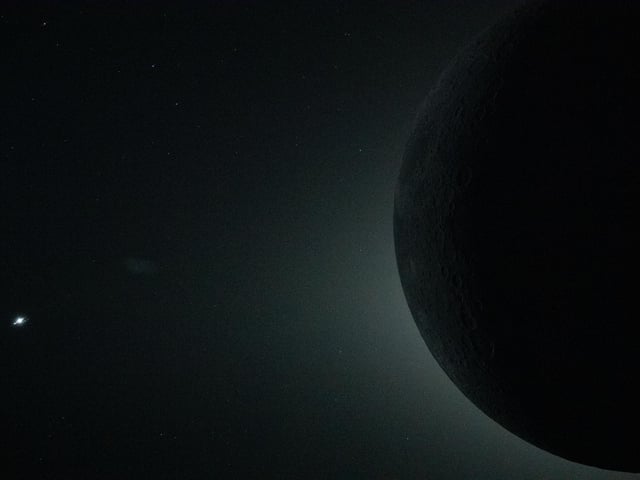
A close-up view from the Orion spacecraft during the Artemis II crew’s lunar flyby on April 6, 2026, captures a total solar eclipse, with only part of the Moon visible in the frame as it fully obscures the Sun. The bright silver glint on the left edge of the image is the planet Venus. Photo: NASA