
Retrospective on life and career of radical artist and activist Barbara Steveni at Derry’s Void
Over the next few months members of the public will sit at an industrial boardroom table in a room in Derry city centre and talk society, culture and values as part of a living art work.
The sculpture is the centrepiece of a new retrospective of the life and work of Barbara Steveni at the Void Art Centre.
Steveni was founder of the ground-breaking Artist Placement Group (APG) in 1965.
The radical group placed artists in industry and later public institutions in order to improve society through the creative potential of the artist.


Her friend Gareth Bell-Jones explains: “They did an exhibition in 1971 funded by the Arts Council called Art and Economics.
"It was just a table in this room that they had made up to look like a board room. They brought industrialists, artists and politicians all together to discuss the role of art in society and new ways to think of how value is calculated.”
Mr. Bell-Jones is the curator of Barbara Steveni, I Find Myself, which is running at Void until April.
He hopes the posthumous show can replicate this in Derry over the next few months.

"We are recreating this in the exhibition. There is going to be a table with the original chairs and meetings taking place during the course of the exhibition. It will be activated with conversation and projects that Void are doing while the show is on.
"I'm sure there will be opportunities for members of the public to be involved in the discussions and be a part of the art work.”
Steveni may not be a household name but she was a hugely influential figure as a conceptual artist in the 20th century.
Her early life reads like something from a spy thriller. She was born in 1928 in Mashhad in Iran where her father was a colonial administrator.
"I think he was actually a British spy, spying against the White Russians, all part of ‘The Great Game’ at that time,” says Mr. Bell-Jones.
Growing up between Iran and South Devon she studied at the Chelsea College of Art under the sculptor Henry Moore. Elizabeth Frink, another influential figure, was a fellow student.
Steveni met fellow conceptual artist, John Latham, and they wed married against her parents' wishes.
"The two of them went on to live together and they were an important hub of artistic connections in London...artists would come and stay with them when they were working. They had good connections with the Fluxus group so artists like Yoko Ono would come and stay with them.”
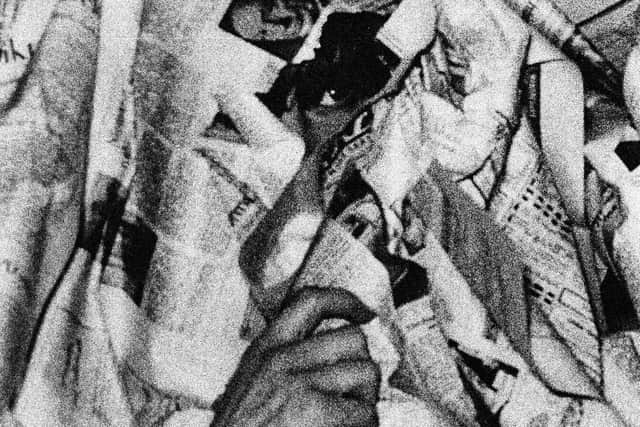
Before this, in the bomb-scarred cityscape of post-war London, Steveni had collected material from the wreckage.
"There were these big industrial sites with a lot of waste materials. Barbara would go out gathering material that could be used in assemblage works. We are really delighted to have some of these early assemblage pieces in the exhibition,” says Mr. Bell-Jones.
An epiphany came in the mid 1960s when Steveni asked why they were going around these sites collecting materials. ‘Why aren’t we sending artists into industry?’
"These factories should be inviting artists in was her view. In 1965 she proposed the APG and it was set up the following year.
"They worked with industrial corporations like Imperial Chemical Industries (ICI) Plastics and British Steel. These very, very big corporations,” says Mr. Bell-Jones.
Under the model pioneered by APG artists were placed in organisations on the same pay as management and with an open brief.
Initially, interventions involved painting machinery different colours, for example, but it soon led to them ‘talking more to the staff and the workforce and it led to a lot of projects which dealt with social change or making connections between the management level and the shopfloor’.
So fundamental was the shift in thinking on the role of art in society that the head of the Arts Council attended every APG meeting.
But the installation of the Art and Economics industrial boardroom put noses out of joint.
"In 1971 they pulled the money from the group saying it was essentially straying too far into the realm of 'social engineering' and away from what they called 'straight art'.”
This led to a shift in approach for APG with attentions turning from industry to the civil service.
A memorandum was signed with government in 1972 for artists to be placed in departments. Labour politicians, Tony Benn and Barbara Castle, were advocates
Mr. Bell-Jones reflects: “It seems like an amazingly radical action, placing artists without a brief into different civil service departments.
"The idea was that this artist would come in with a different way of thinking to the accepted way of doing things.”
When John Latham was placed in the Scottish Office one official asked if he was going to come in and solve all of its problems.
Another colleague replied that he thought Latham was going to show them problems they didn't know they had.
"That gives an insight into how they thought of artists and the benefit of artists to society. It is almost like an utopian aim to how society operates.
"What was incredible was that they were actually in the departments working, these amazing artists,” says Mr. Bell-Jones.
The project was so radical not many placements were realised. But those that did resonated.
Ian Breakwell was posted to Broadmoor and Rampton prisons, as they were then, and documented the historic inhumane and outdated treatment of psychiatric patients.
“The evaluation was held under the Official Secrets Act, because it revealed the terrible conditions of the people who were being held there who were then called the 'criminally insane'.
"That project ended up getting leaked. It led to an expose on ITN.”
Mr. Bell-Jones says Steveni’s legacy is her impact on other artists.
Scottish artist David Harding took on her concept that 'context is half the work' and developed an environmental arts course at the Glasgow School of Arts based on the principle, influencing many.
"That led to loads of artists, Turner Prize-winning artists, coming through that course. APG is seen as a really important precursor to what is called socially-engaged practice and also the development of the artist residency model.”
Steveni passed away in 2021 at the age of 91. Mr. Bell-Jones got to know her when he moved to Flat Time House (FTHo), a gallery, education space and archive in the former London home of John Latham, in 2015.
He notes that Steveni didn’t even consider herself an artist until her later years.
“It was only in the early 2000s that she began to regard herself as such. This comes into feminist discourse where in the 1970s people would write to her as ‘company secretary’ or as ‘Mrs. John Latham’ whereas she was actually the figurehead of this organisation and the driving force behind it.”
Mr. Bell-Jones wanted to bring the show to Derry because of Void director Viviana Checchia’s focus on social engagement.
“In NI I really wanted to work with Viviana, due to the work she has done around socially engaged practice and the importance of how artists work in society and her interest in who has been influenced by Barbara Steveni.
"Many of the artists who work in this way will cite Barbara as an important influence on them so for us it felt like we had to work with a space that had that kind of ethos, rather than doing an art historical show, this should be a show that is living.”
Barbara Steveni, I Find Myself opens at the Void Art Centre on Saturday, January 17, from 5.30pm to 7.30pm and runs until Saturday, April 4.