
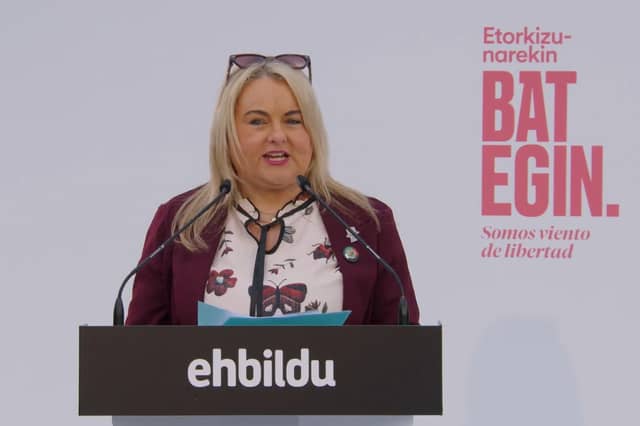

The Derry Sinn Féin Councillor addressed the official 50th anniversary commemoration of the atrocity in the Basque country on Tuesday.
She likened the killing of Pedro María Martínez Ocio (aged 27), Francisco Aznar Clemente (aged 17), Romualdo Barroso Chaparro (aged 19 years), José Castillo García (aged 32) and Bienvenido Pereda Moral (aged 30) by members of the Spanish security forces on March 3, 1976, to the Bloody Sunday massacre in Derry four years earlier.
The victims were among thousands of striking workers who had gathered in the church of San Francisco of Assisi in the working class neighbourhood of Zaramaga when they were attacked by police during the so-called transition to democracy following the death of Francisco Franco.
No one has been held accountable for the killings.
Speaking to the ‘Journal’ Colr. Duffy said it had been ‘a powerful day’ in Gasteiz where she met with the leadership of the left-wing Basque separatist party Euskal Herria Bildu including Pello Otxandiano, a local member of the Basque Parliament.
“We discussed the M3 massacre and the clear parallels with Bloody Sunday, with families who continue to refuse to accept the state's lies and are leading a relentless campaign for truth and justice.
"Their courage, like that of our own families, proves that resilience is inherent and memory does not fade. There is solidarity across our nations,” she said.
In a keynote address Colr. Duffy said: “It is a privilege to stand here in Gasteiz, a city with a proud culture, a strong sense of dignity, and, like my own city Derry, a long memory.
“I come from Derry, a place shaped by resilience, by community, and by a refusal to accept that injustice should ever be the final word.
“We are linked not by geography, but by truth and by the cost of its denial.
“Fifty years ago, in this city, working people marched for rights and dignity. They were met with violence. Lives were taken. Families were shattered. And then came the second injury: the denial. The distortion. The quiet instruction to move on, to forget, to accept that the powerful would never be held to account.
“In Derry, we know that story all too well.
"My uncle was murdered by British forces in 1971. We still await official confirmation of his death never mind truth and justice.
“Then on Bloody Sunday, 1972, innocent civilians marched peacefully and were cut down by those who were meant to protect life.
"Families were told lies. The dead were smeared. The truth was buried under reports designed not to uncover justice, but to smother it. For decades, mothers and fathers, sisters and brothers, carried their grief while being asked to be silent.
“Here in Gasteiz, families were asked the same thing.
“Different languages. Different flags. Same playbook.”
Colr. Duffy told the commemoration that when justice is denied ‘delay becomes policy’ and ‘silence becomes strategy’.
But, she observed, ‘memory does not fade’ and ‘it hardens and it waits’.
“What connects Derry and Gasteiz is not only what happened, but what happened after. The long road. The closed doors. The official shrug. And the extraordinary courage of families who refused to give up, who said, calmly and repeatedly, ‘We are not going away’.
“Let me say this clearly: there is no statute of limitations on truth. There is no expiry date on dignity. And there is no peace built on a foundation of lies. Justice delayed is not justice. It is denial dressed up as procedure.
“In Ireland, families fought for decades until the truth was finally acknowledged, that those killed on Bloody Sunday were innocent, that the killings were unjustified and unjustifiable. That acknowledgement mattered. It did not bring loved ones back. But it restored names. It restored humanity. It restored a measure of peace,” she said.
Colr. Duffy said she recognised the pain of the Gasteiz families and described their demand for truth as ‘not unreasonable’ but ‘essential’.
"We do not ask for special treatment. We ask for equal justice. We ask for transparency. We ask for the basic respect owed to families who lost loved ones through state violence.
“And we promise something else too: memory will not be erased.”
The Gasteiz massacre occurred amidst a strike by workers protesting against a wage cap and in favour of better working conditions.
The police stormed the church of St. Francis of Assisi deploying tear gas and riot gear and then live rounds as the striking workers exited the place of worship. Five people were killed and it is estimated around 100 others were wounded in the attack, which occurred some three-and-a-half months after the death of the Spanish dictator Francisco Franco.
Remembering these events this week Colr. Duffy remarked: "History will not be rewritten by convenience. The names of the dead will be spoken, here and in Derry, not as footnotes, but as human beings whose lives mattered.
“There is a saying back home: Ní neart go cur le chéile—there is no strength without unity. Today, that unity crosses borders.
“From this city, fifty years on, let our message be simple and unshakeable: truth is not a threat to peace. Truth is the foundation of peace.
“And justice, real justice, is not something families should have to beg for. It is something societies owe. Long live international solidarity!”
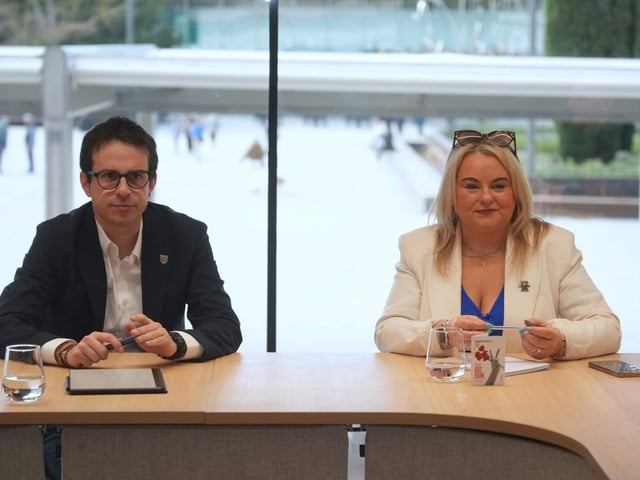
5. Sandra Duffy with Pello Otxandiano, Euskal Herria Bildu member of the Basque Parliament.
Sandra Duffy with Pello Otxandiano, Euskal Herria Bildu member of the Basque Parliament. Photo: Supplied
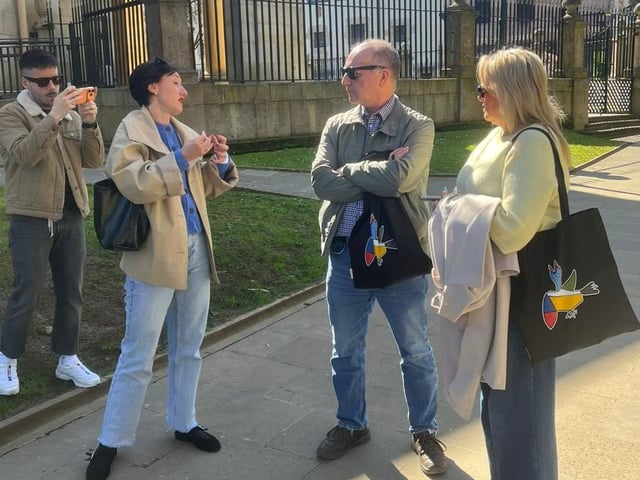
7. Sinn Féin Councillor Sandra Duffy and Bloody Sunday Trust Chair Tony Doherty in the Basque country this week.
Sinn Féin Councillor Sandra Duffy and Bloody Sunday Trust Chair Tony Doherty in the Basque country this week. Photo: Supplied
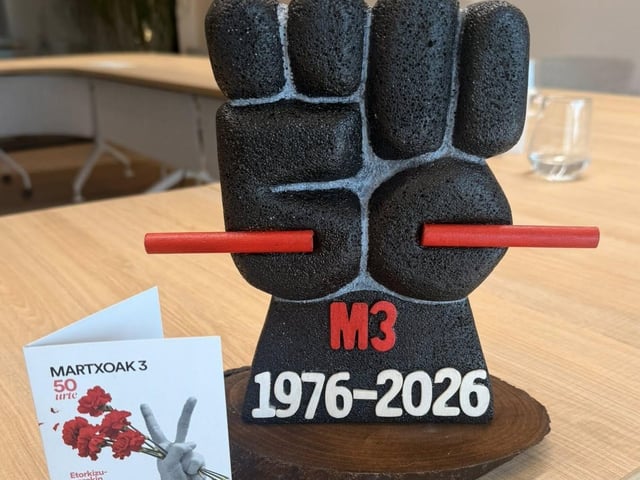
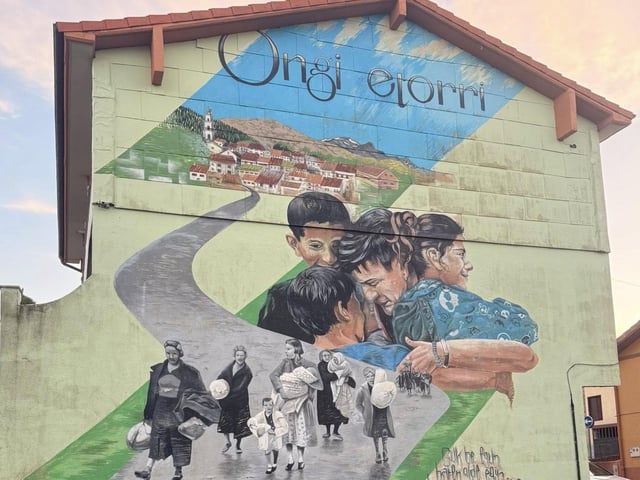
8. A memorial to the victims of the Gasteiz massacre of March 3, 1976.
A memorial to the victims of the Gasteiz massacre of March 3, 1976. Photo: Supplied