
Hundreds of citizens were affected when 60 to 70 millimetres of rain fell in just nine hours on August 22, 2017, devastating local communities.
The deluge caused the Castle and Muff rivers in Eglinton and the Faughan and its tributaries in Drumahoe and Altnagelvin to overflow, inundating many homes.
In a presentation to the Derry City and Strabane District Council Environment and Regeneration Committee this week, Gillian, whose home was flooded in Eglinton, said: “As a result of that night of the flooding I've been engaged with stuff now that has nearly taken over my life.
"That's what flooding does until you can get to a point where you feel safe again in your home. Unfortunately for many people we are just not there yet.”
Gillian, made the comments whilst briefing the committee on the BluePrint project, a cross-border initiative that used art to document the experience of communities, resulting in songs, poetry and sound installations.
The Creative Ireland Programme, led by MaREI at University College Cork, in collaboration with The Playhouse, DC&SDC and Mayo County Council, sought to move beyond the data, science and statistics to capture the human impact of flooding, Cathy Burns, Climate and Biodiversity Lead at DC&SDC told the committee.
Gillian was joined by fellow-participants Steve and Rosemary, who were badly affected when the Strule burst in Newtownstewart.
Flood-affected citizens are constantly fearful of another catastrophe, she said.
“My home flooded in 2017 and I was out of my home for about four months. We had a near miss again in 2022. I went away to Enniskillen for the day. There was no weather warning, no advance warning, and I couldn't get back in time. Thankfully my mum was able to come and put the sandbags out,” she explained.
When approached about participating in BluePrint she was sceptical.
“I thought what am I doing here? I don't have the capacity to do this and I don't want to open up all those horrible memories again,” she said.
But she hailed artist-in-residence at The Playhouse, Sara ‘Sally’ Walmsley, saying the initiative was extremely beneficial.
"The project was actually really therapeutic. Only two good things came out of the flooding: the friendships I've made with other people in the community I didn't know before; and this project,” she said.
Participants went to Ballina and Crossmolina in North Mayo. Both towns have experienced severe floods in the recent past.
Gillian said it was useful to hear from these communities and to learn about advanced flood alleviation schemes in the area.
"I'd encourage anybody to participate in these types of projects. It's a hard sell - art and something very traumatic - but I would say it was really, really good and really, really worth it,” she said.
During the presentation she urged DC&SDC to ensure greater alignment between ‘council initiatives and adoptions like the rights of nature, climate action strategies, emergency responses and the review of the flooding’ with planning decisions.
She criticised a recent Department for Infrastructure consultation on proposed flood alleviation schemes for Eglinton, Ivy Mead and Drumahoe in the Foyle Arena.
"Two o’clock on Friday in Derry was not a great time for people who are working and it felt like a bit of ‘tick box’ thing,” she said.
Gillian attended the meeting and still had questions.
"At the bottom of my garden for 265 metres two walls are being proposed. They couldn't tell me what height that wall is and they couldn't tell me if the water gets over the wall in a flood event how it would get back out again.
"And I would be worried that I'm going to be sitting in a lake for longer. That detail wasn't there on Friday and maybe it hasn't got to that stage yet,” she said.
She was impressed by the flood alleviation scheme along the Moy in Ballina, saying it was not overly engineered and had the support of the community.
Chair of the Environment and Regeneration Committee, Declan Norris, thanked the participants for their presentation.
“It is such an emotive topic,” said the Eglinton-based SDLP councillor.
"I was there at the two floods in Eglinton. I've never been flooded myself but to see the damage it has done to the people and the damage it has done thereafter. I get the phone calls when heavy rain is coming.
"There are pensioners who are worried every day there is heavy rain. You yourselves are worried when there is heavy rain. There is that trauma that is still there to this day and will always be there.”
DUP Alderman Julie Middleton remarked: “We are genuinely so sorry to know of the devastating and stressful experiences you have faced as a result of flooding.
"Many of us, myself included, be on the ground during these events. We know how truly traumatic the experience is for you all as well as how stressful the aftermath is.”
UUP Alderman Darren Guy said: “Myself and many other elected members...have experienced it with these families, especially in the Ivy Mead area, where we have watched families who have been left living in fear, the mental health and well-being of these families has been seriously challenged.” he said.
Independent Councillor Gary Donnelly observed: “I have been involved in the past in helping communities out when flooding has occurred and have seen the devastation in the aftermath where families have to pick up the pieces but I couldn't imagine what it is to go through that...the answer isn't empathy or sympathy or even tears.
"You mentioned the part that the water played. There was no politics in what the water does. But politics is playing every part in the lack of response, the lack of solution, and that's the reality. We shouldn't need disasters like that to break down barriers in our community.”
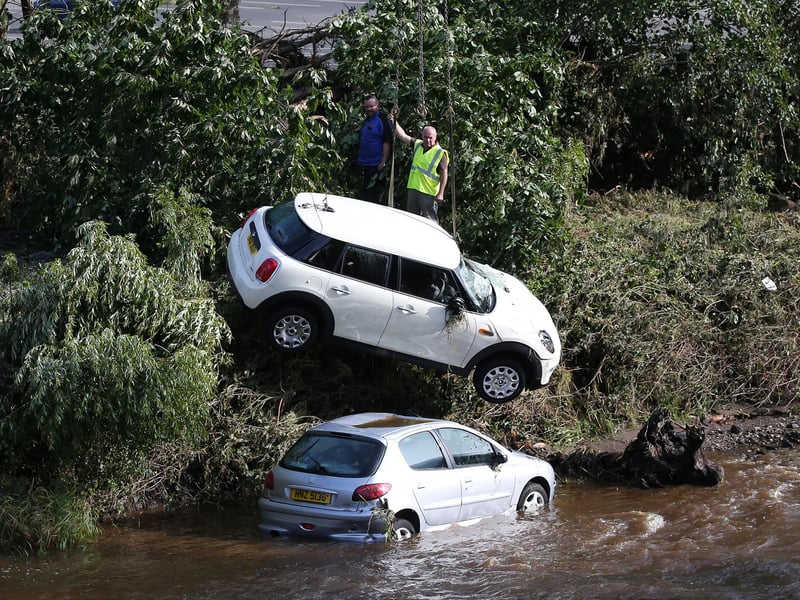
1. The River Faughan at Drumahoe in August 2017. Photo by Kelvin Boyes / Press Eye.
The River Faughan at Drumahoe in August 2017. Photo by Kelvin Boyes / Press Eye. Photo: Kelvin Boyes