
Budget 2025: Stormont to be funded to end two-child limit and hikes to living wage for young people
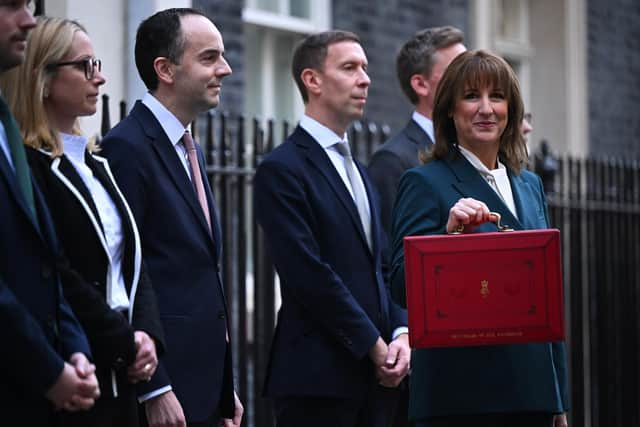
The Executive in the North will be funded to remove the the two-child limit to benefit payments, Rachel Reeves announced in her budget this week.
Speaking in the British House of Commons the Chancellor of the Exchequer said: “I can announce today, fully costed and fully funded, the removal of the two-child limit in full from April.”
Budget 2025 states: “The government will fund the NI Executive to remove the two child limit for families in Northern Ireland should it choose to do so, as welfare is devolved.”
The two-child cap on Universal Credit and Tax Credits prevents parents with a third child born on or after April 2017 from claiming extra support.

The National Living Wage (NLW) and National Minimum Wage (NMW) for young people, meanwhile, is set to increase.
“I am accepting the recommendations of the Low Pay Commission in full and increasing the minimum wage for 18 to 20-year-olds from £10 to £10.85 per hour, and increasing the living wage from £12.21 to £12.71 per hour,” Ms. Reeves told MPs.
The London Government will fund the Executive to increase the Universal Credit Standard Allowance by over 6 per cent and all other relevant working age benefits in line with inflation (an increase of 3.8 per cent) from April 2026, should it choose to do so.
Equally, Stormont will be provided with money to increase ‘the basic and new State Pension by 4.8 per cent, from April 2026’.
The Chancellor confirmed she was maintaining all income tax and equivalent national insurance thresholds at their current level for three further years from 2028.
Ms. Reeves promised to extend the ‘5p fuel duty cut until the end of August 2026’ and cancel the ‘planned increase in line with inflation for 2026‑27’.
And under the Barnett formula the North’s ‘block grant’ is set to increase by £370m in line with increased British Government expenditure in Britain-only under Budget 2025.
"As a result of decisions at Budget 2025, the NI Executive will receive an additional £240 million resource funding and £130 million capital funding through the operation of the Barnett formula on top of these record settlements. This means the NI Executive’s settlement continues to grow in real terms between 2024‑25 and 2028‑29,” the budget documents explain.
The Barnett formula is named after Joel Barnett, a former minister, who introduced it in the late 1970s to allow the North’s ‘block grant’ to increase in line with increased British spending.
The North is due to benefit from £16.6m in new funding over the next three years for an Internal Market Package to boost trade between the North and Great Britain.
The Treasury documents say the North gets more per capita spending than anywhere else.
“The NI Executive continues to receive at least 24 per cent more per person than equivalent government spending in the rest of the UK in all years of the spending review period. This ensures the NI Executive is funded above its independently assessed level of need (124 per cent),” It stares.
Alcohol and tobacco will be more expensive.
"Duty rates on all tobacco products will increase by Retail Price Inflation +2 ppts. These changes will take effect from 6pm on November 26, 2025.
"The one-off increase of £2.20 per 100 cigarettes or 50g of other tobacco products and annual uprating of tobacco duty by RPI + 2 ppts next year will take effect from 1 October 2026 and will be included in Finance Bill 2025-26,” the Budget documents state.
And ‘all alcohol duty rates will increase in line with RPI inflation’.
"The Small Producer Relief discounts will also be uprated so eligible small producers receive relative duty reductions as now. These changes will take effect from February 1, 2026,” it was confirmed.
Anna Doherty, Derry Chamber Chief Executive, described the Budget as ‘a missed opportunity’ for the North West.
"At a time when we should be putting an end to short-termism and shifting to long-term economic planning, the Chancellor has instead delivered another round of tightening that offers little strategic direction.
"While the measures announced apply across the UK, their effects will be felt more sharply here, where our SMEs already operate within a uniquely complex post-Brexit environment.
“The steep rise in the National Minimum Wage underscores the issue. We all want workers to be properly rewarded, and higher wages are a positive outcome in principle, but this increase comes on top of years of cumulative rises and higher Employer National Insurance contributions, pushing up the cost of doing business at the very moment when we’ve been urging the private sector to invest.
"With no compensatory measures in this Budget, no support for productivity improvements, skills development, or business-rate or VAT reform, employers in hospitality, retail, care and other service-based sectors are being hit hardest. This ultimately hampers their ability to grow, invest, and create the jobs our region needs,” she said.
Reacting to the Budget Finance Minister John O’Dowd said: “I welcome the Chancellor’s decision to increase both the Minimum Wage and the Living Wage, important steps that will support our lowest-paid workers.
“However, freezing income tax thresholds will hit working families who will have less disposable income to spend in our local businesses. The Chancellor had an opportunity to ensure those with the broadest shoulders carried more of the burden – but she didn’t go far enough.
“There was little in today’s budget to support economic growth and for small to medium businesses. Despite calls to support our hospitality industry by reducing the VAT rate – these calls went unanswered.”
Ms. Doherty said: “For owner-managers and senior staff, the continued freeze on income-tax thresholds amounts to a hidden tax rise as wages rise, squeezing disposable income in a region where earnings are already lower than the UK average.”