
Graham Spencer: The Reconciliation Problem
What is reconciliation and how can it be known?
There has been some attention given to reconciliation as a basis for a more inclusive and progressive Northern Ireland but the term has already been taken and used to reinforce political division rather than build positive change.
This division reflects two positions. On the one hand, reconciliation is seen as necessary condition before a Border Poll is called while, on the other hand, a Border Poll can only be called once reconciliation has been reached.
In one instance reconciliation is seen as an outcome while in another it is seen as part of a process.

For one side it meets a desire for stasis while for the other it meets a desire for movement. Unsurprisingly unionists prefer the former so they can insist reconciliation has not been attained and republicans prefer the second because they can insist it is a work in progress.
For those who believe reconciliation can be measured the immediate question that arises is how? In theory, reconciliation seems to imply putting oneself in the position of the other. In that case it functions to support empathy and enables us to see that difference is legitimateeven if disagreeable.
Here reconciliation should not be seen as a process of conversion but a re-evaluation of one’s own thinking in the light of engagement with another. As the writer Christopher Bollas put it ‘To talk to one’s presumed enemies is also to engage in a conversation with oneself’.
Perhaps we would be unwise to think that reconciliation can be measured. Like each of us it is part of a moving situation and only a shift in how different individuals relate to each other can provide the basis for that change.
But whatever reconciliation might mean it surely demands listening and looking for where potential common ground can be found on the terrain of difference. Not all issues can be accommodated or agreed upon and some are offensive but even within disagreeable positions some points of commonality may be found.
Respect for difference and giving others attention and space to articulate their experiences introduces the possibility of new understanding.
What this also suggests is that reconciliation requires a receptiveness and openness to new stories and a shift away from the same old onesthat may provide the stability of certainty but also hinder change.
Politicians who seek to exploit the idea of reconciliation to support established political aims surely violate what reconciliation means. Used to reinforce some known idea it stands in the way of a better future by keeping us chained to the past.
Reconciliation enables us to work with uncertainty and through that uncertainty encounter new possibilities.
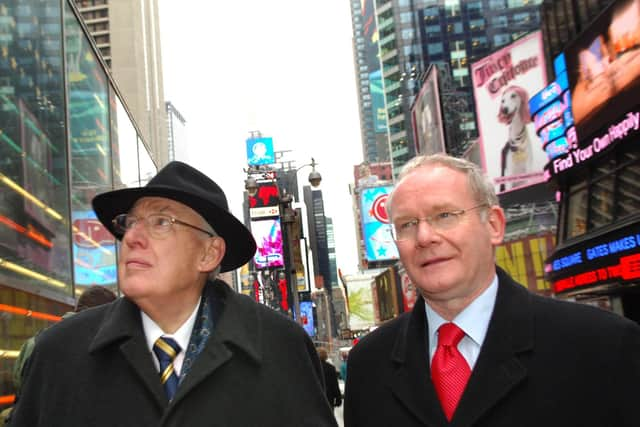
This may sound idealistic and dangerously romanticised for some but we have seen what reconciliation can look like. We saw it between Ian Paisley and Martin McGuinness when they were first and deputy first minister. That relationship represented transformation and hope, two of the primary conditions for reconciliation.
The relationship also stood as a symbol for what Northern Ireland might be. Although each held diametrically opposed beliefs with regard to national identity and responsibility for the past both were able to overcome those differences and work constructively together, so personifying hope, possibility and a better future.
We do not have to agree on what something means. Indeed debate and discussion is what gives exchange and disagreement meaning. The test is whether the space that separates us from them can also become the basis of bringing both closer and by so doing create something new for each in the process.
Hope, as the philosopher Byung-Chul Han notes, ‘does not isolate people; it unites and reconciles them. The subject of hope is a We’. It takes the narrowness of ideology and certainty and replaces each in a wider context of possibility and in that space other stories and points of view can emerge.
Lack of hope to quote the philosopher again creates a fear to think and act imaginatively. As a result, he insists, ‘A climate of fear produces a continuation of the same’.
As things stand the dominant politics of Northern Ireland is one of fear and the tendency for humiliation, where if it is bad for them it must be good for us. This does not offer hope. Unless this approach is changed and politics begins to draw on a new sense of moral responsibility and direction Northern Ireland will remain trapped by this negative state of affairs.
Reconciliation could become the new story of national purpose for Northern Ireland and between North and South. It could become a symbol of collective renewal rather than used to further bolster national division and separation.
That is why a National Reconciliation Forum should be set up and driven by the British and Irish governments together. Not as a process to be subsumed into the quagmire of legacy, or to support law and order, but through extensive public and political consultation used to develop a national reconciliation framework for social and political change.
Viewing reconciliation as an overarching context that is able to absorb a range of meanings and possible lines of engagement rather than merely used as a precondition for party political ends provides for an environment where the potential benefit for all rather than just some is enlarged. This is the vital foundation for transformation and it requires looking outside of ourselves to be realised.
Yes there are many possible definitions of what all of this might mean and there will be inevitable disagreement about how differing interpretations might be used but now is surely the time to give more serious consideration to reconciliation as a national framework for transforming Ireland, North and South. Without such a framework change will be stifled and the restrictive positions and prejudices of the past will endure.
Graham Spencer is Emeritus Professor in Social and Political Conflict at the University of Portsmouth.