
Korean reunification minister Chung Dong-young lays flowers at grave of ‘great statesman’ John Hume
Senior South Korean politician Chung Dong-young, who is responsible for Seoul’s Korean reunification policy, laid flowers at the grave of John Hume during a visit to Derry on Wednesday.
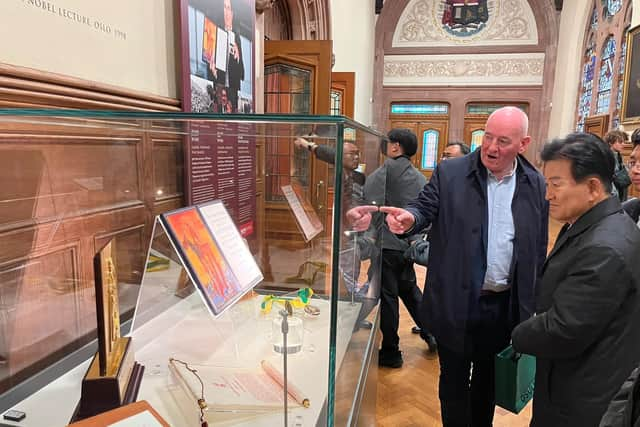
Mr. Chung visited the Guildhall where he viewed Mr. Hume’s Nobel, Martin Luther King Jnr and Mahatma Gandhi Peace Prizes.
The Minister for Unification was part of a Republic of Korea delegation greeted by Mark Durkan and Tim Attwood of the John and Pat Hume Foundation.
Mr. Durkan briefed him on the Peace Process and the Good Friday Agreement.

Minister Chung then observed a solemn ritual at John Hume’s grave as well as laying flowers.
The delegation, however, had to return early to Korea following the fall-out over a landmine explosion that injured three South Korean soldiers in the Korean demilitarised zone that Seoul has blamed on Pyongyang.
Mr. Chung said: “Yesterday afternoon, in poor weather, I visited the grave of John Hume, the man of peace, in the city cemetery on a hill overlooking Derry. I laid a bouquet of chrysanthemums and paid my respects.
"Along with my respect for a great statesman who realised the ideal of peace amid the harsh storms of history, I reflected deeply on our efforts and aspirations for peace and coexistence on the Korean Peninsula.
“The philosophy of John Hume, leader of the Social Democratic and Labour Party, who led the way to the 1998 Belfast Agreement and received the Nobel Peace Prize, offers painful lessons for the reality of the Korean Peninsula. Amid fierce criticism and political backlash, he never wavered in his conviction: ‘Peace is made with enemies. There is no need to negotiate peace with friends or colleagues. Even with extremist forces bearing arms, the task of a politician is to enable them to lay down their guns and return to dialogue. To stop the bloodshed, we must talk with our enemies.’”
He noted that John Hume’s politics was not about waving flags but transforming hatred and violence into ‘mutual respect and institutional coexistence’.
"With his whole being, he showed that only the patience and courage to confront fear and hatred head on, rather than taking the easy path of exploiting them, will ultimately bring forth peace. In the course of history, he put into practice the belief that a politician's duty is to save future generations.. I believe that John Hume's political philosophy is precisely the virtue most urgently needed by politicians in a divided Republic of Korea.
"The blood-soaked wind that once blew across the barley fields of Ireland has now become a wind of peace. Yet in our own barley fields, a sorrowful wind has still not ceased.
“As the great poet Yeats wrote, perhaps peace comes dropping slow. Here in Northern Ireland, a land that has turned the tragedies of the past into the hope of today, I renew my resolve to end the long war on the Korean Peninsula and build a lasting peace regime. For this is the only path, and the fastest one, by which our young people in the prime of their lives will no longer be sacrificed and can stride confidently beyond the DMZ towards the continent.”