
‘The SDLP, Politics and Peace’ sheds fresh light on thinking of key architect of Good Friday Agreement Mark Durkan
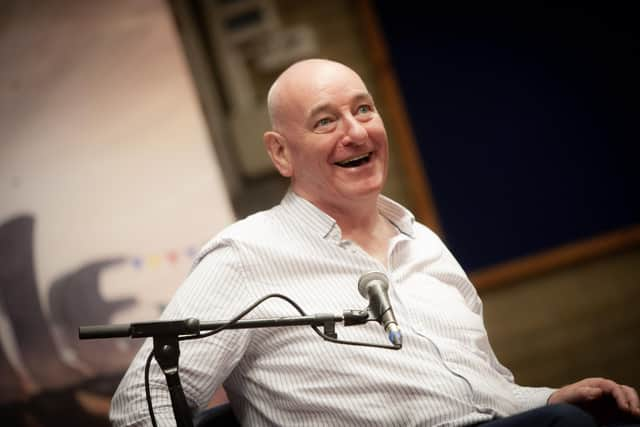
A compelling selection of interviews with former SDLP leader Mark Durkan will be launched in Derry next week shedding fresh insight into the former politician’s thinking.
‘The SDLP, Politics and Peace - The Mark Durkan Interviews’ sees one of the key architects of the Good Friday Agreement field a range of questions about pivotal political developments from the Anglo-Irish Agreement (AIA) up to the present.
The interviews were conducted and edited by Graham Spencer, Emeritus Professor of Social and Political Conflict, University of Portsmouth.
Mr. Durkan’s political formation, his role within the SDLP and in the negotiations that led to the GFA and his analysis of the repeated crises of power-sharing over the past 27 years are all covered in extensive detail.


"In my student days I was as good a bar stool critic of the SDLP as anybody else. I would say they’re not green enough, or they are not red enough, but it was very much during the build-up towards the hunger strike and the misreading of how issues were not addressed, or recognised, that influenced me to become more political.
“Then, I found myself recognising that the SDLP were the party who were trying to deal with issues on the basis of reason and not rage,” Mr. Durkan tells Professor Spencer, in an arresting opening interview.
Mr. Durkan canvassed for John Hume in the seminal June 1983 General Election that saw the late peace-maker returned as MP for Foyle for the first time.
The book relates how Mr. Hume was looking for someone to act as his parliamentary assistant.
“It was February 1984 that I started working for John. I think technically the change date was St. Valentine’s Day, even though it may have been a Sunday that year,” Mr. Durkan recalls.
Asked why Mr. Hume sought him out, he suggests: “He indicated that he liked my thinking because it was like his thinking...his wife Pat also said that she thought I had a very good read, or anticipation, of how John would interpret, or react to things.”
The interviews consider the work of the New Ireland Forum (1983-84) and the Anglo-Irish Agreement (1985), which Mr. Durkan views as crucial to subsequent progress towards peace.

"The AIA provided the backdrop to everything that happened after. It was the backdrop to the Hume-Adams dialogues and it was also the backdrop to the Brooke-Mayhew talks which John never saw as rival exercises.
"Rather he saw both as part of a process that could potentially converge, so his thinking all along was that this would be a long and complex journey,” he reflects.
The AIA, Mr. Durkan argues, set ‘the context in which the peace process subsequently happened’.
"Over time, as they realised the Agreement wasn’t going away, Sinn Fein obviously started to explore possibilities and you had Adams in conversation with former senior Irish official Michael Lillis about what the British were like to negotiate with.
"This indicated that Adams was intrigued in this new dynamic and how it might enable different prospects that could encourage a rethink of the IRA position.”
In one of the chapters Prof. Spencer asks Mr. Durkan about Mr. Hume’s relationship with the late Seamus Mallon. He acknowledges a ‘certain tetchiness that there could be between them as they would argue things out’.
“There was nothing about either of them that was artificial, made up, or calculated for individual positioning. It was raw and it was real and that is why when it came to discussions in the party each would challenge, test and develop the other’s thinking,” he recounts.
Following the Downing Street Declaration in December 1993 many were impatient at a lack of progress on an IRA ceasefire.
"We saw that again later with a lot of the worries, doubts and anxieties about Hume-Adams and what was and what was not happening. This was also particularly so after the Downing Street Declaration (DSD) when John believed there was going to be a ceasefire and argued that patience was going to have to be shown.
"He was as frustrated as anyone else that it was taking so long for Sinn Féin and the IRA to properly respond to the DSD, but he believed that it was going to come and therefore we should extend a degree of anxious patience for that.”
A ceasefire was declared in August 1994 but lasted less than two years.
“The sense in the party was bitter disappointment, anger, and frustration. There was a real feeling that this was hard for John and been made so by some of the other political parties and the media,” Mr. Durkan remembers.
Notwithstanding this setback Mr. Hume continued talking with Gerry Adams and Fr. Alec Reid. The book reflects on efforts to re-establish the ceasefire in 1997, and on the Mitchell talks that led to the GFA.
And on the GFA itself and the process of reconciliation that continues today, Mr. Durkan says: "The GFA was meant to pledge us all to the concept of reconciliation regardless of our different attitudes to constitutional futures. I think we got to understand that the idea coming from some people was saying there cannot be reconciliation without a united Ireland and that was the best setting for achieving it.
"There could be truth and validity in that and I say that as someone who supports a united Ireland and wants reconciliation. But that is not the only context in which reconciliation can be achieved and nor do I think it should be framed as though it is all about that and it can only happen with unity because if you do that you are going to put a lot of people off the idea of reconciliation per se.”
‘The SDLP, Politics and Peace’ by Graham Spencer, will be launched at 4.30pm on Wednesday, January 29, in the Whittaker Suite in the Guildhall.
The event will be chaired by Dr. Shelley Deane, DCU.