
Celtic Park story comes full circle with historic meeting of Derry City and Shamrock Rovers
Mention of soccer in Celtic Park wouldn't have raised an eyebrow for your average Derry sports fan of the early 1920s. Nor would talk of greyhound racing, tennis, boxing, political rallies.... or even marching brass bands if said fan was of a certain vintage.
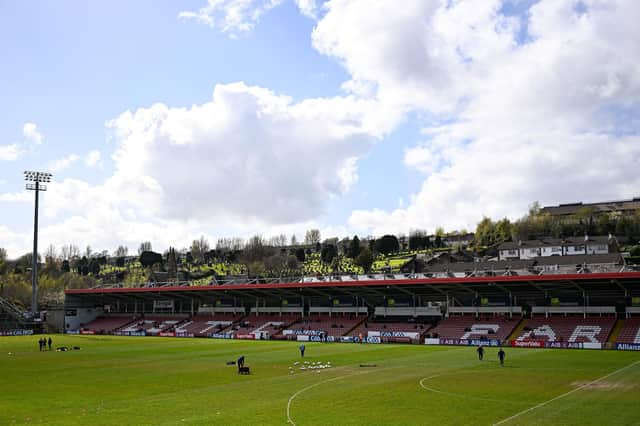
In fact it's from association football that the Lone Moor Road venue - indirectly at least - gets it's name; a name which has become synonymous with Derry Gaelic Games for more than 80 years. And when Derry City kick off their Airtricity League Premier Division encounter with Shamrock Rovers they will be following in some illustrious footsteps.

Just over two weeks ago marked exactly 130 years - April 4th 1896 to be precise - since the mighty Glasgow Celtic arrived to face their north west counterparts, Derry Celtic, the latter changing their name from St. Columb's Hall to reflect their close relationship with the Scottish giants and the famous Belfast Celtic.
And it's from that Derry Celtic team that the ground took it's name; so just who exactly where Derry Celtic?
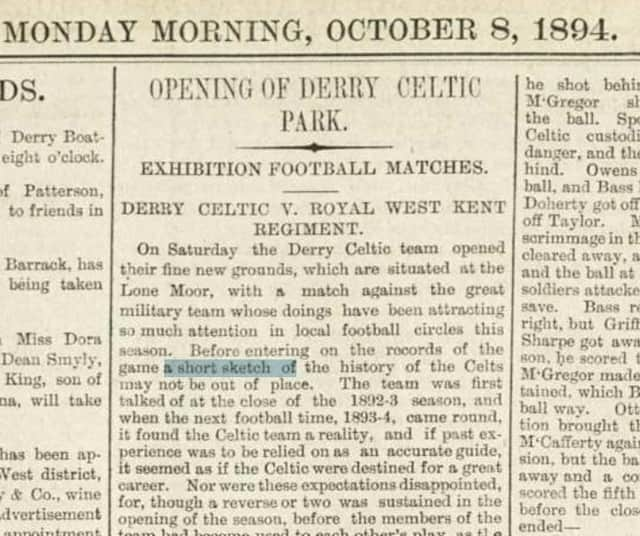
Here's an extract from the Derry Journal of Monday October 8th, 1894 marking Celtic Park's official opening, which may shed some light:
“The (Derry Celtic) team was first talked of at the close of the 1892-3 season, and when the next football time, 1893-4, came round it, found the Celtic team a, reality, and if past experience was to be relied on as an accurate guide it seemed as if the Celtic were destined for a great career. Nor were these expectations disappointed for, though a reverse or two was sustained in the opening of the season, before the members of the team had become used to each other's play, as the months wore on the Celtic quickly asserted their evident superiority over all the other teams in the district, and finished a brilliant season by becoming champions of the North-West , and being the proud possession of the North-West Challenge Cup and the Charity Cup.”
A great start then but while things had started well for Derry Celtic on the field of play, there was still a major element missing for a senior club of their new found stature: a ground.
The article continues...
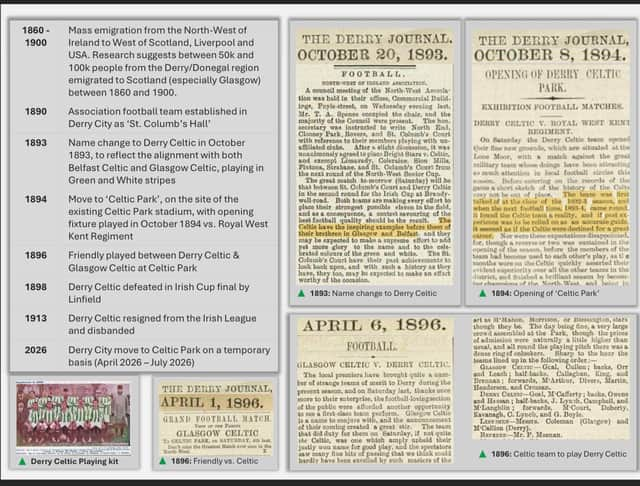
"All this time the team had been in occupation of a rather poor ground for a senior team of their calibre, and new quarters were being looked for in every direction. The club was formed into a Limited Liability Company, and consequently with plenty of capital at command, the field they now possess, was taken, and the important work of levelling and otherwise preparing it for play was entered on. That the work has been well done was apparent to everyone who was present on Saturday, and when the turf gets properly knit together it will be a splendid pitch on which to play.
“The reserved portion of the ground is on an elevation and is in consequence as good as a grand stand for viewing the game. The field of play is surrounded by a very strong wooden railing, while the ground as a whole , is surrounded by corrugated iron. Altogether the ground reflects great credit on those who have had charge of the initial preparations, and Mr. E. J. Toye, the architect, is to be congratulated on the success attending him in his work.
“To come to the match of Saturday. A great crowd was expected, and the expectations were realised as something like £60 were taken at the match which, we think, is the largest amount yet taken at a football match in Derry. Great interest was manifested, and every move of the game was closely followed. At each corner of the enclosure flags were floating, while from the pavilion the club colours, green and white were flapping the breeze."
And the first visiting team to a ground that would eventually become home to the Gaels of the Oak Leaf county? None other than the Royal West Kent Regiment, described in the 'Journal' as 'the great military team whose doings have been attracting so much attention in local football circles.....'.
For the record, the first official kick of a ball in what is now known as Find Insurance Celtic Park belonged to a Mr. C. O'Neill who will unlikely have realised his starring role in a seminal moment of Derry sporting history. It was an inauspicious start too as the military men schooled their hosts 5-0 to the tunes of the St. Columb's Temperance Society Band who provided a musical backdrop.
The result though was secondary. This day was about Celtic Park which had proven a huge success as a sporting venue, success that would help Derry Celtic become the biggest club in the north west for a time.
Indeed just two years later that status was reflected in that visit from their namesakes from Glasgow who, we are told, arrived at the Waterside terminus to be met by a number of representatives of Derry Celtic before being ferried in an open horse-drawn carriage to see the sights of the city and arriving at Roddy's Hotel for "a sumptuous luncheon."
With the local Celtic men bowing to their more illustrious visitors by wearing plain white, the legendary Hoops lined out as follows for a game that remains the most high profile soccer fixture at the ground:
GLASGOW CELTIC: Cullon, Orr, Leach, Callaghan, King, Brennan, M'Arthur, Divers, Martin, Henderson and Crossan. DERRY CELTIC: M Cafferty, Owens, Hasaan, J. Lynch, Campbell, McLaughlin, McCourt, Doherty, Kavanagh, C. Lynch and G. Boyle.
That was 130 years ago. Derry Celtic no longer exist. Outraged by an Irish League rejection to a re-admission application in 1913, they subsequently became a GAA club and a set of events were set in motion that led directly to Celtic Park becoming the county’s GAA hub that it now is.
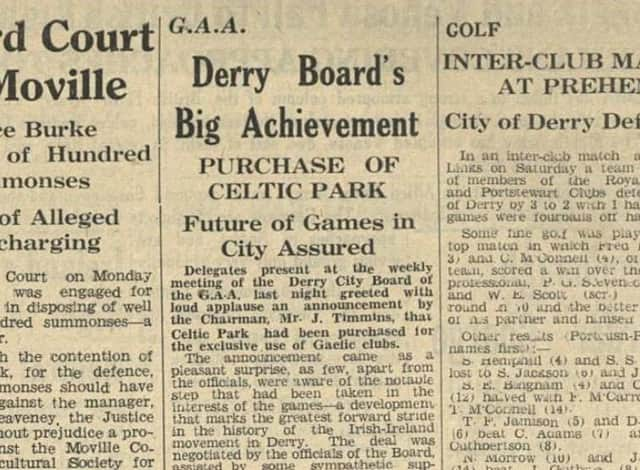
Football and greyhound racing remained staple events at the venue until, in 1943, the newly established City GAA Board were trying to re-establish Gaelic Games in the city and caught a rumour the ground may be available. They promptly purchased it for £1,000 on September 28th 1943 but it's been far from plain sailing.
Ballymaguigan's 1970 Junior Championship victory - a game in which the St. Trea's were led by a certain Eamonn Coleman - was played out to the backdrop of an ongoing gun battle along the Lone Moor Road. It would be the last significant fixture in Celtic Park for close to 20 years. Amid the growing civil unrest and Troubles that followed, Celtic Park became another victim.
Greyhounds were trained and kids dug holes amid large boulders left unclaimed by roadworks. Celtic Park was a derelict site in what became a ‘no-go’ area for some during the Troubles, more useful as a rat run to other parts of the city than a once proud sporting venue. Not a ball was kicked on it from 1970 until 1989.
But things had began to change in the mid-80s. The GAA, sick of paying out on injury claims emanating from the site, issued Derry GAA with an ultimatum: 'Develop it or sell it!' with even Bishop Edward Daly weighing in with a plea for the ground to be restored.
Bishop Daly's words proved prophetic. Following the GAA's ultimatum a new Celtic Park Development Committee was formed and, backboned by names like Mellon, McFadden, McChrystal, McKane and McNaught, the Lone Moor Road stadium was transformed. An Ulster Championship first round tie against Fermanagh in 1989 was the redeveloped stadium's first official fixture.
Further development has taken place since, notably the erection of the Tommy Mellon Stand in the '90s but perhaps the most significant development of all has been the blossoming relationship of mutual respect between Derry GAA and Derry City.
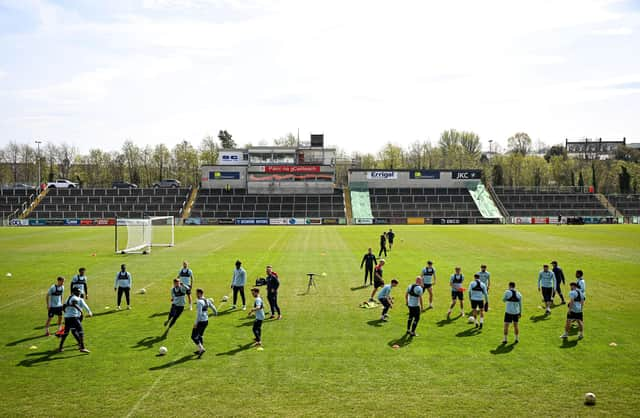
When the Candy Stripes take to the field against the ‘Hoops’ of Shamrock Rovers on Friday night they bring The Park's story full circle.
And a new chapter will begin…..