
Selina Horshi says VAT cut is ‘sledgehammer’ needed to support hospitality industry resting on ‘very shaky foundations’
Selina Horshi has said a VAT reduction for hotels is a much-needed ‘sledgehammer’ to revitalise an industry that is currently resting on ‘very shaky foundations’.
“The time for a nutcracker has come and gone,” Mrs. Horshi told the NI Affairs Committee as she briefed MPs in Westminster on Wednesday.
The Derry hotelier and Hospitality Ulster member travelled to London with colleagues to provide evidence to the NIAC’s new inquiry on the taxation of the hospitality and tourism sectors in the North.
She told MPs that a VAT cut was urgently needed after the Dublin government reduced VAT on food services from 13.5 per cent to 9 per cent in July.
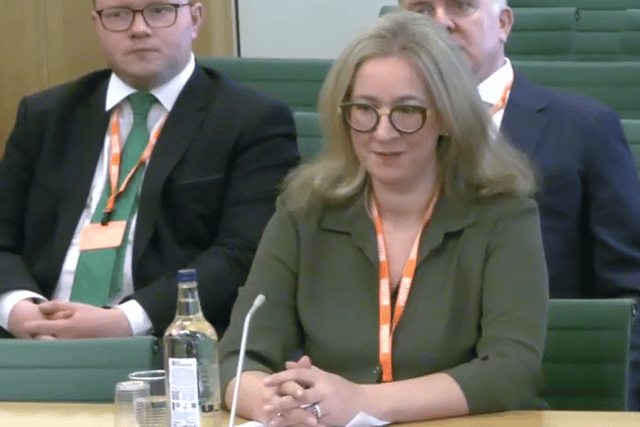
When the Labour MP for North Northumberland David Smith wondered aloud whether slashing the tax was ‘a bit of a sledgehammer to crack a nut’, Mrs. Horshi replied emphatically: “I'd say we need a sledgehammer. The time for a nutcracker has come and gone.”
During the evidence session the Derry hotelier outlined the significant challenges currently facing the sector, which have led to redundancies in recent times.
"Over 900 jobs have been lost in the hospitality industry which is the largest fall since those records really started to be kept.
"It shows that what we have is an industry from the outside that can look busy but the margins have been squeezed so much that it is now on very shaky foundations. So we are operating in increasingly challenging times.
“The biggest challenge we have is quite simply our geography, it leads us to be a border region where we are competing against our sister hospitality organisations in the Republic of Ireland,” she said.
Mrs. Horshi manages the White Horse Hotel in Campsie.
She told the committee how her costs are roughly equivalent to those being borne by her peers across the border but there is a significant VAT differential.
This is costing hotels in the North hundreds of thousands of pounds vis-a-vis their counterparts in Donegal, she said.
"We are marketed alongside them and yet a customer is looking at a price in my hotel three and a half miles from the border and a price in Donegal and what they are seeing is the price is lower in Donegal.
“For every £100 that I take into my business on accommodation the equivalent hotel in the Republic taking £100 would retain £4.78 more on the VAT alone.
"Per room that doesn't sound like a lot but we are a high volume, low margin industry and that quickly adds up to hundreds of thousands of pounds within a business each year that we simply don't have.
"The margins have been so squeezed on all sides of the border and all parts of the UK by the cost of living and the cost of doing business but that VAT differential is really putting pressure on our businesses at the moment,” she said.
The burden of rates is also an issue, acknowledged Mrs. Horshi, who pointed out that rates relief for hospitality had been implemented in parts of Great Britain but not in the North
However she insisted that ‘the biggest lever is quite simply the VAT differential when you are looking at food at nine per cent in the Republic versus 20 per cent in NI and you are looking at accommodation at 20 per cent in NI versus the 13 per cent in the Republic.’
She estimated that hotels in the North are roughly ‘£140,000 to £160,000 worse off due to location’ and the extra VAT overhead that applies here.
“If you take the hotel in the North and look, from its ledgers, at exactly what it has made, exactly what it has been taxed, and then you present that it was in the South, the difference on the tax alone - same operating model, same split across the different revenue streams - you are looking at a huge amount in difference in margin.”
Mrs. Horshi insisted the argument was not about making profits but about making a low margin export industry sustainable, providing employment and bringing money into the local economy.
"This isn't about profitability. This is about the fact that margin supports jobs, it supports refurbishments, it supports jobs in rural areas, it supports jobs for young people and ultimately a hotel like mine is having to do things like postpone refurbishment work that is stopping the business from circulating money around the economy; that's no quantity surveyors, it is no brickies, it is less money spent in the local taxi trade, going to the local laundrette, so it has a big impact across the economy.”
Referring to her recent experience as managing director of the White Horse Hotel she explained that approximately 40 per cent of the Campsie establishment’s occupancy at peak time comes from tour operators who often bring tourists to Derry in coach loads from Dublin.
"My demand in July was significantly down, more than 25 per cent down year-on-year. I spoke to the coach operators who have been regulars and I'm asking them why.
"I'm expecting to hear answers like ETAs (Electronic Travel Authorisation), fuel costs, all of those things were happening, but what I repeatedly got back was price.
"These guys are working on their own small margins. They are booking tens of thousands of bed nights and they are choosing - at £5 cheaper…to keep the business in the Republic,” she told the committee.