
Brother renews call for plastic bullet ban as ‘powerful’ Stephen McConomy tribute is published
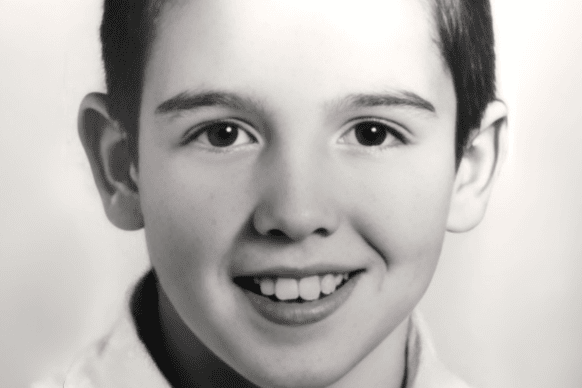
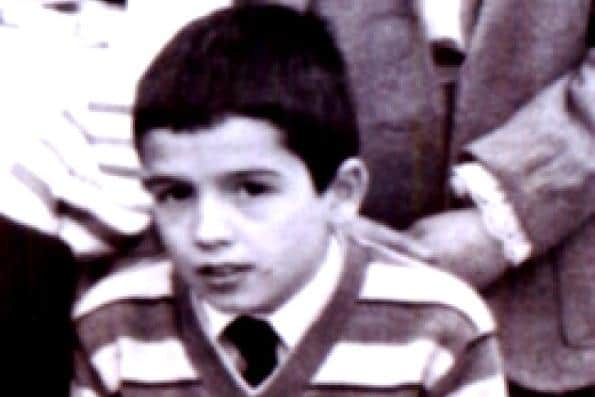
A new memorial booklet for Stephen McConomy has been described by his brother as a powerful tribute that will heighten awareness about the Derry schoolboy’s killing by a British soldier in 1982.
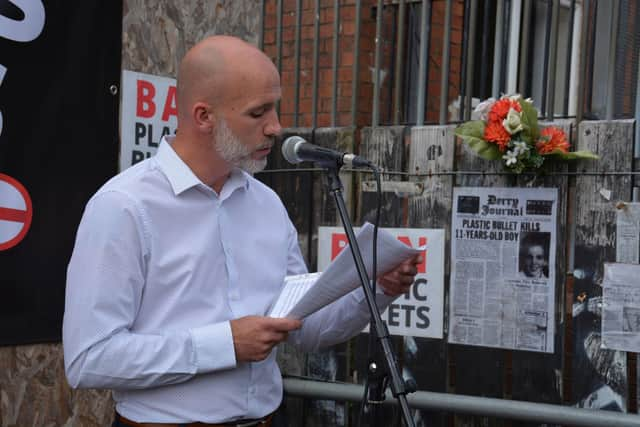
‘Stephen McConomy: A young life cut short’ will be launched this weekend by US-based human rights activist Dr. Brian Dooley on behalf of the Pat Finucane Centre.
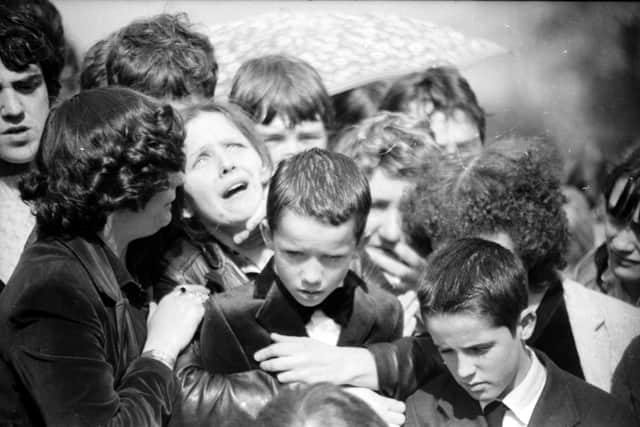
The pamphlet, collated by PFC case worker Stuart Ross from a wide range of sources, emphasises the devastating human impact the shooting had on his loved ones.
"It's fitting. It's a truthful and accurate reflection of what happened which was what we really wanted as a family, for the truth to be out there.

“I think it does that. It does it in spades,” said his brother Emmett.
Stephen was just 11 when he was shot in the back of the head at close range by a Lance Corporal from the Royal Anglian Regiment close to the Donagh flats at Fahan Street on Friday, April 16, 1982.
The booklet includes a heartrending account of Maria McConomy’s last conversation with her oldest boy just before the shooting.
This was recorded by Fr. Raymond Murray on August 23, 1982:
"On April 16, 1982 Stephen left the house that morning at 11am and he says, ‘If you are looking for me Mammy I am down at the Market Flats.’ I says – ‘Right son’. The two other boys [Stephen’s brothers] were out in the street playing and I tidied up the home for it was a nice day and above all days I decided to do a dinner early.
"I went down to the Market Flats at 3.30pm and Stephen was just standing at the wall and I said – ‘Son, your dinner is ready’, and he said – ‘God, Ma you made it early’ and I said ‘Aye – Son, miracles! I did it early today because I was all redd up anyhow’.
"Me and Stephen walked up the Lecky. There was no bother. The sun was shining. All came in here and had their dinner.
"He lay around the sofa after dinner waiting for me to give him the go-ahead to go out again. I said – ‘Son, you want to go back out again?’ ‘Aye, Ma, half eight’. He went out of the house and opened the wee glass window of the kitchen and said – ‘Ma. I’ll be in at half eight,’ and that’s the last I saw of him.”
Stephen left Dove Gardens and made his way to the flats. Rioting had earlier been taking place as the British Army bomb squad attended a suspect device at Butcher’s Gate but it had dissipated.
According to eyewitnesses Stephen had been ‘watching what was going on but had lost interest’, the booklet testifies.
As he was walking towards the Rossville Flats a British soldier shot Stephen in the back of the head with a plastic bullet.
Testimony from Elaine McGrory, also collected by Fr. Murray, states: “I was looking at Stephen and the next thing Martin [Moore] shouted to me
“‘The flap is down. They are going to shoot somebody.’ At that the gun came out – I saw it coming out – I heard the bang and saw Stephen falling.”
The booklet relates how two older teenagers, James Meenan and John White, also saw Stephen being shot.
Mr. Meenan recounted: “I shouted over to the driver of the ‘Pig’, ‘Can we get the wain?’ The driver of the ‘Pig’ said, ‘Go near him and I’ll shoot you’. Our people were shouting at him, ‘Can we go up?’ and they still did not answer. The soldier who fired the plastic bullet had a grin on his face.”
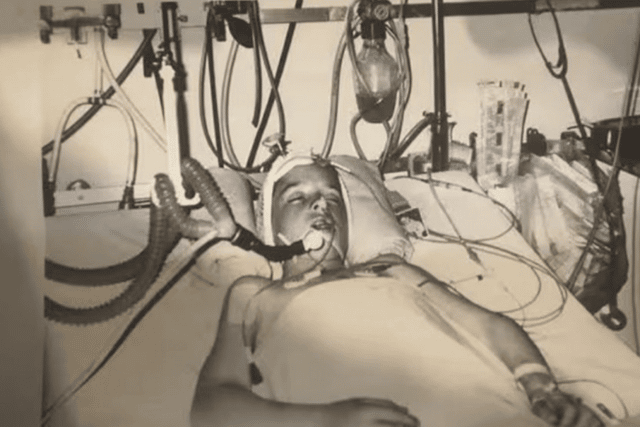
Stephen succumbed to catastrophic head injuries when his life support was switched off at the Royal Victoria Hospital on Monday, April 19, 1982.
Before he passed away his mother Maria had asked the Belfast activist Chrissie McAuley, who was visiting the family, to take a photograph of her son to show the world what they had done to him.
An account, first published in 1997, is included in the new book:
"She looked at me intensely and asked if I would photograph Stephen. She said she wanted to let people decide whether her little boy, the eldest of three sons, the brightest in his class deserved the death sentence for being a child playing too close to an army Saracen at the wrong time.
"She wanted to know did the world agree with a heavily armed professional soldier when he said he believed his life was at risk by the proximity of Stephen and his friends tending a makeshift fire by the side of the road.”
The harrowing photograph (pictured) appears in the pamphlet.
Coverage of Stephen’s killing at the time is catalogued including a Derry Journal editorial that described him as the latest ‘victim of the barbarous plastic bullet weapon’ and observed ‘no police spokesman nor Unionist leader ... [had expressed] either sympathy with his family or reservations about the employment of this death-dealing method of riot control’.
It recalls the words of the Bishop of Derry, Dr. Edward Daly, who was in Rome when Stephen was shot. He said: “If reports are correct that the fatal missile was fired at close range then the soldier responsible should be made to answer the most serious charges – and the charge of murder should not be ruled out.”
The shooting of Stephen ignited an ongoing campaign to have plastic bullets banned.
Emmett has long been of the opinion that the British State were well apprised of how lethal these projectiles were.
This is backed up by declassified documents contained in the booklet.
“They were fully aware of the seriousness of this weapon and hid from the public the dangers of them and how lethal they were. That has come out in the reports and documents that we have seen from the British National Archives; that the Ministry of Defence and British Government were fully aware of how dangerous these weapons were and yet and all they were still deployed in this country and they are currently still deployed in this country,” he told the ‘Journal’.
The new publication points to the fact that Stephen was the eleventh victim of plastic baton rounds fired by members of the security forces in Ireland and, tellingly, the sixth child to die after being shot with one.
“From the records we have seen they were fully aware that these weapons were lethal. And yet and all the narrative that they kept in the media and in the public domain was that they were a less lethal alternative, which simply just wasn't true. If you look at the statistics surrounding deaths from plastic bullets the overwhelming majority were children,” said Emmett.
The book concludes with ‘This Was His Kingdom’ a poetic tribute to Stephen penned by the local writer Julieann Campbell.
It includes the lines:
‘Bowing in reverence up Fahan Street hill, passing the flowered memorial where you fell. We remember.
‘Thinking of the little boy, the brother and son you were. The man you could have become. We remember.
‘Those who recall your big smile, who love and miss you still. And all the strangers who never knew you – but still remember.
‘Here, on these streets – in your kingdom – we always will.’
Emmett has described the book as a ‘powerful representation of what happened’.
"The family welcome the publication of it, as it corrects the narrative that was aired in and around the time of Stephen's murder. I think it sheds additional light on what actually happened. But also, it brings into question what the State knew about plastic bullets and how lethal they were.
“As we acknowledge Stephen's life in this booklet, the family are still calling to this day for their withdrawal from our society. They should not and should never have been here and as a legacy from the conflict they should be absolutely and totally removed from the arsenals of the police or whomever may hold these weapons currently.”