
New history of Al Rawdah internment ship where Derry republicans including Seán Dolan, Neil Gillespie and Seán Keenan were held captive
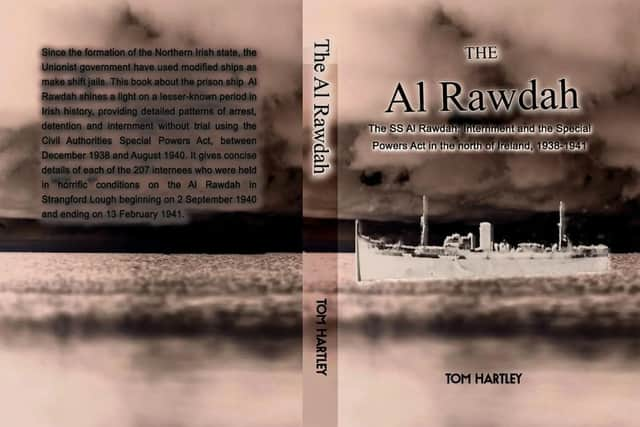
Historian Tom Hartley Derry-launched his new book ‘The Al Rawdah: Untold Story of Internment’s Prison Ship’, in conversation with Derry poet, Eoghan ‘Gino’ Mac Cormaic.
The launch took place in the Museum of Free Derry.
Speaking about The Al Rawdah, Mr Hartley said his interest in the ‘infamous prison ship moored on Strangford Lough, two miles off Killyleagh, County Down, which held 207 Republican internees’ was sparked when he was researching some prisoners and came across some details in the Public Record Office (PRONI).
“I also think it is a particular period of history that has really been forgotten about,” he added.

“So, in the history of the Northern State, it was and still is, the longest period of Internment. In the 1920s, Internment ran for two years. In the 1970s, it was 1971 to 1975, four years. But, in the 1940s, it was seven years.
“In a way it is a period that has been forgotten about. I can’t get my head around that because I come from a generation who were very active in campaigns around prisoners, particularly the Hunger Strikes, and yet, when you look at this period in the 1940s, I have about 1200 people interned and charged during that period.
“And I think, in some senses, you don’t see them, you don’t hear them. I was raised with a generation who were very active about the prisoners, whereas when you look at the history of the 1940s, they had no big infrastructure support outside. They had their families. I suppose the Movement was very heavily repressed at the time, so it is a very hidden period of the history of the Northern State.
“That then propelled me to do something around the issue of The Al Rawdah and the story of The Al Rawdah, and now, for my next book, I am working on collecting the names of all of those who were charged and interned during the 1940s,” said Mr Hartley.

There have actually been three prison ships in the North’s history: The Argenta in the 1920s; The Al Rawdah in the 1940s; and The Maidstone in the 1970s.
“There have been publications on The Argenta, people know about it, and my generation also know about The Maidstone,” said Mr Hartley, “so, it appeared to me there was a historical gap that needed to be addressed regarding The Al Rawdah. I started to research it and the book is the result of that research.”
The Al Rawdah was used as a prison ship from September 1940 until February 1941, so none of the men imprisoned on it are still living.
Tom Hartley revealed another trigger for his interest in The Al Rawdah was seeing the names of people he knew in his community when he was a young boy.
Laughing he said: “When I was a young fella, I ran about the place and met all these old boys, and, you know when you’re young, you’re full of energy, and you fly on, but, now that I am an old boy, I appreciate what they experienced because the conditions in the jails were horrendous.
“Suddenly, when I started to look at the names on The Al Rawdah, I started to see Republicans I knew, people like Jimmy Drumm and Derry’s Sean Keenan [who was named as John Keenan on the list].
“There was also a man called Neil Gillespie from Derry who was very active. He was charged under the Special Powers Act in, I think, 1935 for making a statement during an election meeting. He was also done for flying an Irish Tricolour, and later on, there was a meeting in Derry and they put out a statement opposing the coronation of the king, and he was done again.
“There is so much hidden history starting to emerge. The 1940s, you might say, is positioned as the central years of the Northern Unionist State. You have the Special Powers Act [1922 to 1973] which they argued was a ‘security measure’ but it also becomes a measure to really suppress any sense of identity coming out of the Nationalist/Republican community. All these issues start to pile in on one another when you look at The Al Rawdah and the 1940s,” observed Mr Hartley.
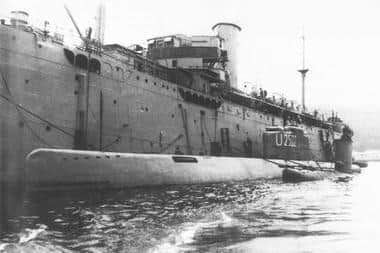
Derry IRA Volunteer Seán Dolan was also imprisoned on The Al Rawdah.
“He was released in July 1941 and died in October 1941 from the effects of an illness contracted on The Al Rawdah,” said Mr Hartley.
“There were also Keenans, Harkins and Gallaghers listed on The Al Rawdah, all from Derry,” he added.
“There is a man called Dermott Kavanagh, from Alexander Place, who was arrested in May 1940 and not released until July 1945. So at the time, because Internment went on so long, you could be charged in a court and get three or four years, but those who were interned served much longer sentences. The longest internees were interned for seven years during this period.
“Charles Harkin was another prisoner from Derry. There were Keenans from St Columb’s Wells, and Laverys and Joseph McGinley from Meenan’s Row, all on The Al Rawdah, along with prisoners from County Derry.
“In November 1939, the internees in Belfast were moved to Derry Jail and then, when the Al Rawdah became a prison ship in September 1940, the internees were moved onto it. There were two batches of internees moved, more than 150 of them from Derry Jail, the bulk to The Al Rawdah and a small number to Belfast, and when The Al Rawdah closed, many of the internees went back to Belfast Jail but then you can see them being moved back to Derry Jail.
“There was a big riot of the internees in Derry Jail in Christmas 1939 and one of the biggest escapes took place in 1943 from Derry Jail, and among the escapees there were 12 ex Al Rawdah internees. So, in a sense, the story of Derry Jail is really central to the telling of the story of The Al Rawdah and of that particular period in time.”