
Blockading the Foyle 1689 - Our Space 75
Boom Hall is named from the barrier that the besieging Jacobite army built to blockade the river. It actually took two attempts to create an effective boom.
On June 13, 1689 Major-General Kirk had appeared with ships above Culmore. This, wrote Rev John Mackenzie, “gave us … the joyful prospect, not only of the siege being soon raised, but of being furnished with provisions … They were already reduced to such straits, that where they could find a horse grazing near the Windmill, they would kill him and eat him”.
On sighting Kirk’s ships, the Jacobite army “began to make a boom cross the river”.
“This first boom was made of oak beams, chained together with iron, and great cables twisted about them. For a week together we saw them making some preparations for this boom cross the river, as drawing of timber, etc. … it was not entirely finished till about a fortnight after the ships appeared in the Lough. But this boom when finished, was useless to their design, because it did not float, and it was broke away by the great tides”.
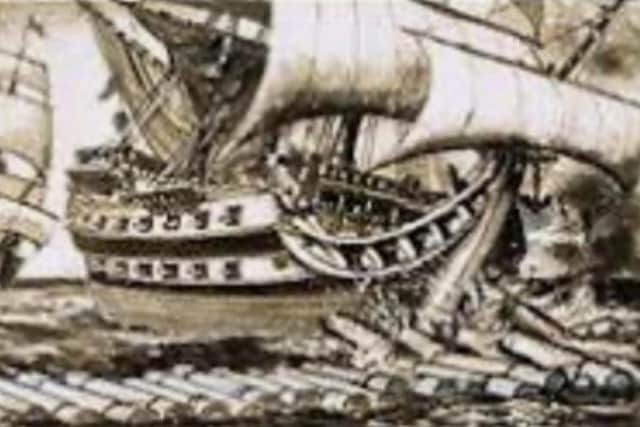

“After this they made another of fir beams, chained as the other was”.
Gov Walker described this more effective boom as “fastened at one end through the arch of a bridge, at the other by a piece of timber forced into the ground and fortified by a piece of stone work”.
It lasted six weeks until broken through by Captain Micaiah Browning on the ship ‘Mountjoy’.