
Frances Browne, Poet & Storyteller - Our Space 54
210 years ago today, on 16 January 1816, Frances Browne was born in Stranorlar, Co Donegal - the seventh of 12 children of the postmaster Samuel Browne and his wife Frances.
Tragically blinded by smallpox at only 18 months, Frances picked up education from her family, from books read to her, and from other children repeating lessons at school. (One of her classmates was William MacArthur whose Blue Plaque is in Derry’s Diamond - an interesting class!).
She started writing poetry at seven and by her 30s had poems in the Northern Whig, Belfast, the Irish Penny Journal, Dublin, and The Athenæum and Hood's Magazine in London - and published a volume of poems, The star of Attéghéi.
With her sister she moved in 1847 to Edinburgh where she contributed 12 ‘Legends of Ulster’ to Tate’s Magazine. Then in 1852 they moved to London.
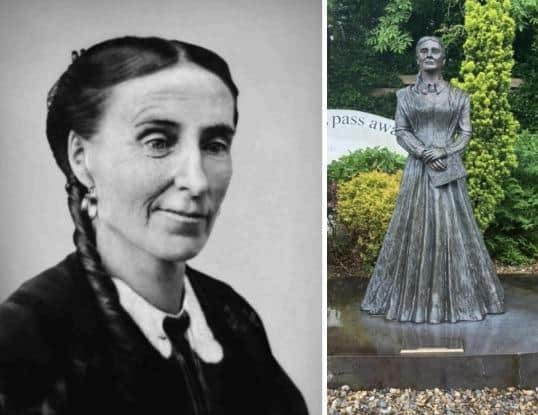

Well known as “the Blind Poetess of Ulster”, in the 1860s she also published three novels, My share of the world: an autobiography; The Castleford case; and The hidden sin.
In the 1850s for children she wrote The Ericksons; and Our uncle the traveller's stories. But her most famous book was Granny's wonderful chair and its tales of fairy times - reprinted at least twenty times.
She died in Richmond, Surrey, in August 1879. But she is proudly remembered in Stranorlar by her statue and the ‘Frances Browne Literary Festival’ which holds competitions for poetry in Irish, English and Scots - all widely spoken in the Finn Valley in Frances’s time.