
Mystery of Derry's ancient Elagh Castle - was it the real Aileach?
The findings of an archaeological dig at the ruins of Elagh Castle in Derry will be the basis for a discussion taking place at the Verbal Arts Centre on Derry on Wednesday, April 22.
The Friends of Derry Walls’ April lecture will see archaeologist Cormac McSparron give a talk titled ‘Elagh Castle Archaeological Dig’, in relation to the 2013 exploration which he led.
Elagh Castle was the historic seat of the Ó Dochartaigh power during their rule of Inishowen. It was both the principal castle and primary residence of chieftains and was during its heyday, probably the most impressive fortification in Inishowen. Indeed it is one of the few major structures featured in some ancient maps of the north west.
Elagh Castle, also known as Docherty’s Tower, survives as a partially collapsed masonry tower constructed upon a rocky outcrop. It lies near Upper Galliagh close to the border at Bridgend and can be seen atop a low hill off the Buncrana Road roughly opposite The Cosh bar & grill.
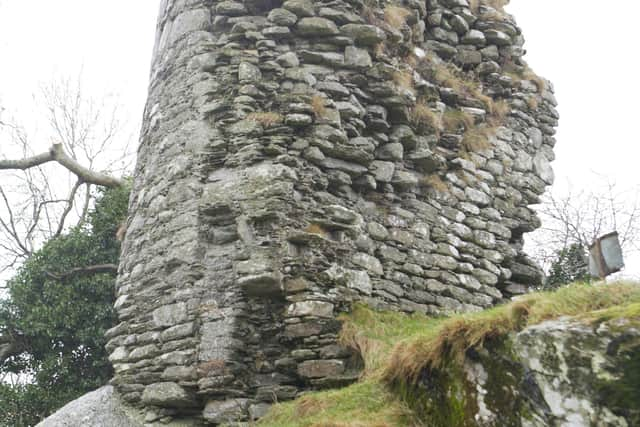

The castle was in the 15th and 16th centuries the main castle and residence of the O'Docherty's, although it is unlikely that they were the castle’s builders. It is probable that the existing remains were built in the 14th century before the O'Docherty's held Inishowen.
The excavation was carried out at Elagh Castle in 2013 by the Centre for Archaeological Partnership in partnership with the Northern Ireland Environment Service as part of the City of Culture celebrations.
A spokesperson for the Friends of Derry Walls said: “Cormac’s excavation’s revealed an Early Medieval outer rampart beyond the later Medieval castle, evidence for Early Medieval glass working, robbed out walls and floor platforms within the perimeter of the later Medieval castle, and foundations of a large structure of uncertain type to the north, which may have been part of an enclosure wall or bawn around the later Medieval castle.
“The results of the excavation, and the chronological information it provided, demonstrated that the remains which we can see today are simply the last phase of a long period of activity at Elagh Castle stretching back to the Early Medieval Period, and beyond into the Iron Age. This supports the arguments made by a number of prominent historians and archaeologists that Elagh Castle is likely to have been Aileach, the capital of the Cenél nEógain, one of the most important royal sites of Ireland.”
This lecture will take place at the Verbal Arts Centre, Bishop Street, Derry at 7pm on Wednesday, April 22.
Tickets are available via https://www.eventbrite.co.uk/