
The End of the 1689 Siege - Our Space 82
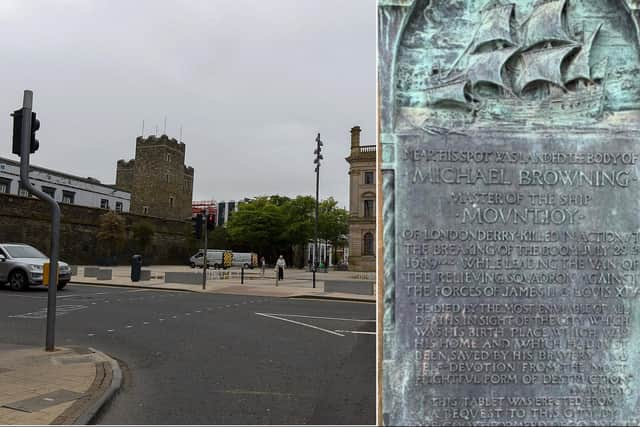
On 28 July 1689, Captain Michael Browning’s ship ‘Mountjoy’, with the ‘Phoenix’ and the ‘Swallow’ longboat, broke the boom and reached the shipquay at about 10pm.
But Browning was killed by gunfire, inspiring Macauley’s memorable description quoted in the Guildhall Square plaque, of Browning’s “most enviable of deaths in sight of the city which was his birthplace, which was his home, and which had just been saved by his bravery and self-devotion”.
“The Phoenix brought from Scotland 600 [bowls] of meal”, wrote Thomas Ash, “and the Mountjoy … has brought from England her cargo of beef, peas, flour, biscuit, etc etc, all of the best kind”.
Three days later the Jacobites conceded defeat and withdrew.

“This night”, wrote Ash “the enemy … left the siege, and burned a great many houses in the County of Derry and elsewhere…”
They left Strabane in such haste, records Gov. Walker, that they “threw 12 cartloads of arms and ammunition into the river”.
On August 4, says Ash, “Major-General Kirke came to Derry … alighted at Bishop Gate, and went through Bishop-Street, the Diamond, and Butcher-Street, to Governor Mitchelburne’s … A guard was formed on both sides of the street, the officers standing at the head of their poor half-starved soldiers…”
By August 7: “Beef is now sold at three halfpence per pound, and butter three pence - a great alteration”.
“And thus”, wrote Mackenzie, “was the Siege of Derry raised, to the admiration of our friends … and to the disappointment of our enemies”.