
The First Apprentice Boys - Our Space 49
After the 1607 Flight of the Earls from Rathmullan and the crushed 1608 rebellion of Sir Cahir O’Doherty, King James 1st decided on yet another settlement in Ireland - this time The Plantation of Ulster.
In two strategic locations he wanted to build strong garrison towns: in Derry a walled town with 200 houses (and room for 300 more); and in Coleraine, a walled town with 100 houses. So Derry became possibly the last town in Europe to be enclosed by a stone wall.
But how was James to pay for it?
He turned to London’s wealthy Livery Companies and offered them land in return - County London-Derry. But they refused - until he jailed 10 of London’s leading businessmen. So they relented and became ‘reluctant developers’.
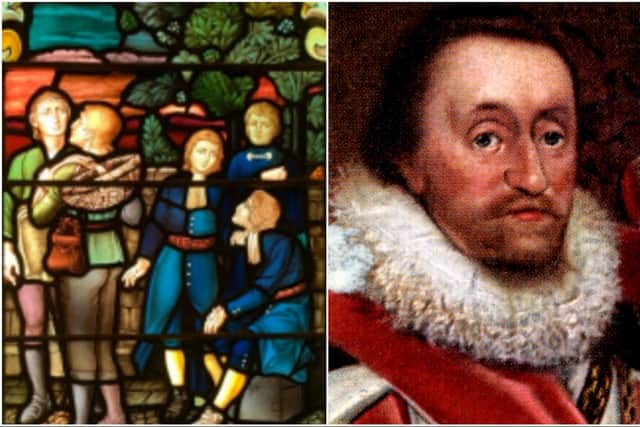

In March 1616 they were ordered to send over craftsmen and their families. Few were keen to go. By taking some young boys from London’s charitable institutions for poor children and orphans, London could provide young apprentice workers for the new county. Charitable schools then often wore the blue school uniform shown in the Guildhall stained glass window (and later adopted in 1773 by First Derry Presbyterian Church’s Blue Coat School).
Of the first 12 apprentices, 10 were sent to Derry and two to Coleraine. Only four of their names are currently known: Thomas Brooke, John Smith (apprenticed to David Alline), Peter Morgan and Hugh Joanes (apprenticed to Willaim Cooke).
The young boys “must have been bewildered and very frightened”, comments historian James Stevens Curl.