
Anniversary records - Derry Motoring with Jim Mc Cauley
The motor industry is celebrating a number of anniversaries this year with Volvo reminding all of its 70 year contribution to accident protection. Volvo was one of the first car manufacturers to introduce seatbelts to the European market when it fitted its 1956 Amazon prototype with a two-point cross-chest diagonal belt, which was made available as an option on production models shortly afterwards.
Three years later it became the first brand in the world to fit three-point belts as standard. Setting the template for the modern safety belt that’s fitted to all cars today, it was created by Volvo design engineer Nils Bohlin and consisted of a lap belt and a diagonal belt anchored at a low attachment point beside the seat.
By 1959 the three-point safety belt was installed as standard in all Swedish market Volvo cars, and later in cars across the world as the patent was made available to all car makers free of charge. As a result, seatbelt availability quickly became widespread and their fitment as a legal requirement was accelerated, helping to save millions of lives since then.
Nicole Melillo Shaw, Managing Director of Volvo Car UK, said, “Volvo has always been at the forefront of safety evolution and innovation, and we’re pleased that we can continue to make new developments on such vital features like the seatbelt. The latest multi-adaptive seatbelt in the new EX60 is a testament to our pioneering technology and approach to safety that is continued today.”
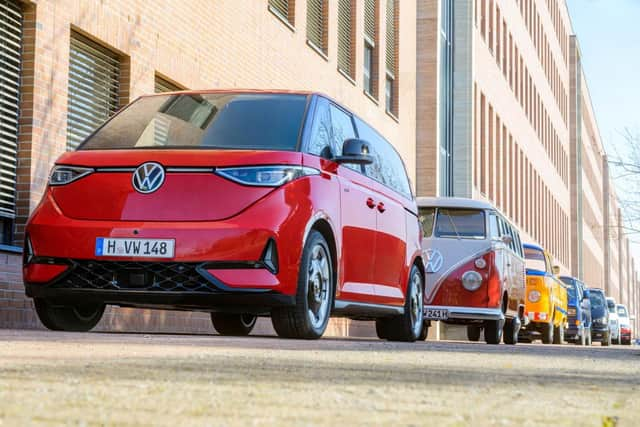

Turning to vehicle production, Volkswagen is celebrating 70 years of commercial vehicle production at its Hanover plant. Production of the legendary T1 Transporter began in March 1956 in what is today the brand’s main plant. Models produced include the ID. Buzz, the Multivan and the Transporter/ Caravelle. This year, the plant will produce its eleven millionth vehicle. The latest commercial vehicle will be the ID. Buzz AD next year. Pre-series production is already under way and it marks the first fully autonomous series production vehicle in Europe. . Over the course of the year, pre-series production at the Hanover plant will be ramped up to around 500 vehicles, which are planned for various projects in Europe and the USA.
Nissan is celebrating 25 years of its X-Trail SUV, originally launched in 2001. It has been one of Nissan’s most successful global SUVs, and over four generations, has built a strong global footprint, achieving success across Africa, Oceania, Asia, and South America. From the 3rd generation onwards, it entered the US market under the name Rogue, where it became — and remains — Nissan’s best-selling vehicle. The X-Trail is sold in 95 countries and to date, it has sold over 8 million units worldwide. In the UK, There are more than 167,400 X-Trails registered since 2001.
The vehicle is designed, engineered and built in Britain where the company employs around 7,000 people including at its design centre in Paddington, London, and its R&D engineering centre in Cranfield. The X-Trail is built in Sunderland at what is now the UK’s biggest single car plant.
“The X Trail must be a functional crossover that adapts to every stage of life. Its design never sacrifices functionality, and functionality never compromises design,” explains Satoru Tanaka, Chief Product Specialist.