
On-street charging for disabled drivers - Derry Motoring with Jim Mc Cauley
With the latest available figures showing Northern Ireland’s appalling position with regards to public EV charge points, it comes as no surprise that disabled drivers are also poorly catered for. The 2024 UK Government report reveals that Northern Ireland rests at the bottom of all regions with only 24.4 public charge points per 100,000 population.
When it comes to the very necessary 50kW and above provision, we are the only region in single figures – and extremely low at that, just 4.1 per 100,000 population.
Vauxhall sits comfortably within the Stellantis group, being able to share common technologies with many brands. It also has several all-electric models and is a founder member of the Motability Scheme.
In July 2025 the UK Government allocated £25 million for cross pavement installation of charge devices to facilitate those without driveway parking. Earlier this year, Vauxhall welcomed Kerbo Charge as an Electric Street partner to raise awareness of cross-pavement charging solutions. Cross-pavement charging creates a channel for the cable to fit in, keeping the pavement clear of obstacles for pedestrians and wheelchair users.
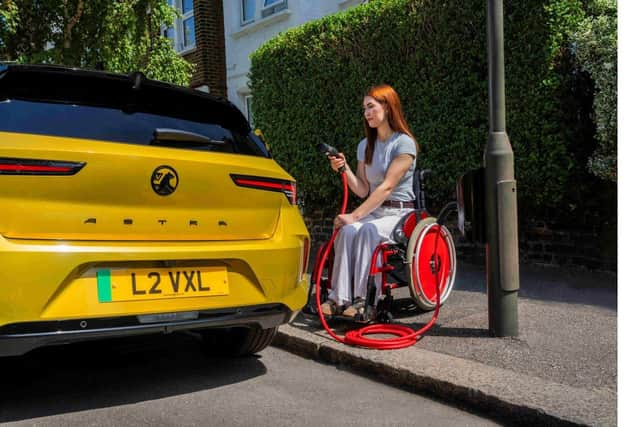

Compared with previous years, the latest research suggests progress is being made. The number of on-street EV chargers located within disabled parking bays in Britain has more than doubled since 2024, rising from 105 to 245. An estimated 15% of on-street chargers are now specifically adapted for disabled drivers, while 14% conform to PAS 1899:2022 accessibility guidance.
The figures obtained by Vauxhall in 2024 and 2025 show there is more work to do to ensure public charging is accessible for all drivers. With some movement in Britain, Northern Ireland is once again playing catch-up. While more than half of councils that responded to Vauxhall’s FOI said their charging strategies include considerations for disabled and elderly residents, accessible charging provision remains uneven across the UK. Vauxhall found just 43 accessible on-street chargers in the Northwest and 14 in Scotland, compared with 2,131 in London.
Referring to their findings, Eurig Druce, Managing Director, Vauxhall said, “As more people switch to electric vehicles, accessibility must be built into public charging from the start, not treated as an afterthought. Through Electric Streets of Britain, Vauxhall is helping drivers register where on-street charging is needed, including where disabled drivers require accessible solutions. If the UK is to bring everyone on the electrification journey, accessible charging needs to become the standard, so going electric is a practical and viable option for all drivers.”
The Motability scheme allows people who receive mobility allowance to exchange all or part of it to lease an approved vehicle, including wheelchair-accessible vehicles. You have to have a minimum 12 months left on your allowance to be eligible and be in receipt of one of the following mobility benefits.
Enhanced rate of the mobility component of Personal Independence Payment (ERMC PIP)
Higher rate mobility component of Disability Living Allowance (DLA)
War Pensioners’ Mobility Supplement (WPMS)
Armed Forces Independence Payment (AFIP)
Restrictions apply including age and licence endorsements.
Motorists can register their need for on-street residential EV charging at electricstreets.co.uk, with more than 12,500 streets already nominated, of which over 500 respondents have told Vauxhall they require disabled access off-street parking. Vauxhall continues to share this data with councils to help inform future charging strategies.