
Test drive the Hyundai Inster 49kWh - Derry Motoring with Jim Mc Cauley
The Hyundai Inster is the company’s smallest electric vehicle recently added to its EV line-up. The compact SUV offers a practical town solution sitting at just under four metres in length and at 1.6 metres wide. In a world of vehicle design constrained by regulations, it is refreshing to see a design that gets itself noticed – and for good reason.
Rather than being a smooth blended solution, the Inster is very much constructed with elements applied to the surface rather than integrated. The result gives a strong, confident image.
Underneath, the power choice is between two battery options of 42kWh and 49kWh. Review choice is the larger battery model providing advantages in power and range. With drive to the front wheels, it is rated at 115PS (84.5kW) with permanent torque of 147Nm. This translates to a 0-62mph time of 10.6 seconds and a potential top speed of 94mph. It has a given range of 230 miles bettering that of the 42kW option by around 60 miles.
Recharging on a 120kW public charger can take the battery from 10% to 80% in 30 minutes.
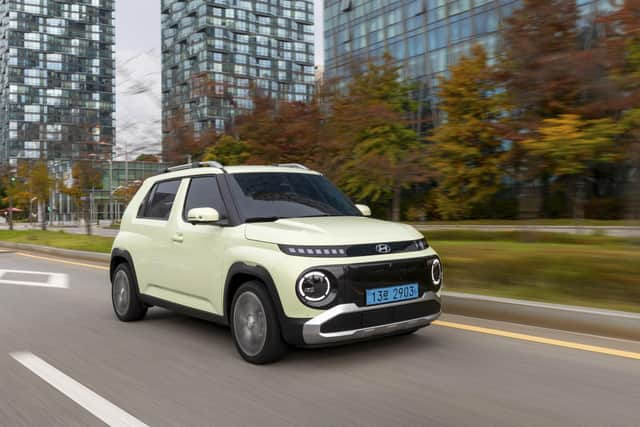

On road, and although the interior departs a little from the standard Hyundai practice, the familiar gear select twist stalk on the steering column gets you moving. As it is one of the smaller all-electric models, it immediately feels lighter and more agile than the heavily battery laden more powerful cars. This is reflected in both the suspension and sensibly weighted steering with the car feeling sharper than its given initial acceleration time.
A drive mode button is incorporated in the steering wheel and provides a choice of Eco or Sport settings in addition to the default Normal. A Snow setting is also included. A comprehensive list of ADAS support includes Forward Collision Avoidance Assist for Car, Pedestrian, Cycle and Junction Turning, Highway Drive Assist, Hill-start Assist Control, Intelligent Speed Limit Assist, and Lane Keep Assist.
Although sitting higher than in a saloon car, you remain more in contact with the driving environment than in larger SUVs. In short, it delivers so well in all respects and confirms its 2025 World Electric Vehicle award.
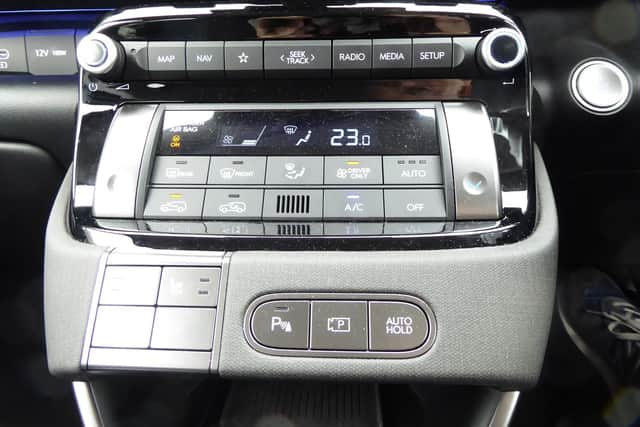
For the driver there is a basic and practical instrument layout. Major instruments are digitised analogue presentations for speed and economy with a dividing information screen. A 10.25” infotainment screen is a sensible and adequate size while a separate unit underneath features manual controls for aircon and infotainment menu selection.
For the passengers, the compact width restricts door storage to map pockets, but for the occupants there is generous all-round room. In the four-seat review model there are two individually sliding rear seats which can be moved to balance rear leg room and luggage space. These have adjustable backrests which also fold flat to further extend luggage space.
This model is the higher ‘02’ specification which adds USB-c charge ports front and rear, upgraded sound and a wireless phone charge-pad. An optional Tech Pack at £500 provides V2L 220v output and ‘Digital Key2Touch’.
In terms of running costs, electricity consumption is given as 15kW hours / 100kms (62miles) while for business users, BIK is 3%. The model reviewed is priced at £26,690 and is in insurance group 23P. Warranty cover is 5 years / 100,000 miles.